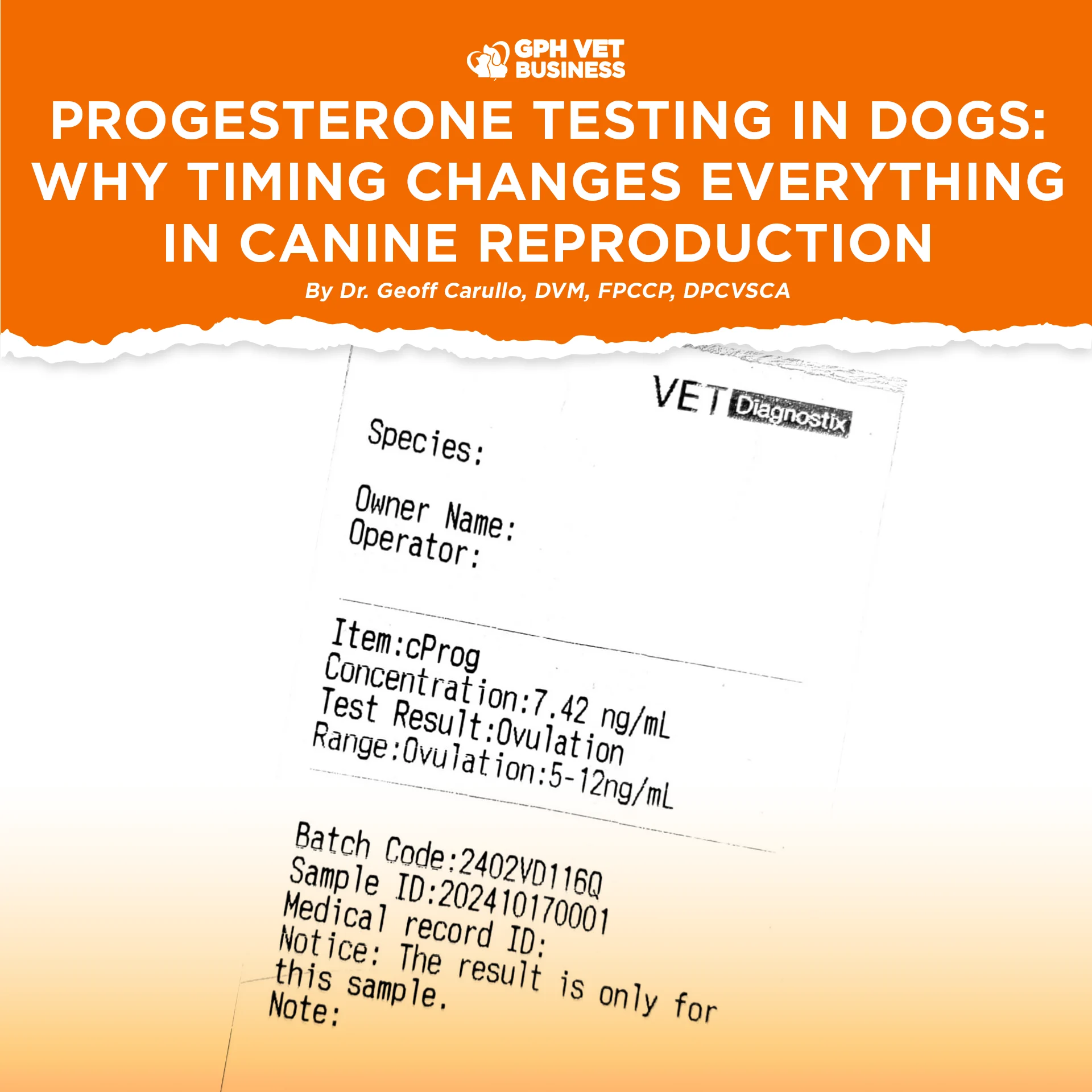
One of the biggest mistakes in canine breeding medicine is assuming that “day 9,” “day 11,” or “day 63” works for every dog.
It does not.
Dogs do not read textbooks.
Some ovulate early. Some ovulate late. Some look clinically ready but are still hormonally immature. Others already ovulated even before the owner notices discharge. This is why progesterone testing became one of the most important tools in modern canine reproduction.
It is not just a laboratory number.
It is a timing tool.
A decision-making tool.
And sometimes, the difference between a successful litter and an empty uterus.
What is Progesterone?
Progesterone is a reproductive hormone produced mainly by the ovaries after ovulation.
In dogs, progesterone has a very unique pattern compared to other species. Even before ovulation fully occurs, progesterone already starts to rise. Because of this predictable hormonal rise, veterinarians can estimate:
- Timing of ovulation
- Best breeding dates
- Artificial insemination timing
- Elective Caesarean section timing
- Fertility window
- Potential reproductive problems
In simple terms:
Progesterone testing allows veterinarians to “see” where the bitch is in her reproductive cycle internally, even when physical signs are misleading.
Why Vaginal Bleeding Alone is Unreliable
Many owners still believe:
“Pag may dugo, fertile na.”
Not necessarily.
Visible signs alone are unreliable because:
- Some dogs bleed heavily but ovulate late
- Some stop bleeding before fertile period
- Some have silent heats
- Some males mount too early
- Some females accept mating before ovulation
This is why relying purely on behavior often leads to failed breedings.
Progesterone testing adds objective data.
The Typical Progesterone Pattern
The values may slightly vary depending on machine, laboratory, and units used, but the general interpretation is relatively consistent.
Baseline / Anestrus
Usually:
Less than 1 ng/mL
The bitch is not near ovulation yet.
LH Surge Window
Usually around:
2 ng/mL
This is important because the LH surge happens roughly 48 hours before ovulation.
However, LH testing is rarely done routinely in practice because the surge is short-lived and easy to miss.
So veterinarians often use progesterone as an indirect marker.
Ovulation Period
Usually around:
4–10 ng/mL
Most dogs ovulate during this range.
But remember:
Ovulation does NOT mean eggs are immediately fertile.
Canine eggs still require maturation after ovulation.
Optimal Fertility Window
Usually:
10–20 ng/mL
This is commonly considered the ideal breeding period for natural mating or insemination depending on semen type.
Fresh semen, chilled semen, and frozen semen all have different ideal timing strategies.
Why Timing Matters in Artificial Insemination
Incorrect timing is one of the most common causes of failed AI.
Fresh Semen
Has longer survival time inside reproductive tract.
There is more flexibility.
Chilled Semen
Requires more accurate timing because sperm lifespan is shorter.
Frozen Semen
This is where progesterone timing becomes extremely critical.
Frozen semen survives only briefly after thawing.
Missing ovulation timing by even 1–2 days may dramatically reduce conception rates.
Progesterone Testing Before Caesarean Section
This is one of the most valuable but misunderstood applications.
Many elective C-sections fail not because surgery was bad…
…but because timing was wrong.
If puppies are removed too early:
- Weak neonates
- Poor suckling
- Respiratory distress
- High mortality
- Prematurity
If surgery is too late:
- Fetal distress
- Dystocia
- Stillbirths
Reverse Progesterone Timing
In reproductive medicine, veterinarians sometimes estimate whelping dates by counting forward from ovulation rather than relying on mating date.
Because mating date is unreliable.
Ovulation date is more accurate.
Typical guide:
- Ovulation to whelping ≈ 63 days
- LH surge to whelping ≈ 65 days
This is why serial progesterone testing can help predict safer elective C-section timing.
Progesterone Alone is Not Enough
One of the biggest misconceptions is believing progesterone should be interpreted in isolation.
It should not.
Interpretation should always be combined with:
- Vaginal cytology
- Clinical signs
- Breeding history
- Ultrasonography
- Fetal maturity assessment
- Radiographs
- Breed considerations
- Type of insemination
- Semen quality
A single progesterone number without context may become misleading.
Important Limitation
Different analyzers may produce slightly different results.
Reference ranges from one machine may not perfectly match another laboratory.
This is why consistency matters.
Ideally:
- Use the same laboratory
- Use serial monitoring
- Interpret trends, not single numbers alone
Trend interpretation is often more valuable than isolated readings.
Common Clinical Uses of Progesterone Testing
Breeding Timing
To maximize conception rates.
Artificial Insemination Planning
Especially for chilled or frozen semen.
Elective Caesarean Scheduling
To reduce neonatal mortality.
Identifying Ovulation
More accurately than relying on behavior alone.
Fertility Investigation
In repeat breeding failure cases.
Shipment Coordination
For imported chilled or frozen semen timing.
One of the Most Important Lessons in Canine Reproduction
Canine reproduction is a timing game.
Not guessing.
Not calendar counting.
Not “usually day 11.”
Hormones changed reproductive medicine because they allowed veterinarians to move from approximation toward precision.
And in many cases, precision saves puppies.
Sources
- Canine and Feline Theriogenology
- American Kennel Club reproductive breeding guidelines
- Merck Veterinary Manual – Canine Reproduction
- VCA Animal Hospitals – Progesterone Testing in Dogs
- Cornell University College of Veterinary Medicine – Canine Reproduction Resources
- Johnston SD, Root Kustritz MV, Olson PNS. Canine and Feline Theriogenology. Saunders Elsevier.
Dr. Geoff Carullo is a Fellow and the current President of the Philippine College of Canine Practitioners.
Sharing this helps others understand what it really means to be a vet. Like and follow if you’re with us.