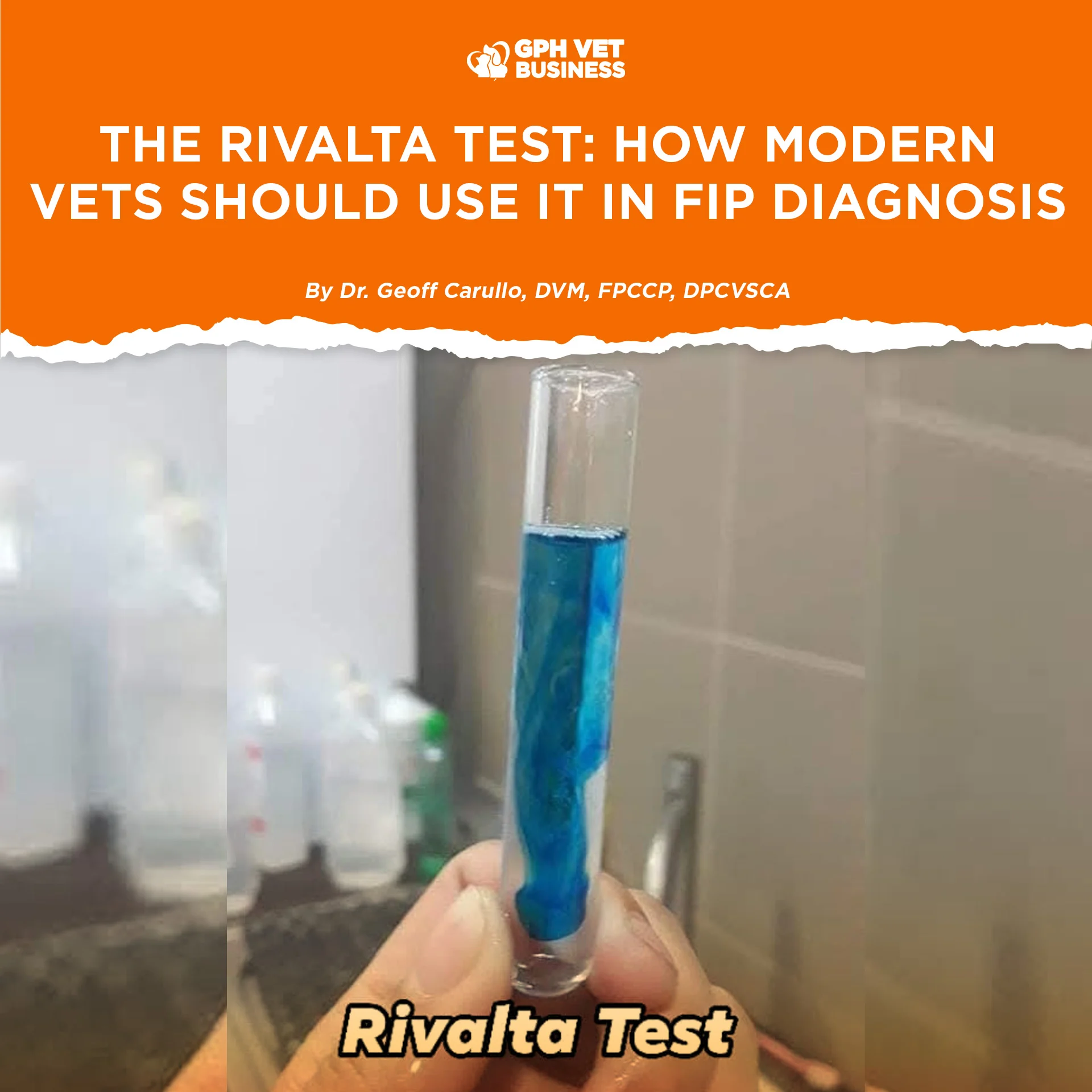
The Rivalta test has remained one of the most practical, low-cost tools for evaluating effusions in cats. Despite the rapid progress in FIP diagnostics—PCR, immunostaining, and advanced imaging—the earliest and most common presentation of FIP is still body cavity effusion. This is where the Rivalta test continues to play an important supporting role.
Although it is simple, the Rivalta test is far from obsolete. When interpreted correctly, it can significantly strengthen or weaken your suspicion for FIP and help guide which cats require more advanced confirmatory testing.
What the Rivalta Test Actually Indicates
The Rivalta test is not a test for coronavirus and does not diagnose FIP directly. It is a protein-based precipitation test that distinguishes exudative, inflammatory effusions from transudates.
A positive result occurs when inflammatory macromolecules—fibrin, globulins, acute-phase proteins—precipitate in acidic solution.
Positive Rivalta: A drop of effusion stays intact, forming a cloudy “jellyfish-like” strand that slowly sinks.
Negative Rivalta: The drop disperses and disappears immediately.
In practice:
- Negative Rivalta → Makes FIP much less likely
- Positive Rivalta → Makes FIP more likely, but is not conclusive
This distinction shapes how the test should be used.
Why It Still Matters in Modern FIP Workups
Large-scale studies have consistently shown:
- High sensitivity (around 90 percent)
- High negative predictive value (over 90 percent)
- Moderate specificity (60 to 70 percent)
The meaning behind these numbers is straightforward:
- A negative Rivalta is powerful for ruling out FIP in effusive cases.
- A positive Rivalta increases suspicion but requires further evaluation.
This makes it an excellent screening tool, especially in general practice where quick decisions matter.
How to Perform the Test Correctly
The Rivalta test is simple but technique-dependent. To perform it:
- Place 7 to 8 mL of distilled water in a clear tube.
- Add one drop of acetic acid (white vinegar is acceptable if pure acid is not available).
- Mix gently.
- Add one drop of the effusion to the surface.
- Observe the behavior of the drop.
Positive – The drop forms a cohesive, cloudy strand that sinks.
Negative – The drop dissolves and disappears.
Fresh samples and correct acidity are essential for reliable results.
False Positives and False Negatives
False positives may occur with other inflammatory effusions such as:
- Septic peritonitis
- Lymphoma-associated effusions
- Pancreatitis-related peritonitis
- Neoplastic or severe inflammatory exudates
False negatives may occur in:
- Early or atypical FIP
- Samples with low protein content
- Old or improperly handled effusion samples
- Incorrect acidity during preparation
Because of these limitations, modern guidelines emphasize that Rivalta must be interpreted alongside the rest of the clinical picture.
Where Rivalta Fits in the Modern FIP Algorithm
The Rivalta test should be integrated into a structured diagnostic process:
If a cat presents with straw-colored effusion, fever, weight loss, and typical signalment, a positive Rivalta increases suspicion dramatically.
Combine this with:
- A low A:G ratio
- High globulins
- Elevated bilirubin
- Compatible imaging findings
- Characteristic cytology
When these align, suspicion rises to a strong clinical probability.
For confirmation, follow with RT-qPCR on effusion or FCoV immunostaining on macrophages.
If Rivalta is negative, and other findings contradict FIP, shift attention to alternative diagnoses first.
The Rivalta Test in Daily Practice
The Rivalta test remains valuable for clinicians because it bridges the gap between suspicion and confirmation. It is quick, inexpensive, and easy to perform at the point of care. More importantly, it helps decide which cats need immediate confirmatory testing and which ones require a broader differential approach.
FIP is now a treatable disease, and early detection saves lives. When used correctly, the Rivalta test continues to be a reliable frontline tool in identifying the cases that matter most.
Dr. Geoff Carullo is a Fellow and the current President of the Philippine College of Canine Practitioners.
Sharing this helps others understand what it really means to be a vet. If you found this valuable, like and follow for more insights.