A blocked cat walks in.
Tense abdomen.
Painful.
Bradycardic.
Owners panicking.
And in the back of your mind, there’s always that thought:
“Will this end in a urethrostomy?”
Not always.
Not if you understand one simple concept that changes everything:
Retrograde hydropulsion.
WHAT IT REALLY IS
Retrograde hydropulsion is not a fancy term.
It’s a decision.
A decision to push the obstruction back into the bladder instead of forcing it out through the narrowest part of the urethra.
You’re not trying to win against resistance.
You’re trying to change the battlefield.
From urethra…
to bladder.
Where you have control.
WHY THIS MATTERS IN REAL PRACTICE
Most feline urethral obstructions are not giant stones.
They’re:
- Urethral plugs
- Small uroliths
- Debris mixed with crystals
- Spasm layered on top of inflammation
These are movable problems.
And movable problems don’t always need surgery.
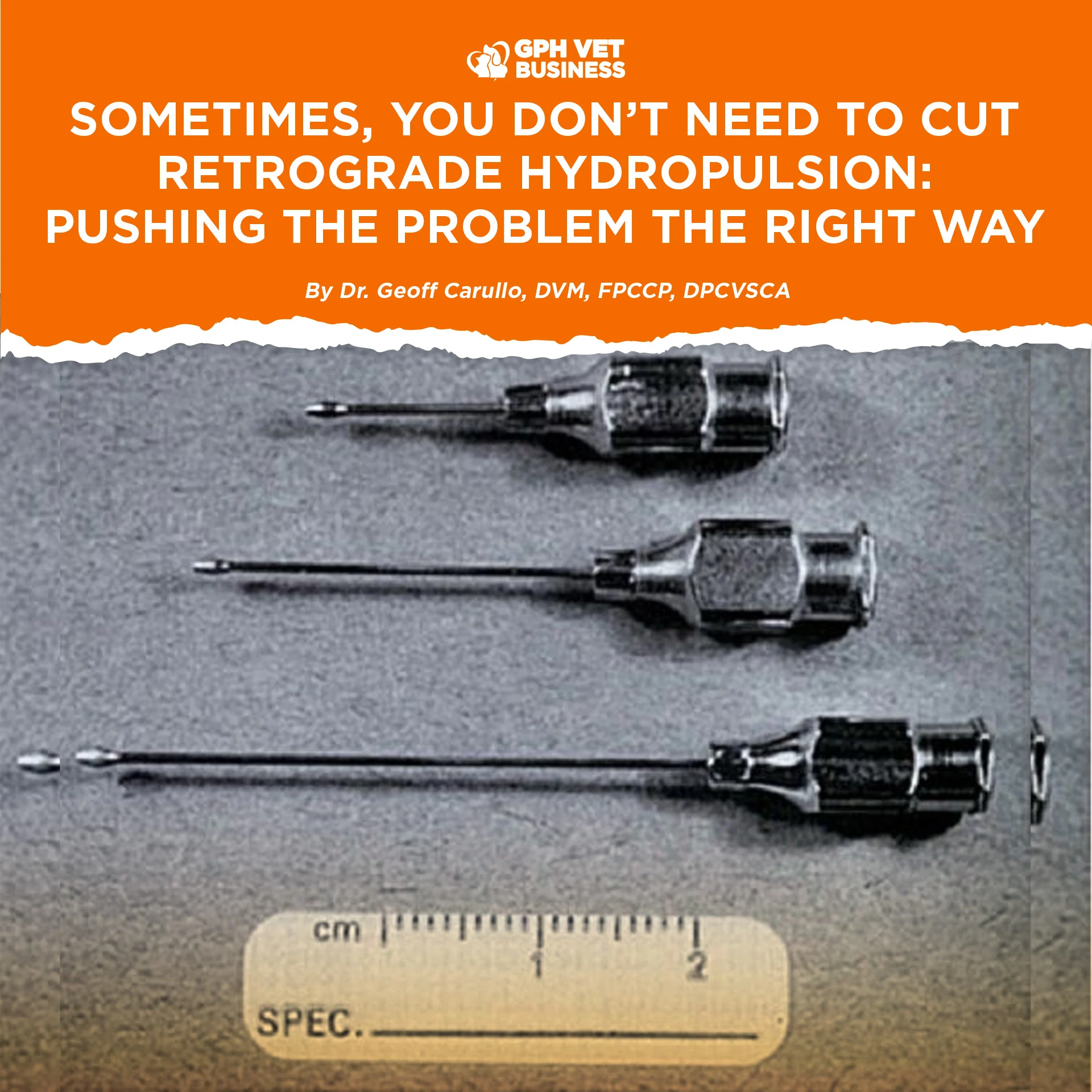
Figure: Minnesota Olive-Tip Urethral Catheters (22G) Image showing three sizes (0.5, 1.0, and 1.5 inch) of olive-tip urethral catheters designed for feline urethral catheterization and retrograde hydropulsion. The rounded, open-ended “olive tip” allows atraumatic passage through the urethra while facilitating flushing of urethral plugs or uroliths back into the bladder. Compared to traditional polypropylene “tomcat” catheters, these are associated with less urethral irritation and reduced risk of iatrogenic trauma, making them ideal for initial relief of urethral obstruction rather than indwelling use.
Source: Veterinary Information Network (VIN) Clinical Resource – Feline Urethral Obstruction Management.
THE MOMENT THAT CHANGES THE CASE
You sedate.
You place your catheter.
You apply controlled pressure.
Then you feel it.
That slight give.
That release.
That’s the moment the case changes.
From:
👉 Surgical candidate
To:
👉 Medical management
And that moment is everything.
HOW IT PREVENTS URETHROSTOMY
Let’s be clear.
Perineal urethrostomy is life-saving.
But it is not harmless.
It is:
- Permanent
- Prone to stricture
- Prone to infection
- A lifetime anatomical change
So every time you avoid it, you are protecting the patient long term.
1. YOU RELIEVE WITHOUT DESTROYING ANATOMY
If the obstruction goes back to the bladder, you preserve the urethra.
No incision.
No reconstruction.
No compromise.
2. YOU CONVERT A CRISIS INTO A MANAGEABLE CASE
Once in the bladder:
- You can dissolve (struvite)
- You can retrieve
- You can plan
You are no longer reacting.
You are managing.
3. YOU REDUCE IATROGENIC DAMAGE
Repeated aggressive catheterization does more harm than good.
Edema.
Bleeding.
Stricture.
And guess what that leads to?
Surgery.
Retrograde hydropulsion, done right, prevents the damage that creates surgical cases.
4. YOU BUY TIME
Even partial relief improves:
- Renal perfusion
- Electrolyte status
- Patient stability
Time is survival in blocked cats.
BUT LET’S NOT PRETEND
Not all cases will bend.
Some are:
- Chronically obstructed
- Fibrotic
- Severely inflamed
- Impacted with larger stones
These are the cats that will eventually need urethrostomy.
And that’s okay.
The goal is not to avoid surgery blindly.
The goal is to avoid unnecessary surgery.
THE REAL DIFFERENCE
Two vets.
Same patient.
Same blockage.
One forces the catheter.
Creates trauma.
Fails.
Refers to surgery.
The other pauses.
Uses pressure with purpose.
Repositions the problem.
Wins without cutting.
Same training.
Different outcome.
FINAL THOUGHT
Retrograde hydropulsion is not just a technique.
It’s a mindset.
Before you cut…
Ask yourself:
“Did I try to move the problem first?”
Because sometimes, the best surgery…
Is the one you never had to do.
SOURCES
- International Society of Feline Medicine. Feline Lower Urinary Tract Disease Guidelines
- American Animal Hospital Association. Management of Urethral Obstruction in Cats
- Small Animal Internal Medicine. Urethral obstruction and FLUTD
- BSAVA Manual of Feline Practice. Urinary emergencies in cats
- Ettinger and Feldman Textbook of Veterinary Internal Medicine. Lower urinary tract disorders
Dr. Geoff Carullo is a Fellow and the current President of the Philippine College of Canine Practitioners.
Sharing this helps others understand what it really means to be a vet. If you found this valuable, like and follow for more insights.