There’s a moment every clinician has faced.
A dog comes in.
Bright. Eating. No fever. No anemia.
But the test says… positive.
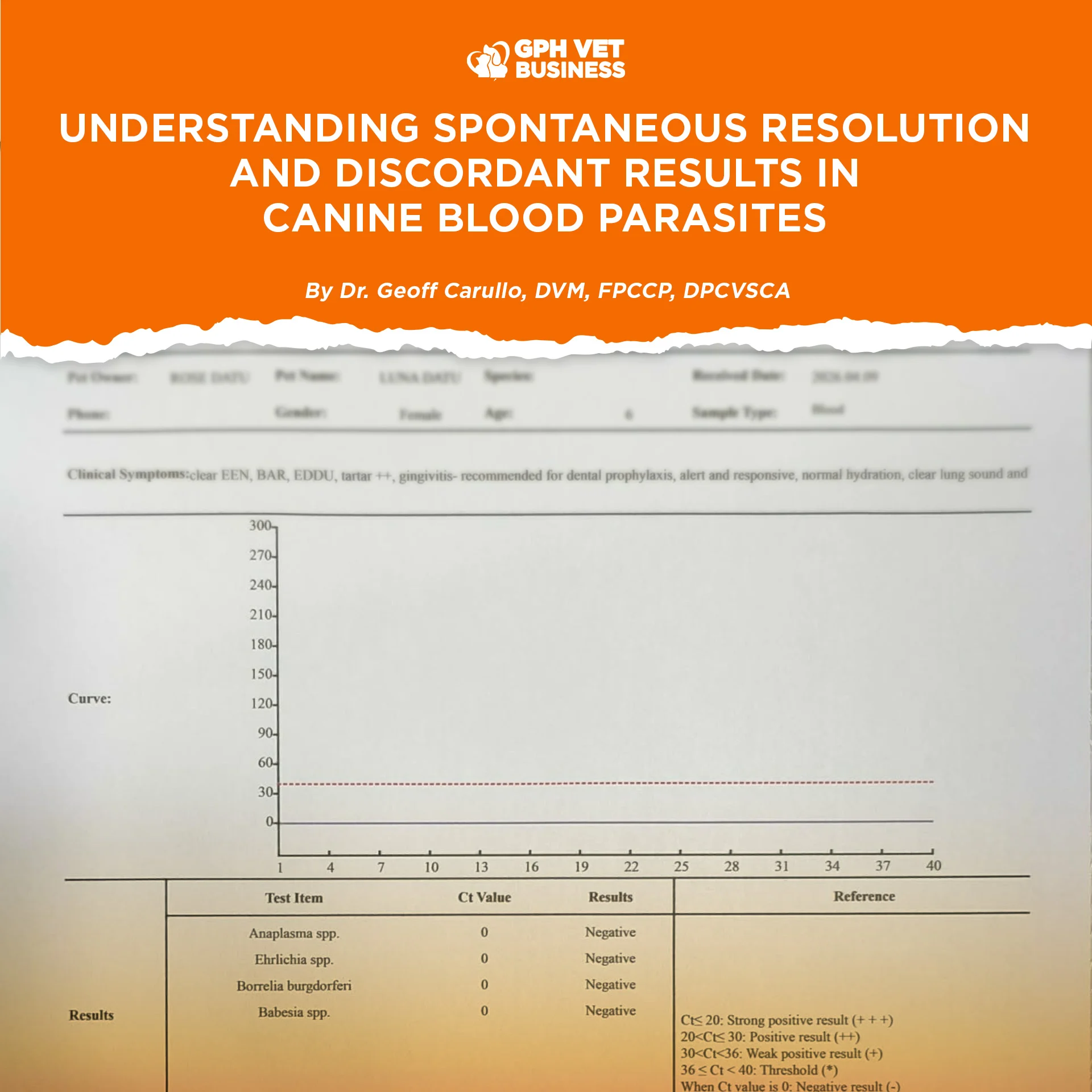
Then you run PCR.
And suddenly… negative.
So what now?
Was the dog infected?
Is it still infected?
Or did the disease… disappear?
CAN BLOOD PARASITISM RESOLVE WITHOUT TREATMENT?
The short answer: yes, but not always—and not safely assumed.
Certain canine blood parasites, particularly:
- Ehrlichia canis
- Anaplasma platys
- Babesia gibsoni (less commonly)
can enter subclinical or chronic phases where:
- Parasitemia drops to very low levels
- Clinical signs disappear
- The immune system partially suppresses the organism
In some dogs, the infection may become undetectable by PCR over time.
“Undetectable” does not always mean “eradicated.”
THE ROLE OF LATERAL FLOW KITS IN THIS CONFUSION
Most of the time, the initial “positive” comes from what we casually call:
lateral flow kits
More formally:
- lateral flow immunoassay (LFIA) kits
- rapid immunochromatographic test kits
These are:
- Point-of-care
- Fast (minutes)
- Widely used in clinics
But they detect antibodies, not the organism itself.
WHY ANTIBODY POSITIVE, PCR NEGATIVE?
This is where most misinterpretations happen.
1. Lateral flow kits detect exposure, not active infection
Lateral flow immunoassays pick up antibodies produced by the dog.
- Months
- Even years
A positive lateral flow result = history of exposure
2. PCR detects active circulating DNA
PCR requires:
- Presence of organism DNA in the blood
- Adequate parasitemia
If the parasite load is:
- Too low
- Intermittent
- Sequestered in tissues
PCR may come back negative despite infection
3. The “Occult Phase” phenomenon
Especially in Ehrlichia canis, dogs may enter a stage where:
- No clinical signs
- Low organism burden
- Bone marrow involvement
The disease is not necessarily gone.
SO… GUMALING BA TALAGA?
Not so fast.
There are three possible interpretations:
1. True past infection (resolved)
- Antibody positive (lateral flow kit)
- PCR negative
- Clinically normal
Possible immune clearance
2. Chronic subclinical infection
- Antibody positive
- PCR negative (low organism load)
Infection still present, just below detection
3. False negative PCR
- Sampling timing issue
- Low sensitivity in chronic phase
Infection still active
CLINICAL DECISION MAKING
This is where being a veterinarian matters.
Not the test. Not the kit.
You.
Consider:
- CBC (platelets, anemia)
- History of tick exposure
- Previous treatment
- Clinical signs (past or present)
WHEN TO TREAT?
Treat if:
- Clinical signs are present
- Hematologic abnormalities exist
- High suspicion of active infection
Monitor if:
- Dog is clinically stable
- No lab abnormalities
- Incidental finding
THE DANGEROUS MISTAKE
“PCR negative = disease gone”
That’s where relapses happen.
REALITY CHECK
Diagnostics are not black and white.
They are:
- Snapshots
- Not the full movie
Lateral flow kits tell you the past
PCR tells you the present (if detectable)
Your job is to understand the story in between
FINAL TAKE
Some dogs may suppress or even clear blood parasites without treatment—but many don’t.
Many just hide the infection well enough to fool your diagnostics.
So the real question is not:
“Is the test positive or negative?”
It’s:
What is the disease doing right now in this patient?
REFERENCES
- American College of Veterinary Internal Medicine Consensus Statement on Tick-Borne Diseases in Dogs
- Companion Animal Parasite Council Guidelines on Tick-Borne Diseases
- Harrus S, Waner T. Diagnosis of canine monocytotropic ehrlichiosis (Ehrlichia canis): an overview. Vet J. 2011.
- Neer TM, et al. Consensus statement on ehrlichial disease of small animals. J Vet Intern Med.
- Irwin PJ. Canine babesiosis: from molecular taxonomy to control. Parasit Vectors. 2009.
- Otranto D, Dantas-Torres F. Canine and feline vector-borne diseases in the tropics. Vet Parasitol.
Dr. Geoff Carullo is a Fellow and the current President of the Philippine College of Canine Practitioners.
Sharing this helps others understand what it really means to be a vet. If you found this valuable, like and follow for more insights.