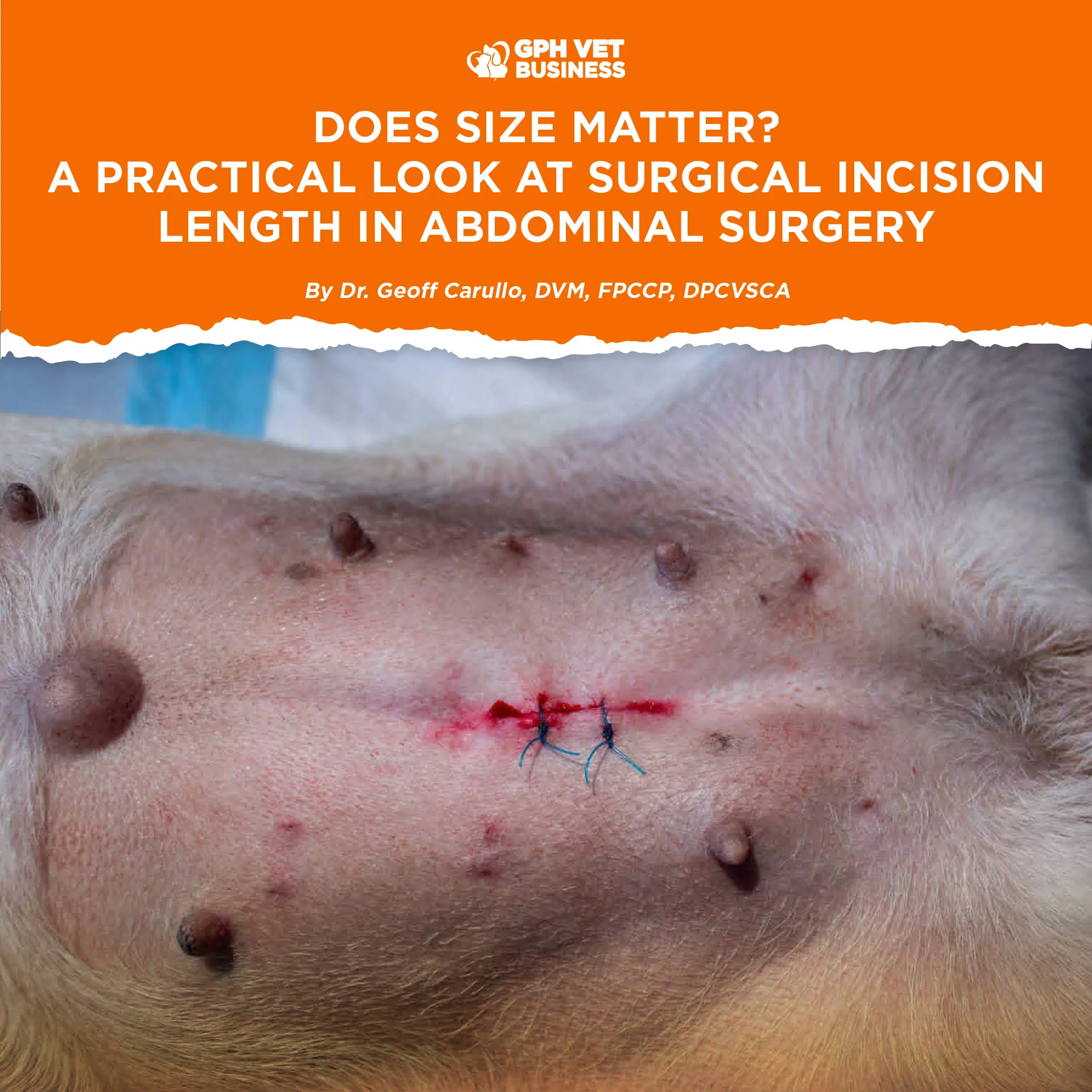
“Ang liit ng hiwa.”
We’ve all heard it.
Sometimes it’s praise. Sometimes it’s pressure.
Incision size is not a badge of honor. It’s a decision.
And like every decision in surgery, it should be guided by one thing:
What gives the patient the safest outcome?
WHY WE MAKE AN INCISION IN THE FIRST PLACE
An abdominal incision is not meant to impress anyone.
It is there to give you:
- Adequate exposure
- Proper visualization
- Room for safe tissue handling
Without those three, even a simple case can turn into a difficult one.
In procedures like spays, pyometra, or exploratory laparotomy, you’re not just “opening the abdomen.” You’re trying to work precisely inside a confined space.
If you can’t see clearly, you’re guessing. And guessing has no place in surgery.
THE PROBLEM WITH CHASING SMALL INCISIONS
There’s a tendency, especially among younger surgeons, to aim for the smallest possible cut.
On paper, it sounds good. Less invasive. Cleaner look.
But in practice, a too-small incision can:
- Limit visibility of critical structures
- Force excessive traction on tissues
- Increase operative time
- Raise the risk of tearing or hemorrhage
- Lead to incomplete procedures
You may end up causing more internal trauma while trying to make things look better externally.
WHEN EXTENDING THE INCISION IS THE RIGHT CALL
There are situations where a slightly larger incision is simply the safer option:
- Pyometra with a distended uterus
- Obese patients with deep abdominal cavities
- Foreign bodies that are difficult to exteriorize
- Exploratory cases where you don’t know what you’ll find
Extending the incision in these cases:
- Improves access
- Reduces unnecessary force
- Allows cleaner, faster work
- Lowers complication risk
It’s not about being aggressive. It’s about being in control.
WHAT ACTUALLY MATTERS
Incision length is one of the least important indicators of surgical quality.
What matters more:
- Gentle handling of tissues
- Good hemostasis
- Efficient surgical flow
- Proper aseptic technique
- Secure closure
A well-managed 6–8 cm incision that heals cleanly is far better than a 2–3 cm incision that leads to complications.
WHAT THE LITERATURE SUPPORTS
This isn’t just opinion. It’s consistent with surgical principles across veterinary and human medicine:
- Adequate exposure is considered essential for safe abdominal surgery and is often achieved by adjusting incision length as needed.
- Excessive traction through small incisions has been associated with increased tissue trauma and operative difficulty.
- Surgical outcomes (infection rate, healing, complications) are influenced more by technique and tissue handling than by incision size alone.
- Even in minimally invasive surgery, the goal is not “small for the sake of small,” but minimal trauma with maximum control.
FINAL TAKE
A good surgeon doesn’t ask:
“How small can I make this incision?”
A good surgeon asks:
“How much exposure do I need to do this safely?”
Because in the end…
The best incision is not the smallest one.
It’s the one that allows you to finish the surgery cleanly, safely, and without complications.
REFERENCES
- Fossum TW. Small Animal Surgery, 5th ed. Elsevier.
- Tobias KM, Johnston SA. Veterinary Surgery: Small Animal, 2nd ed. Elsevier.
- Monnet E. Small Animal Soft Tissue Surgery. Wiley-Blackwell.
- Halsted WS. “The operative story of wound healing” (principles of gentle tissue handling and exposure).
- Johnston SA, Tobias KM. Principles of surgical exposure and tissue handling in small animal surgery (textbook chapters).
Dr. Geoff Carullo is a Fellow and the current President of the Philippine College of Canine Practitioners.
Sharing this helps others understand what it really means to be a vet. If you found this valuable, like and follow for more insights.