When People Say “You Need a System” to Make Your Veterinary Clinic Successful, What Does It Really Mean?
By Dr. Geoff Carullo, DVM, FPCCP, DPCVSCA
Many veterinarians think success comes from being a good diagnostician, a skilled surgeon, or a compassionate clinician.
That is only half true.
A clinic can have a brilliant veterinarian and still fail financially, collapse operationally, lose employees, face legal problems, or create chaos every single day.
Why?
Because skill alone is not a system.
A system is what allows a clinic to function consistently even when the owner is tired, absent, stressed, or overwhelmed.
Without systems, the clinic depends entirely on the mood, memory, and presence of the veterinarian.
That is dangerous.
The most successful veterinary clinics today are not simply “good clinics”.
They are organized systems.
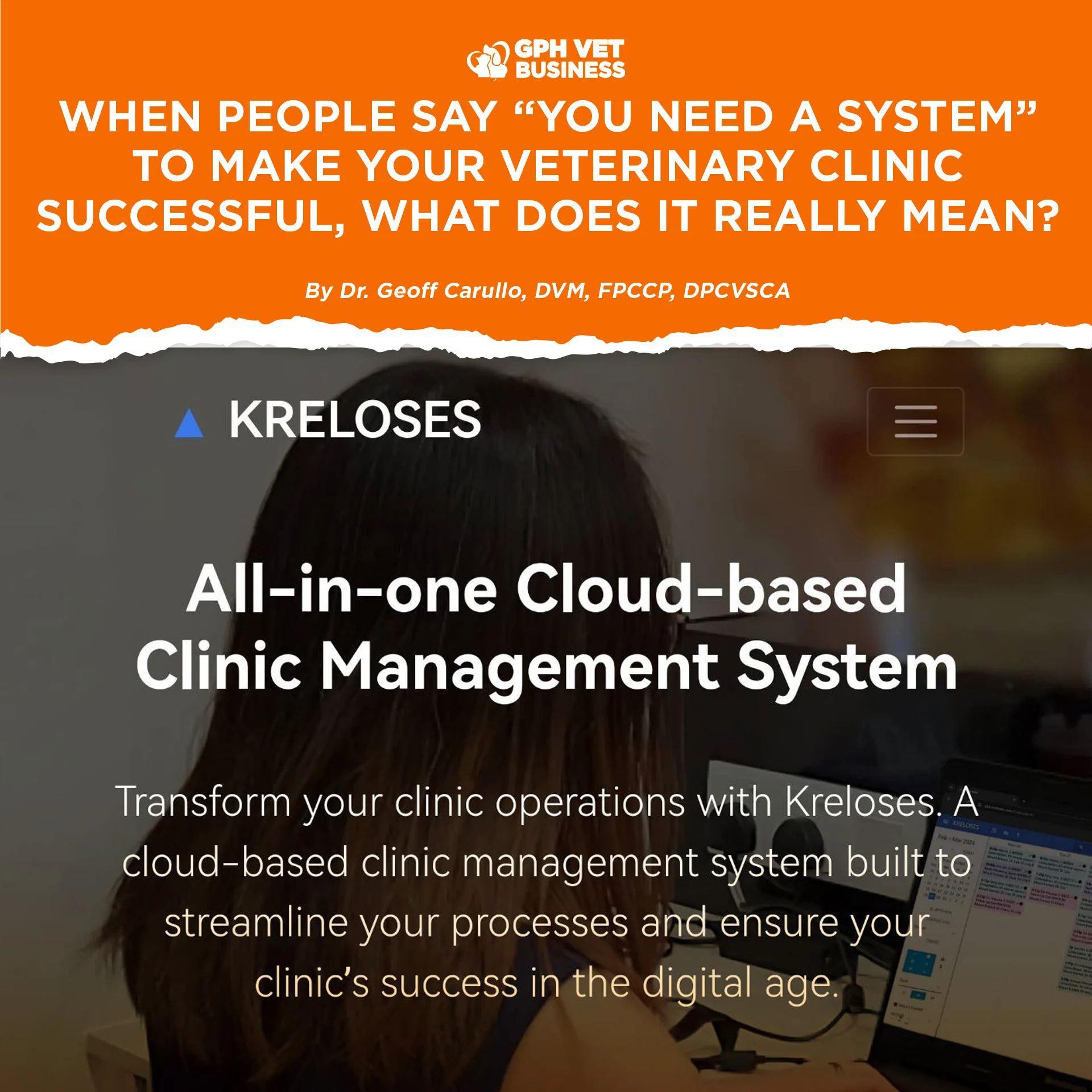
1. Veterinary Management System (Kreloses, Vet Cloud, etc.)

A veterinary management system is no longer a luxury.
It is the digital backbone of the clinic.
Modern systems centralize:
- Medical records
- SOAP notes
- Laboratory results
- Vaccination history
- Billing
- Inventory
- Client communication
- Scheduling
- Financial reports
- Staff accountability
A proper veterinary software system reduces:
- Lost records
- Medication errors
- Double entry mistakes
- Forgotten charges
- Miscommunication between staff
- Delayed follow-ups
It also protects the clinic legally.
Time-stamped medical records, treatment plans, diagnostics, and doctor notes can become critical evidence during disputes or litigation.
The reality is simple: If your clinic still depends heavily on paper, memory, or handwritten reminders, your clinic is vulnerable.
—
2. Point of Sale (POS) System
Many clinics leak money silently.
Not because they lack clients.
But because they lack tracking.
A proper POS system monitors:
- Sales
- Inventory movement
- Discounts
- Receivables
- Payment methods
- Staff transactions
- Daily cash flow
Without a POS system:
- Products disappear unnoticed
- Inventory expires
- Charges are forgotten
- Financial leakage becomes normal
A busy clinic without financial systems can still be an unprofitable clinic.
That is one of the biggest realities in veterinary business.
—
3. Payroll Systems (KAMI, biometrics, digital attendance)

Payroll is not just about salary computation.
It is about structure, accountability, and labor protection.
A proper payroll system tracks:
- Attendance
- Overtime
- Leave credits
- Holidays
- Shift differentials
- Tardiness
- Government contributions
- Payroll transparency
When payroll is disorganized:
- Staff morale drops
- Conflicts increase
- Legal risks increase
- Owners lose trust in employees
- Employees lose trust in management
Systems remove emotional decision-making.
Everything becomes documented. Everything becomes measurable.
4. Government Compliance Systems

This is one of the most overlooked systems in many veterinary clinics.
Many clinic owners focus heavily on medicine but neglect compliance infrastructure.
That becomes dangerous later.
A real clinic system also includes:
- Mayor’s Permit / Business Permit
- DTI or SEC registration
- BIR Certificate of Registration
- Professional permits and PTRs
- Sanitary permits
- Occupational permits
- Fire safety inspection certificates
- Lease agreements
- Zoning compliance
- Waste disposal agreements for medical waste
These are not “extra paperwork.”
These are legal foundations of the business.
One missed renewal or missing permit can disrupt operations, delay renewals, trigger penalties, or expose the clinic during legal disputes.
Professional clinics do not only focus on medicine.
They also protect the business legally.
BIR, SSS, PhilHealth, Pag-IBIG, and Tax Compliance systems include:
- BIR filing
- OR and invoice monitoring
- VAT and withholding tax computation
- SSS contributions
- PhilHealth contributions
- Pag-IBIG contributions
- Payroll tax compliance
- 2316 preparation
- Monthly and quarterly reporting
Taxumo is a Philippine-based online tax and accounting platform designed to simplify compliance for businesses, professionals, and SMEs.

It helps automate:
- Tax calculations
- BIR filing assistance
- SSS, PhilHealth, and Pag-IBIG processing
- Payroll tax computation
- Deadline reminders
- Income and expense tracking
- Compliance reporting
A clinic earning millions can still suffer because of poor compliance systems.
Late filings, incorrect taxes, missing receipts, payroll inconsistencies, and unpaid contributions can lead to penalties, audits, and sanctions.
A clinic that earns well but has poor compliance systems is still vulnerable.
Professional clinics are financially and legally organized too.
—
5. Veterinary Waivers and Consent Forms
A consent form is not merely paperwork.
It is risk management.
Good clinics use digital waivers with:
- Real-time signatures
- Date and time stamps
- Procedure explanations
- Estimated risks
- Financial acknowledgment
- CPR/DNR decisions
- Anesthetic consent
- Hospitalization authorization
These documents protect the client, the veterinarian, the clinic, and the staff.
If something was not documented, many will argue it never happened.
—
6. Diagnostic and Treatment Protocols
Protocols create consistency.
Without protocols, chaos increases.
Protocols may include:
- Vaccination schedules
- Anesthesia guidelines
- Emergency triage flowcharts
- Sepsis management
- Isolation procedures
- Parvo protocols
- C-section baselines
- CPR algorithms
- Pain management standards
- Disinfection protocols
Systems reduce chaos and improve training.
A new staff member learns faster when structured protocols exist.
High-performing hospitals do not rely on improvisation.
—
7. Employee Handbooks and Code of Conduct
Culture is also a system.
Many clinics fail because of people problems, not medicine.
An employee handbook defines:
- Expectations
- Professional behavior
- Attendance policies
- Social media policies
- Client interaction standards
- Confidentiality
- Grooming standards
- Disciplinary procedures
- Workplace ethics
Without structure:
- Favoritism develops
- Policies become emotional
- Discipline becomes inconsistent
- Toxicity spreads
A handbook creates fairness and protection for both employer and employee.
—
8. Contracts for Veterinarians and Staff
Many clinics still operate on verbal understanding.
That becomes dangerous later.
Contracts clarify:
- Compensation
- Duties
- Schedules
- Confidentiality
- Non-compete clauses
- Intellectual property
- Commission structures
- Resignation terms
- Liabilities
- Professional expectations
Clear contracts prevent emotional conflict later.
Ambiguity is expensive.
—
9. Time Scheduling Systems
Scheduling is operational engineering, not just calendar management.
A clinic without scheduling systems experiences:
- Burnout
- Long waiting times
- Overbooking
- Surgical delays
- Staff exhaustion
- Angry clients
- Medical errors
Good systems organize:
- Doctor shifts
- Technician assignments
- Surgery blocks
- Grooming schedules
- Hospital rounds
- Break times
- Emergency buffers
Time management directly affects revenue, client satisfaction, team morale, and medical quality.
—
The Real Meaning of “You Need Systems”
It means this:
Your clinic should not collapse simply because one person is absent.
A true systemized clinic:
- Functions consistently
- Protects itself legally
- Tracks finances properly
- Maintains government compliance
- Trains employees efficiently
- Maintains medical standards
- Creates accountability
- Scales easier
- Reduces chaos
Systems transform a veterinary clinic from a small negosyo into a real organization.
Many veterinarians work extremely hard.
But hard work without systems creates exhaustion instead of growth.
The clinics that survive long-term are not the loudest.
They are the most organized.
—
Sources
- Digitail Veterinary Software
- AcuroVet Guide to Veterinary Record Keeping
- Carrington Veterinary Practice Management Overview
- Shepherd Veterinary HR Essentials
- Lucca Veterinary Practice Management Systems Guide
- Taxumo
Dr. Geoff Carullo is a Fellow and the current President of the Philippine College of Canine Practitioners.
Sharing this helps others understand what it really means to be a vet. Like and follow if you’re with us.