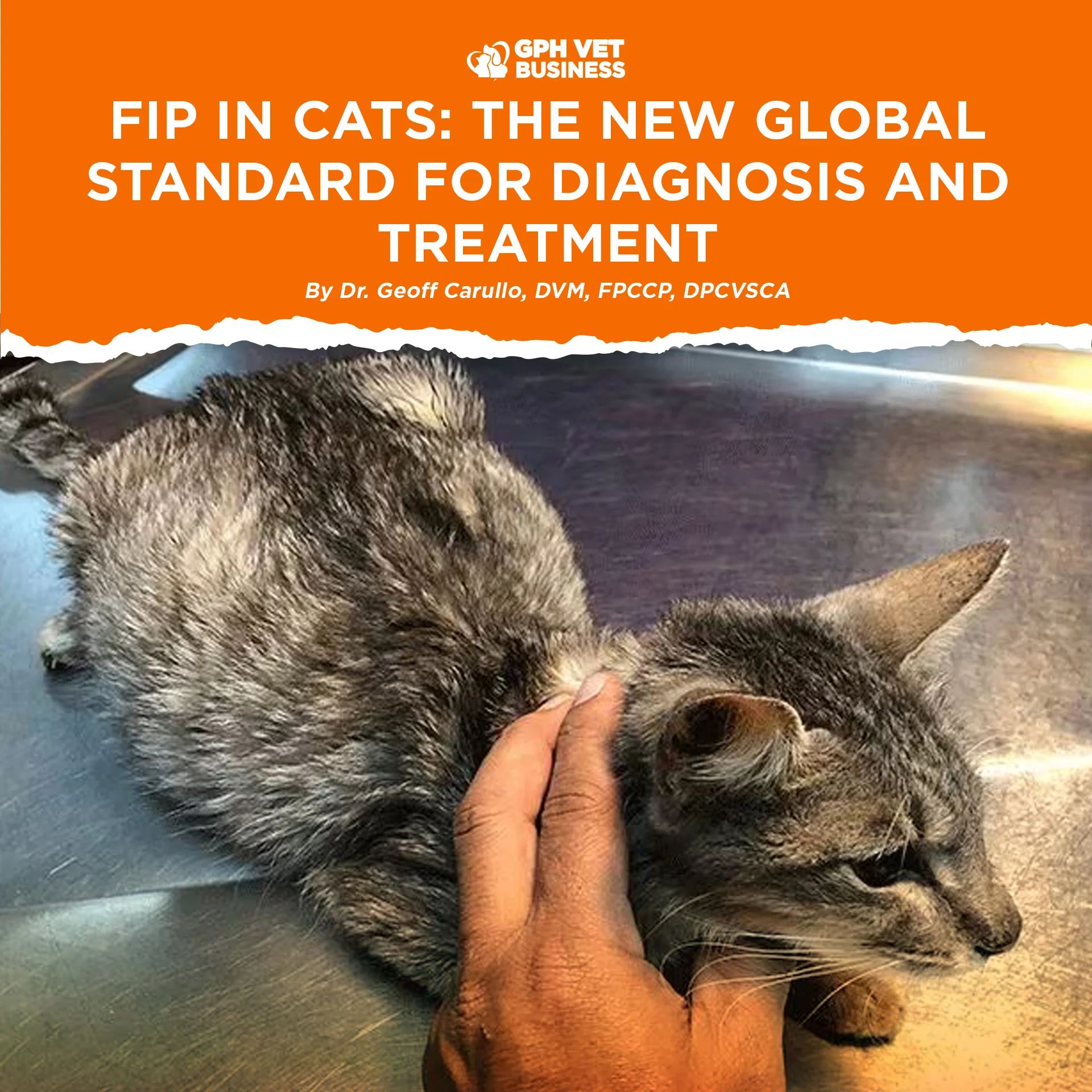
For decades, Feline Infectious Peritonitis (FIP) was considered one of the most heartbreaking diagnoses in feline medicine. Nearly every veterinarian has experienced the pain of telling a pet owner that nothing could be done.
But the world has changed.
Today, FIP is one of the most rapidly evolving fields in veterinary medicine, with breakthroughs in diagnostics and antiviral treatment producing survival rates once thought impossible. In many countries, remission now reaches 80 to 90 percent when modern protocols are applied correctly.
This article summarizes the most up-to-date global guidance on how veterinarians can diagnose and treat FIP confidently and accurately.
1. Understanding FIP Under the Modern Lens
FIP develops when a common intestinal coronavirus (FCoV) mutates into a disease-causing form that triggers widespread inflammation and organ damage. It appears in two major presentations:
Effusive (wet) FIP
High-protein fluid in the abdomen or chest, fast progression.
Non-effusive (dry) FIP
Granulomas in organs, ocular or neurologic signs, gradual progression.
Any young cat from a multi-cat environment with fever that does not respond to antibiotics should raise immediate suspicion.
2. Modern Diagnostic Approach
Global guidelines, including AAFP and ABCD Europe, now emphasize a multi-step diagnostic strategy. No single test can confirm FIP alone. Instead, veterinarians are encouraged to build a diagnosis by combining clinical signs, laboratory changes, imaging, and molecular tests.
A. Clinical Red Flags
- Persistent fever unresponsive to antibiotics
- Weight loss or stunting
- Lethargy, inappetence
- Ocular inflammation
- Neurologic deficits
- Distended abdomen or breathing difficulty from effusion
B. Laboratory Markers
Typical patterns include:
- Lymphopenia
- Non-regenerative anemia
- High globulin levels
- Low albumin resulting in a decreased A:G ratio (0.4 to 0.6 is strongly suspicious)
- Increased bilirubin
- Elevated acute phase proteins such as AGP or SAA
These findings do not confirm FIP but form the biochemical backbone of diagnosis.
C. Effusion Analysis
If fluid is present, it is the best sample to analyze. Key features:
- Straw colored and viscous
- High protein but low to moderate cellularity
- Positive Rivalta test strongly suggests FIP
- RT-PCR on effusion has high specificity especially with high viral load
D. Imaging Findings
Ultrasound may reveal:
- Free abdominal fluid
- Enlarged mesenteric lymph nodes
- Hypoechoic lesions in organs
- Thickened intestines or renomegaly
For ocular or neurologic FIP, CT or MRI is ideal if available.
E. Tissue Confirmation
When needed, the definitive test is:
- Histopathology showing granulomatous inflammation
- Immunohistochemistry for coronavirus antigen within macrophages
This remains the gold standard when diagnosis is unclear or when ruling out lymphoma, fungal disease or toxoplasmosis.
3. Treatment Protocols That Now Save Lives
This is where global FIP management has transformed dramatically.
A. Antiviral Therapy
The backbone of modern treatment is nucleoside analog antivirals, mainly:
- GS-441524
- Remdesivir, which converts to GS-441524 in the body
These drugs directly inhibit viral replication. Across multiple countries and cohort studies, survival rates reach:
- 80 to 90 percent for non-neurologic cases
- 60 to 70 percent for neurologic and ocular cases using higher intensity regimens
Most protocols run for a continuous treatment period lasting several weeks to months followed by a close observation window.
Key principles:
- Start treatment quickly once FIP is strongly suspected
- Avoid under-dosing because this increases relapse and resistance
- Do not stop treatment early even if the cat looks normal
- Use high-quality, legally sourced medication whenever possible
Oral therapy is now preferred for most non-neurologic cases. Severe, unstable or neurologic cases may benefit from an initial injection phase before switching to oral.
B. Supportive Care
Supportive treatment remains essential and includes:
- Hydration and electrolyte stabilization
- Appetite support and nutritional planning
- Anti-nausea medications
- Pain management
- Careful paracentesis for respiratory compromise
Corticosteroids are no longer recommended as primary therapy. They may mask disease progression and interfere with antiviral effectiveness.
4. Monitoring During and After Therapy
During Treatment
Every 2 to 4 weeks:
- Check body weight and temperature
- Assess behavior, appetite and activity
- Repeat CBC and biochemistry
- Reassess effusions or organ lesions with ultrasound
Improvement is often visible within the first week.
After Treatment
There is a silent risk window after the antiviral course.
Watch for:
- Return of fever
- New ocular or neurologic signs
- Recurrence of effusion
- Drop in A:G ratio or rising bilirubin
Early relapse can be managed with an adjusted protocol.
5. Prognosis
Untreated FIP is still almost always fatal.
But with modern therapy:
- Cats with non-neurologic FIP now survive and return to normal life at rates that were impossible five years ago.
- Neurologic FIP, once hopeless, now has meaningful recovery potential in many cases.
- Young cats treated early with correct dosing have the best outcomes.
6. The Global Shift
Around the world, veterinary organizations are updating their guidelines to reflect the new reality:
FIP is treatable.
FIP is survivable.
FIP is no longer a guaranteed death sentence.
Veterinarians must stay updated, teach owners accurate information and dismantle outdated beliefs that persist in social media and some clinical circles. Early detection, correct diagnosis and proper antiviral therapy give cats the best chance of long-term remission.
Dr. Geoff Carullo is a Fellow and the current President of the Philippine College of Canine Practitioners.
Sharing this helps others understand what it really means to be a vet. If you found this valuable, like and follow for more insights.