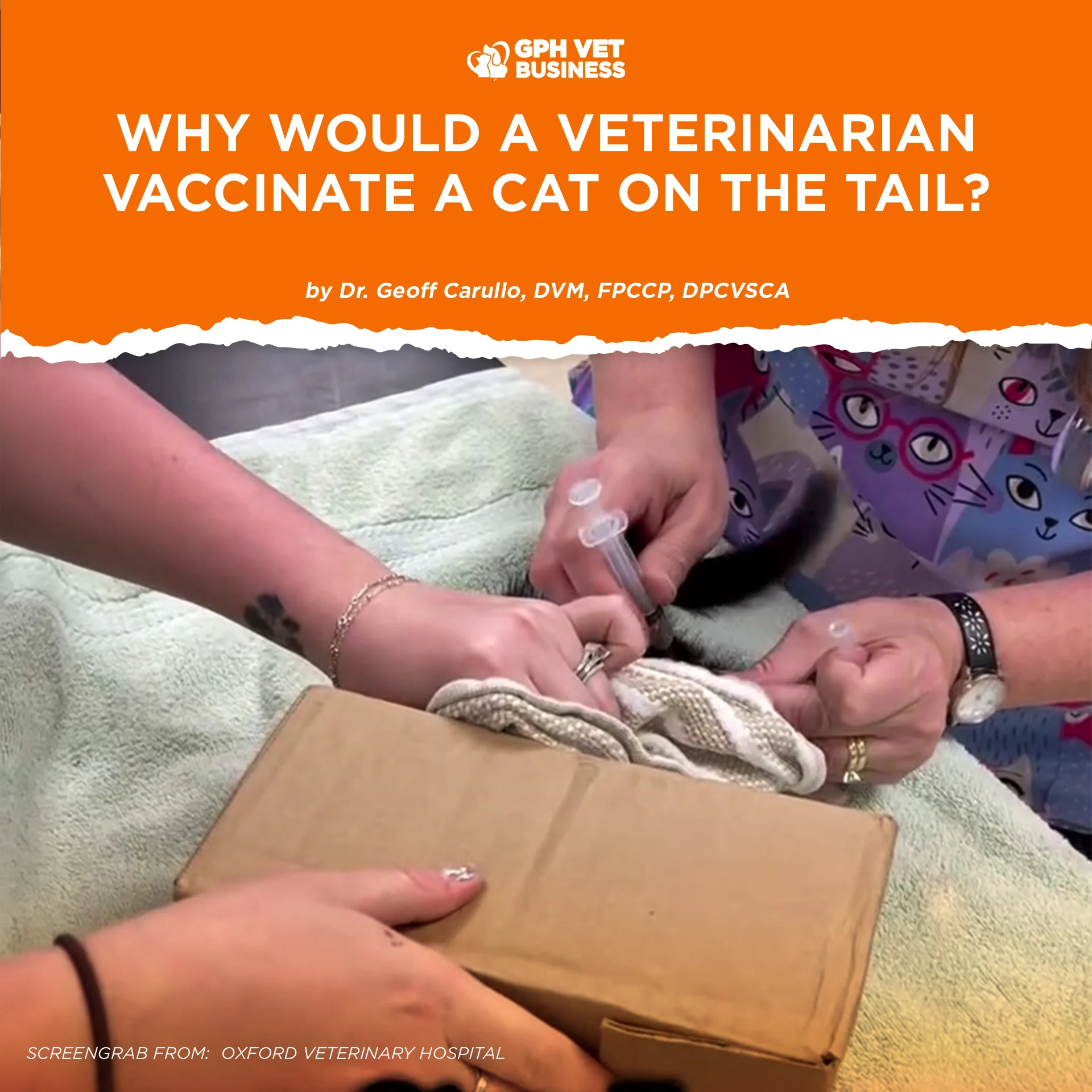
If you have never seen a cat vaccinated on its tail before, your first reaction might be, “Is that even the correct place to give a vaccine?”
Surprisingly, yes.
Although it is not yet the routine practice in most veterinary clinics, tail vaccination is an evidence-based technique that was developed to address one of the rare but serious complications associated with injectable vaccines in cats: Feline Injection-Site Sarcoma (FISS).
FISS is an uncommon but highly aggressive soft tissue tumor that can develop at the site of an injection. While the overall risk is very low, these tumors can be locally invasive and often require extensive surgery to achieve complete removal.
Historically, vaccines were commonly administered between the shoulder blades. However, if a sarcoma developed in that location, obtaining adequate surgical margins was extremely difficult. As a result, international vaccination guidelines shifted toward administering vaccines as distally as possible on the limbs. If a tumor were to develop, limb amputation offers a much better chance of complete surgical excision.
More recently, researchers have explored vaccination in the distal third of the tail. Studies have shown that tail vaccination is generally well tolerated and capable of producing adequate immune responses. The greatest advantage is surgical. Should the rare event of FISS occur, partial tail amputation is often less invasive than limb amputation.


Not All Feline Vaccines Are the Same
However, there is another important point worth discussing.
Not all feline vaccines are the same.
For example, PUREVAX® vaccines are non-adjuvanted vaccines. Adjuvants are substances added to many vaccines to enhance the immune response, but they also produce greater local inflammation. Because chronic inflammation is believed to play a role in the development of FISS, non-adjuvanted vaccines such as PUREVAX were specifically developed to minimize this inflammatory stimulus.
Does that mean PUREVAX completely eliminates the risk of injection-site sarcoma?
No.
Current international guidelines emphasize that every injectable vaccine has the potential to be associated with FISS, although vaccines containing adjuvants generally induce more inflammation than non-adjuvanted products. At present, there is still insufficient evidence to recommend one vaccine type exclusively for preventing FISS.
Therefore, when using a non-adjuvanted vaccine such as PUREVAX, routine tail vaccination is generally not considered necessary solely for sarcoma prevention. Many veterinarians continue to administer these vaccines in the recommended distal limb locations, consistent with current guidelines.
Ultimately, the choice of vaccine and injection site should be individualized based on the patient’s risk factors, the vaccine being administered, and the veterinarian’s clinical judgment.


Key Principles That Remain Unchanged
Regardless of the vaccine selected, several principles remain unchanged:
- Vaccinate only when indicated based on an individualized risk assessment.
- Avoid the interscapular region whenever possible.
- Record the exact vaccine administered and its anatomical injection site.
- Educate owners about the 3-2-1 Rule: investigate any post-vaccination lump that persists for more than 3 months, exceeds 2 cm in diameter, or continues to enlarge 1 month after injection.
Veterinary medicine continues to evolve through scientific research. Sometimes what appears unusual, such as vaccinating a cat on the tail, is actually supported by thoughtful surgical planning and evidence-based medicine. Likewise, understanding the differences between adjuvanted and non-adjuvanted vaccines helps veterinarians make informed decisions that balance disease prevention with patient safety.

References
- Stone AES, et al. 2020 AAHA/AAFP Feline Vaccination Guidelines. Journal of Feline Medicine and Surgery. 2020.
- AAHA/AAFP Update on Feline Injection-Site Sarcomas. American Animal Hospital Association.
- ABCD Guideline for Feline Injection-Site Sarcoma. European Advisory Board on Cat Diseases.
- PUREVAX® Feline Vaccines Product Information. Boehringer Ingelheim Animal Health. PUREVAX vaccines are non-adjuvanted and designed to reduce injection-site inflammation while providing protective immunity.
- Vaccines and Sarcomas: A Concern for Cat Owners. American Veterinary Medical Association.
Dr. Geoff Carullo is a Fellow and the current President of the Philippine College of Canine Practitioners.
Sharing this helps others understand what it really means to be a vet. Like and follow if you’re with us.