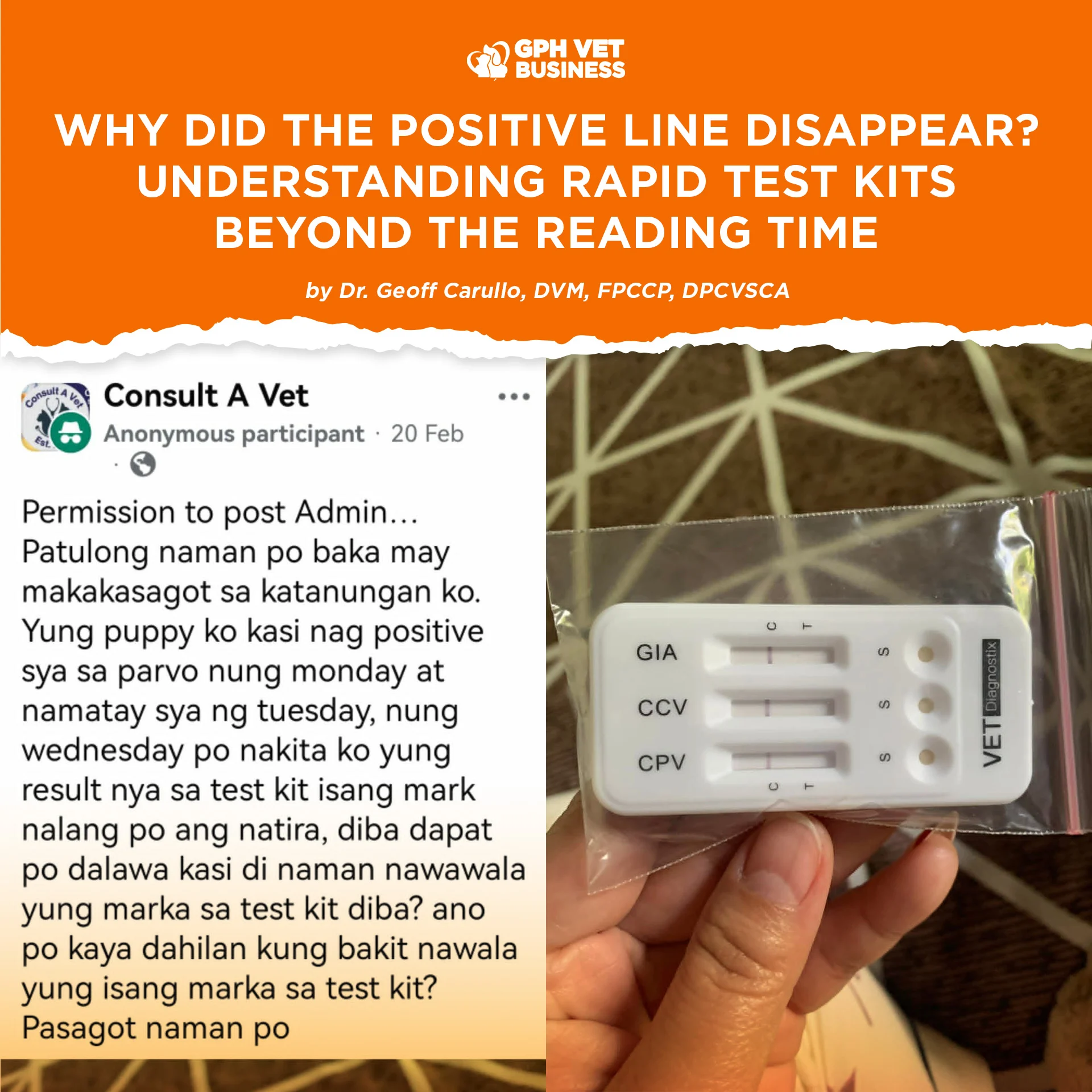
Why Did the Positive Line Disappear? Understanding Rapid Test Kits Beyond the Reading Time
By Dr. Geoff Carullo, DVM, FPCCP, DPCVSCA
A social media post recently raised an interesting question. A puppy reportedly tested positive for canine parvovirus (CPV) on Monday, unfortunately passed away the following day, and when the owner looked at the test kit again on Wednesday, only one line remained. The owner wondered if the positive result had somehow changed.

The short answer is:
No. A rapid test kit should never be interpreted days after it was performed.
How Rapid Test Kits Work
Lateral flow immunoassays, commonly known as rapid test kits, are designed to be interpreted only within a specific reading window, usually 5 to 15 minutes, depending on the manufacturer’s instructions.
During this period, the sample migrates through the membrane where antibodies capture the target antigen, producing the colored lines that indicate the result.
After this recommended reading time, the chemistry of the test is no longer guaranteed to remain stable.


Why Can a Positive Line Disappear?
Several factors can explain why a previously visible test line is no longer present after one or more days.
1. The Test Has Dried Out
Once the membrane dries completely, the colored complexes that formed during the reaction may fade. This is expected and does not invalidate the original result that was read within the proper time.
2. Pigment Degradation
The colored particles used in rapid test kits are not intended to remain stable indefinitely. Exposure to air, humidity, sunlight, and temperature changes can gradually reduce the intensity of the line.
3. The Kit Was Never Designed for Long-Term Storage After Use
Manufacturers validate rapid test performance only during the specified interpretation period. They do not guarantee that the result will look the same after several hours or days.
Therefore, looking at an old cassette days later has no diagnostic value.
Can a Positive Become Negative on the Cassette?
No.
The patient’s infection status does not change because the line disappeared later.
If the veterinarian documented the result as positive during the proper reading time, that remains the valid diagnostic interpretation.
The faded or missing line observed days later is simply a consequence of the test aging after use.


The Importance of Proper Documentation
In veterinary practice, rapid test results should ideally be:
- Read strictly within the manufacturer’s recommended time.
- Recorded immediately in the medical record.
- Photographed at the correct reading time when appropriate.
- Interpreted together with the patient’s history, clinical signs, physical examination, and other laboratory findings.
A rapid test should never be re-read days later to question its original interpretation.
The Take-Home Message
Rapid diagnostic kits are excellent point-of-care tools when used correctly. However, their accuracy depends not only on proper sample collection but also on proper timing of interpretation.
If a positive line disappears several days later, this does not mean the puppy was never infected. It simply means the cassette is already outside its validated reading period and should no longer be interpreted.
Understanding the limitations of rapid diagnostic tests helps prevent unnecessary confusion and ensures that veterinarians and pet owners make decisions based on scientifically valid results rather than the appearance of an expired test cassette.

Sources
- American Veterinary Medical Association (AVMA). Point-of-Care Diagnostic Testing in Veterinary Medicine.
- Greene CE. Infectious Diseases of the Dog and Cat. 5th Edition. Elsevier.
- Decaro N, Buonavoglia C. Canine Parvovirus—A Review of Epidemiological and Diagnostic Aspects. Veterinary Microbiology.
- OIE/WOAH Manual of Diagnostic Tests and Vaccines for Terrestrial Animals. Canine Parvovirus chapter.
- World Health Organization. Guidance on the Use and Interpretation of Rapid Diagnostic Tests (Lateral Flow Immunoassays).
- Manufacturer Instructions for Use (IFU) of veterinary lateral flow immunochromatographic assays (read results only within the specified interpretation time; results read outside the recommended window are considered invalid).
Dr. Geoff Carullo is a Fellow and the current President of the Philippine College of Canine Practitioners.
Sharing this helps others understand what it really means to be a vet. Like and follow if you’re with us.