Few things are more heartbreaking than losing a beloved pet.
For many families, pets are not just animals. They are companions, family members, and loyal friends. When they pass away, especially after being brought to an emergency hospital, emotions naturally run high. Anger, frustration, and grief often follow.
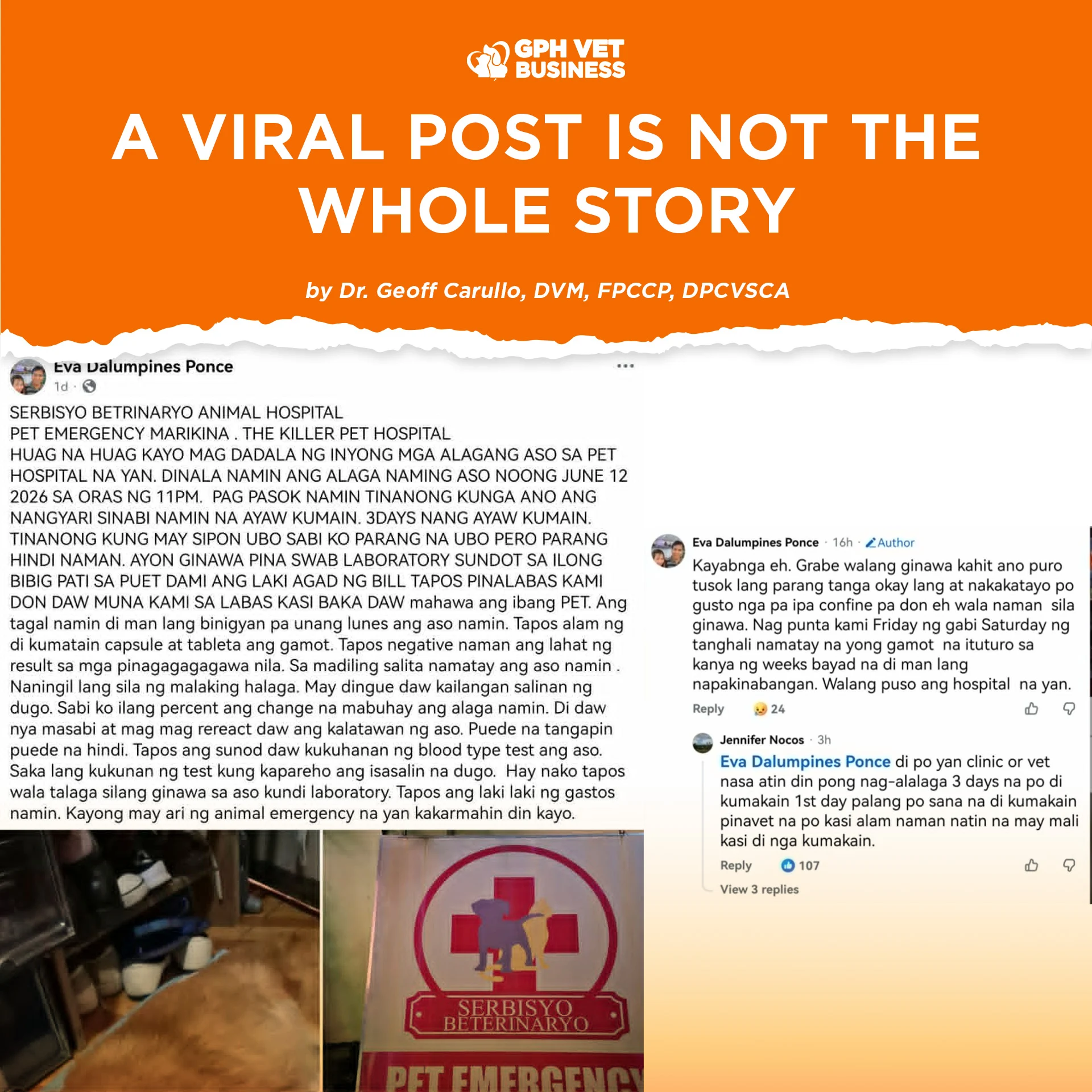
Recently, a social media post went viral accusing a veterinary hospital of being a “killer pet hospital.” The owner described expensive diagnostic tests, isolation of the patient, discussions about blood transfusion, and ultimately, the death of their dog.
See post here: Facebook.com
Reading such a story is painful.
However, it is also important to remember one principle:
A social media post tells only one side of the story.
As veterinarians, we understand that many critically ill patients arrive at the hospital after several days of illness. In this case, the owner mentioned that the dog had not eaten for three days before being brought to the emergency hospital.
Three days of anorexia in a sick dog is already a medical emergency.
At that point, the underlying disease may already be advanced.
Why Were So Many Tests Performed?
Many pet owners wonder why veterinarians request laboratory tests before treatment.
The answer is simple.
Symptoms such as loss of appetite are not diseases by themselves. They can be caused by numerous conditions, including:
- Severe infections
- Tick-borne diseases
- Kidney failure
- Liver disease
- Pancreatitis
- Poisoning
- Immune-mediated disorders
- Many other medical conditions
Diagnostic tests help identify the cause so treatment can be directed appropriately.
Without diagnostics, treatment often becomes educated guesswork.


Why Was the Dog Isolated?
The owner mentioned that the dog was kept away from other patients while tests were being performed.
Isolation is not necessarily a sign that the veterinarian already knows the diagnosis.
Rather, it is often a precaution when an infectious disease cannot yet be ruled out. Emergency hospitals have a responsibility to protect every patient inside the facility.

What About the Blood Transfusion?
The owner also stated that a blood transfusion was recommended.
This usually suggests that the dog may have developed severe anemia or another life-threatening condition.
Unfortunately, no ethical veterinarian can honestly guarantee survival after a blood transfusion.
Medicine is never 100%.
Veterinary medicine is no exception.
Even with blood transfusions, intensive care, medications, oxygen support, and hospitalization, some patients simply arrive too late to be saved.
Expensive Does Not Always Mean Unnecessary
Emergency veterinary medicine is resource-intensive.
Laboratory tests, emergency staff, hospitalization, blood products, monitoring equipment, medications, and intensive nursing care all contribute to the overall cost.
A large bill does not automatically mean that unnecessary procedures were performed.
Likewise, an unfortunate outcome does not automatically mean malpractice occurred.


Before We Judge
If there is genuine concern regarding the quality of veterinary care, the proper approach is to review the complete medical record, including:
- Physical examination findings
- Laboratory results
- Treatment sheets
- Monitoring records
- The attending veterinarian’s medical reasoning
Without these, no one can fairly determine whether the standard of care was met.
Social media posts often contain only the owner’s perspective.
The veterinarian, on the other hand, is bound by professional ethics and confidentiality and usually cannot publicly disclose medical details to defend themselves.
That creates an imbalance in public perception.
A Final Thought
Grieving pet owners deserve compassion.
Veterinarians deserve fairness.
Before we label a hospital as negligent or a “killer,” let us remember that medicine is complex, every case is different, and not every life can be saved despite everyone’s best efforts.
Sometimes, despite doing everything medically possible, the disease simply wins.
That is one of the hardest realities every veterinarian lives with.

Sharing this helps others understand what it really means to be a vet. Like and follow if you’re with us.
Dr. Geoff Carullo is a Fellow and the current President of the Philippine College of Canine Practitioners.