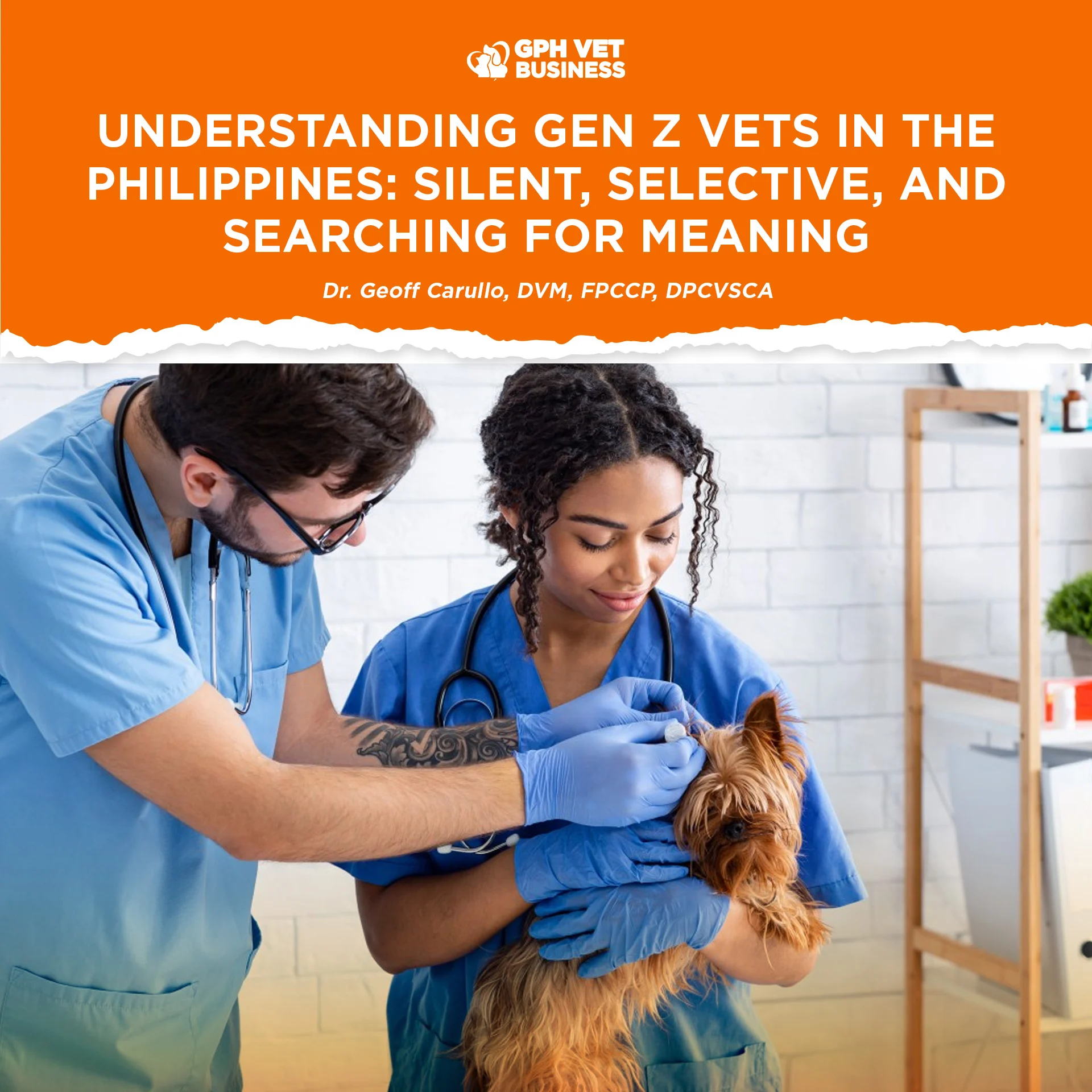
As more Gen Z veterinarians graduate and enter the workforce, a quiet shift is happening inside veterinary clinics across the country.
They’re not loud.
They’re not always online.
And they’re not easy to predict.
In the Philippine setting, where family-run clinics, hierarchy, and “pakikisama” still dominate practice culture, Gen Z vets present both a challenge and an opportunity.


1. Not Everyone Wants to be a Social Media Vet
While many assume Gen Z are “digital natives,” Filipino Gen Z vets are more private than performative.
They’re comfortable using apps, yes—but many are reluctant to create content or promote themselves online, especially when still unsure of their clinical confidence or personality.
Insight: Don’t expect them to be the face of your TikTok or Facebook page. Many of them are still trying to find their voice—and they’re cautious about being misjudged by peers and clients.
2. Quiet, But Not Weak
In Philippine clinics, where the loudest usually gets heard, these younger vets may come off as mahiyain or walang gana—but don’t be fooled.
They listen closely, analyze silently, and act with intention.
They value peace over confrontation and will not engage in power struggles. But if they feel disrespected or unsupported, they’ll simply… resign. No drama. Just silence.
Insight: Respect is key. They won’t always demand it out loud—but they know when it’s missing.

3. Mental Health is Non-Negotiable
This is the therapy generation.
They speak more openly about stress, anxiety, and burnout. They ask for mental health breaks, days off, and “safe” work environments.
In a culture where older vets wore burnout as a badge of honor, Gen Z vets are breaking the cycle.
Insight: They don’t want a clinic that just values skills. They want a clinic that values people. If your clinic is toxic, no salary offer will keep them.
4. They Question Tradition, Not to Be Rude—But to Understand
From questioning mandatory “OT na walang bayad,” to outdated SOPs and price markups, Gen Z vets are less afraid to ask why.
This isn’t disrespect. It’s curiosity paired with fairness. Many have grown up in families who struggled financially, and they want to make their profession more ethical and efficient.
Insight: Instead of dismissing their questions, use them as opportunities to improve your systems—or explain why they exist.


5. They’re Not in a Hurry to Be Bosses—But They Want Options
Some Gen Z vets are entrepreneurial. Others just want a stable job with boundaries. What’s common?
They want the option to grow.
They want to feel that staying in your clinic for 3–5 years won’t make them feel stuck.
Insight: Offer mentorship. Teach both medicine and business. Show them they have a future with you—without pressuring them to “prove loyalty” right away.
Final Reflection
Gen Z veterinarians in the Philippines may not fit the mold, but that’s exactly why they’re valuable.
They’re introspective.
They protect their peace.
They’re quietly building a version of veterinary life that doesn’t just survive—but thrives.
If we learn to listen, support, and guide them—without expecting them to be copies of our past—we won’t just retain them.
We’ll raise a generation of vets who are kinder, smarter, and stronger than we ever were.
Sharing this helps others understand what it really means to be a vet. Like and follow if you’re with us.
Dr. Geoff Carullo is a Fellow and the current President of the Philippine College of Canine Practitioners.