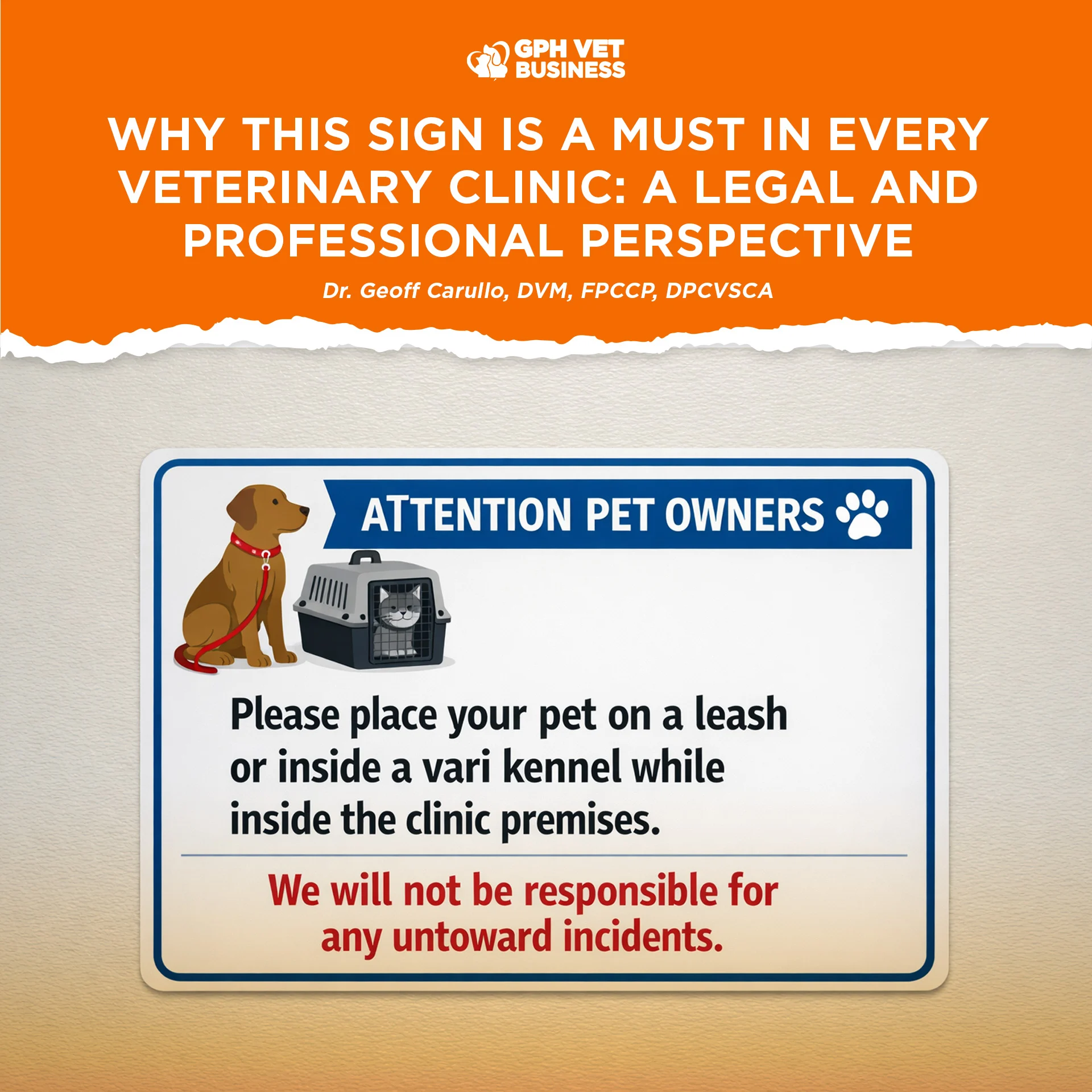
“Please place your pet on a leash or inside a vari kennel while inside the clinic premises. We will not be responsible for any untoward incidents.”
Veterinary clinics are spaces where animals of different sizes, temperaments, and medical conditions are brought together in close proximity. While these spaces are designed with care, they are not risk-free zones.
Posting clear, visible reminders about pet control and clinic liability isn’t just a best practice—it’s a legal safeguard and a professional obligation.


1. Client Education Is a Duty, Not a Luxury
Many pet owners may not fully understand the potential risks within a veterinary clinic: reactive animals, stress-induced aggression, and even zoonotic concerns. Without clear reminders, the burden of knowledge shifts entirely onto the clinic, which can create issues in disputes or complaints.
By posting this sign:
- You’re educating clients about shared responsibility.
- You’re reinforcing proactive risk mitigation, not reactive damage control.

2. Legal Liability: “Untoward Incidents” and Foreseeable Harm
In the event of a bite, injury, or pet-to-pet altercation, legal complaints often hinge on whether the clinic acted with “reasonable care.”
If a clinic has no posted rules, a client may argue:
- That they were not informed of standard protocols.
- That the clinic failed in its duty to warn or prevent foreseeable harm.
However, if a sign is clearly displayed, the clinic can demonstrate:
- That reasonable precaution was communicated.
- That the pet owner was reminded of their duty to leash or crate their animal.
- That liability may be mitigated due to contributory negligence on the part of the owner.
3. Documentation & Disputes: Signage as Evidence
If ever a legal or PR dispute arises (e.g., client posts a negative review after an altercation or files a Barangay complaint), posted signs serve as:
- Tangible evidence that the clinic has safety protocols in place.
- A visible reinforcement of client accountability.
- A reference point for CCTV footage and incident reports.
In short, that simple sign can protect you in court, in social media backlash, or in face-to-face client mediation.
4. Legal Precedent in the Philippines and Beyond
While there is no exact RA (Republic Act) specifically mandating this type of signage, several legal doctrines apply:
- Doctrine of Contributory Negligence – If a client fails to restrain their animal after being warned and an incident occurs, their own negligence may limit liability of the clinic.
- Doctrine of Assumption of Risk – Visible signs that outline risks and policies may reduce legal burden by establishing that clients entered the premises with informed awareness.
- Batas Pambansa Blg. 881 on transparency and fairness in business premises (consumer rights) indirectly supports the idea that clearly posted policies protect both the client and the business.


Final Thoughts: A Simple Sign with Powerful Protection
This isn’t just about a dog snapping at another or a cat escaping from its carrier. It’s about setting the tone of shared accountability, protecting the welfare of every patient, and protecting your practice from avoidable legal and ethical dilemmas.
Posting this message clearly and respectfully helps:
- Promote safe clinic culture.
- Establish reasonable expectations for pet owners.
- Serve as a layer of defense in unforeseen situations.
Suggested Placement:
- At the clinic entrance
- Inside the reception area
- Near the examination or waiting areas
- In multiple languages or Taglish, depending on clientele.
Dr. Geoff Carullo is a Fellow and the current President of the Philippine College of Canine Practitioners.
Sharing this helps others understand what it really means to be a vet. Like and follow if you’re with us.