I have no problem with veterinary students asking questions. In fact, they should ask questions. That is how we learn.
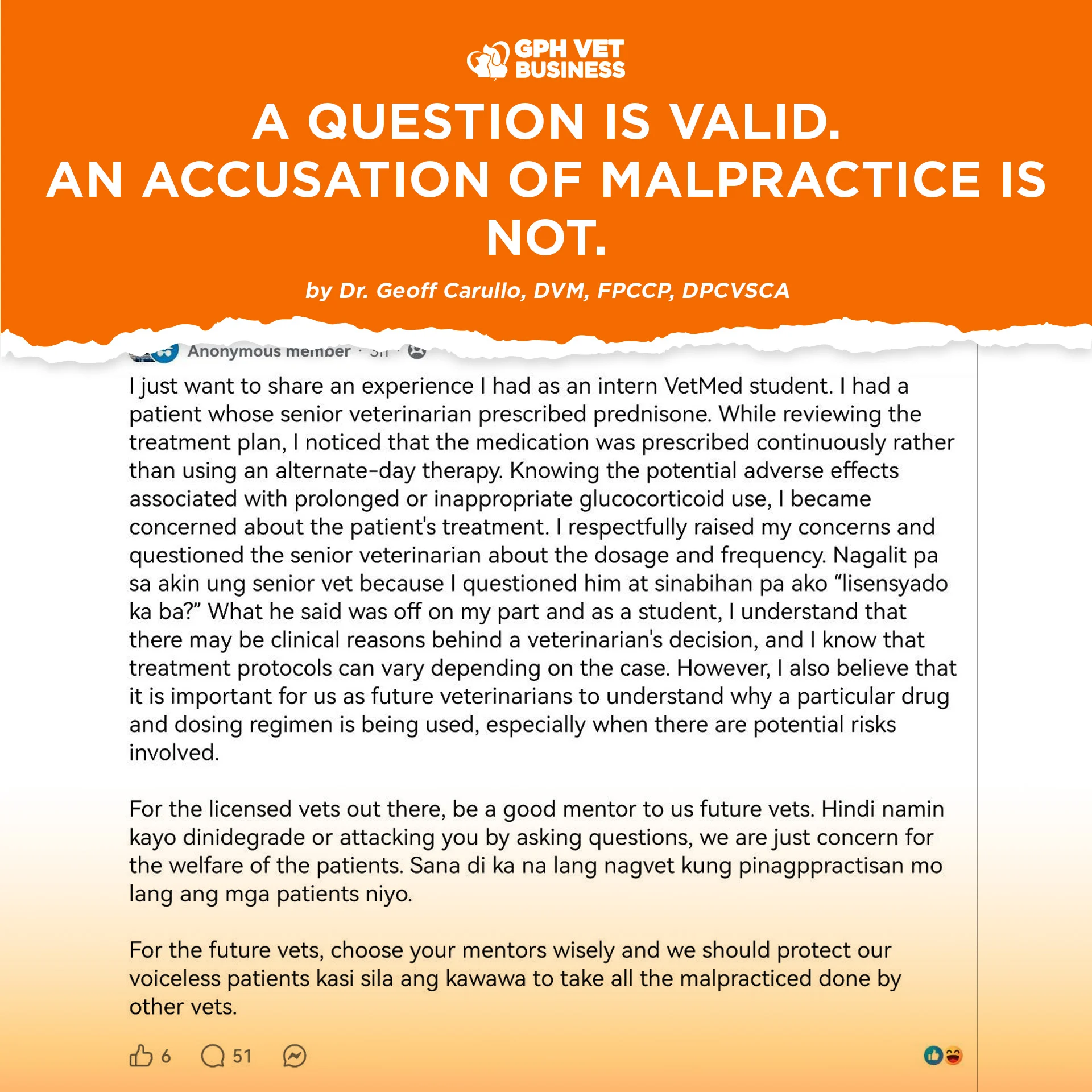
But there is a big difference between asking why a veterinarian chose a particular protocol and publicly implying that a veterinarian is committing malpractice simply because the treatment does not match what you remember from a textbook.

And in this particular case, the premise itself deserves correction.
1. Prednisone does NOT automatically have to be given on alternate days.
The statement that prednisone was being given continuously “rather than using alternate-day therapy” makes it sound as though daily administration is inherently improper.
It is not.
The MSD Veterinary Manual specifically states that the adverse effects of long-term glucocorticoid therapy may be reduced through alternate-day treatment. However, it also states that inflammation may first be controlled using daily prednisone or prednisolone, after which the patient can gradually be transitioned to alternate-day therapy.
That distinction matters.
Alternate-day therapy is often a strategy for reducing adverse effects during longer-term treatment. It is not a universal starting regimen for every patient receiving prednisone.
MSD also describes anti-inflammatory prednisolone therapy in dogs at every 24 hours during induction, followed by reduction to the lowest effective maintenance dose, ideally with longer dosing intervals when clinically appropriate.
So before declaring that daily prednisone is questionable, the first question should be:
What disease is being treated, at what dose, for how long, and at what stage of therapy?
Those details matter.


2. A dosing interval cannot be judged without knowing the case.
We were not told the diagnosis.
We were not told the species, dose, duration of treatment, severity of disease, previous response, concurrent medications, laboratory findings, or whether the veterinarian was still in the induction phase or already attempting maintenance therapy.
Different diseases require different glucocorticoid protocols.
For example, MSD Veterinary Manual lists prednisone or prednisolone at 2 mg/kg every 24 hours initially for certain chronic enteropathies in small animals, with subsequent tapering to the lowest effective dose.
For flea allergy dermatitis, MSD describes prednisone or prednisolone being administered every 24 hours initially, then tapered to alternate-day treatment afterward.
And there are conditions where daily glucocorticoid therapy may even be part of long-term management. The 2023 AAHA Selected Endocrinopathies Guidelines, for example, recommend a small daily dose of prednisone or prednisolone for dogs requiring glucocorticoid replacement for hypoadrenocorticism.
Therefore:
Daily prednisone ≠ malpractice.
It may be appropriate, inappropriate, too high, too low, too prolonged, or perfectly justified depending on the patient.
You cannot determine that from the words “once daily” alone.
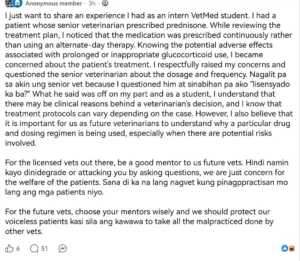
3. There is a difference between asking for an explanation and suggesting the veterinarian is wrong.
According to the student’s own clarification, the question was essentially:
“Doc, pina-prednisone niyo po yung patient. Should this treatment plan be in an alternate-day therapy?”
Perhaps the intention was innocent.
But communication matters.
There is a substantial difference between:
“Doc, may I ask why we are giving prednisone daily in this patient instead of alternate-day therapy?”
and
“Shouldn’t this be alternate-day therapy?”
The first asks the clinician to teach.
The second can easily sound like the student has already decided what the correct treatment should be and is asking the veterinarian to defend the prescription.
A student absolutely has the right to ask.
But a mentor also deserves the opportunity to explain the clinical reasoning before being judged.
4. The senior veterinarian could also have handled it better.
If the response was simply, “Lisensyado ka ba?”, then yes, there was probably a better way to answer.
A teaching environment should encourage thoughtful questions.
The veterinarian could simply have explained the indication, the dose, whether the patient was in an induction phase, and whether tapering or alternate-day therapy was eventually planned.
That would have turned an uncomfortable moment into a useful clinical lesson.
But poor communication from a senior veterinarian does not automatically make the treatment medically wrong.
Bad bedside teaching and bad medicine are two different allegations.


5. Being an intern does not mean remaining silent. But being concerned does not make your conclusion correct.
Students should speak when something genuinely worries them.
But veterinary medicine becomes dangerous when we start reasoning like this:
“I learned Protocol A. My senior used Protocol B. Therefore, Protocol B must be malpractice.”
Clinical medicine is rarely that simple.
Textbooks provide principles.
Patients provide context.
The MSD Veterinary Manual itself makes clear that glucocorticoid regimens vary depending on the indication, treatment phase, dose, duration, and therapeutic objective. Daily treatment may precede alternate-day treatment, and some conditions require very different dosing strategies altogether.
That is precisely why internship exists.
6. “Malpractice” is a very serious word.
The most troubling part of the post is no longer the prednisone question.
It is the statement warning future veterinarians to protect patients from the “malpracticed done by other vets.”
That is an enormous leap.
You cannot responsibly conclude malpractice because you disagree with one medication interval, particularly when the complete medical record and clinical reasoning have not even been presented.
Disagreement is not malpractice.
A different protocol is not automatically malpractice.
And a veterinarian becoming irritated by a student’s question is certainly not proof of malpractice.
7. Students deserve good mentors. Mentors also deserve fair students.
Mentorship is a two-way relationship.
Senior veterinarians should be patient enough to teach.
Students should be humble enough to recognize that knowing a pharmacologic principle is not the same as knowing everything about the patient standing in front of them.
Ask.
Challenge respectfully.
Read.
Request the rationale.
Discuss the literature.
But before publicly accusing another veterinarian of harming “voiceless patients,” make very sure that what you are calling malpractice is actually malpractice and not simply a clinical decision you have not yet learned to understand.
Because protecting patients requires vigilance.
But protecting our profession also requires something equally important:
Evidence, context, humility, and fairness.

Sources
MSD Veterinary Manual. Corticosteroids in Animals. Updated May 2025.
MSD Veterinary Manual. Hormonal Treatment for Integumentary Disease in Animals.
MSD Veterinary Manual. Flea Allergy Dermatitis in Dogs and Cats.
MSD Veterinary Manual. Chronic Enteropathies in Small Animals.
American Animal Hospital Association. 2023 AAHA Selected Endocrinopathies of Dogs and Cats Guidelines: Canine Hypoadrenocorticism Therapy.
Dr. Geoff Carullo is a Fellow and the current President of the Philippine College of Canine Practitioners.
Sharing this helps others understand what it really means to be a vet. Like and follow if you’re with us.