When a pet dies inside a veterinary clinic, does that automatically mean the clinic must store the body indefinitely?
Not necessarily. Storage and proper disposition are two different things.
The BAI Veterinary Clinic & Hospital Inspection Form itself includes “Disposition of dead animal” under waste disposal.
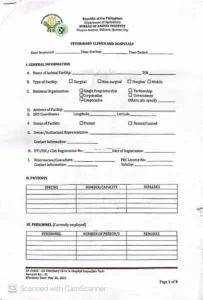
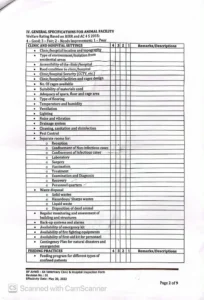
Figures 1 and 2 show the BAI Veterinary Clinic & Hospital Inspection Form. Under waste disposal, the checklist specifically includes “Disposition of dead animal.” This means clinics are expected to have a proper system for handling deceased animals. However, the form itself does not specifically state that every clinic must own a cadaver freezer. Disposition is not the same as storage. The key is that remains are handled, transferred, or disposed of properly and lawfully.
The important issue is therefore not simply whether a clinic owns a freezer, but whether it has a safe and lawful system for handling deceased patients.
Animal remains must never be allowed to decompose improperly or become a sanitary hazard.
But a veterinary clinic may have a policy that it does not provide prolonged cadaver storage.
This is where a clear client agreement becomes important.
The owner may agree that if the pet dies:
- The remains must be retrieved within 24 hours after notification.
- If the owner fails to retrieve them, the clinic may proceed with the agreed lawful transfer or disposition.
- Transportation, handling, cremation, burial, or other authorized expenses may be charged as provided in the agreement.
Of course, a contract cannot override the law.
Whatever the parties agree upon must still comply with BAI, DENR, DOH, sanitation, and applicable local regulations.


But there is an important difference between a clinic improperly storing a cadaver and a clinic that does not offer cadaver storage at all and instead follows a documented procedure for prompt lawful disposition.
Perhaps the better regulatory principle is very simple:
If you store a cadaver, store it properly.
If you do not provide storage, have a clear and lawful system for its prompt disposition.


The purpose of regulation should be to prevent decomposition, contamination, improper disposal, and public-health risks, not simply to require every veterinary clinic to own a freezer regardless of how it handles deceased patients.
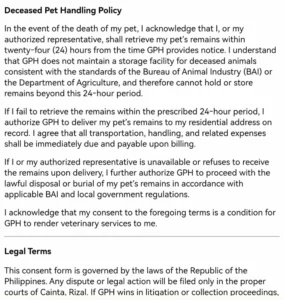
Figure 3. GPH’s New Deceased Pet Handling Policy. Under the new Greenwoods Pet Hospital policy, owners must retrieve their deceased pet within 24 hours from notification. If the remains are not claimed, GPH may arrange delivery to the owner’s registered address at the owner’s expense. If the owner is unavailable or refuses to receive the remains, GPH is authorized to proceed with lawful disposal or burial in accordance with applicable regulations.
Good regulation should protect public health while recognizing different but equally compliant ways of achieving that goal.

Dr. Geoff Carullo is a Fellow and the current President of the Philippine College of Canine Practitioners.
Sharing this helps others understand what it really means to be a vet. Like and follow if you’re with us.