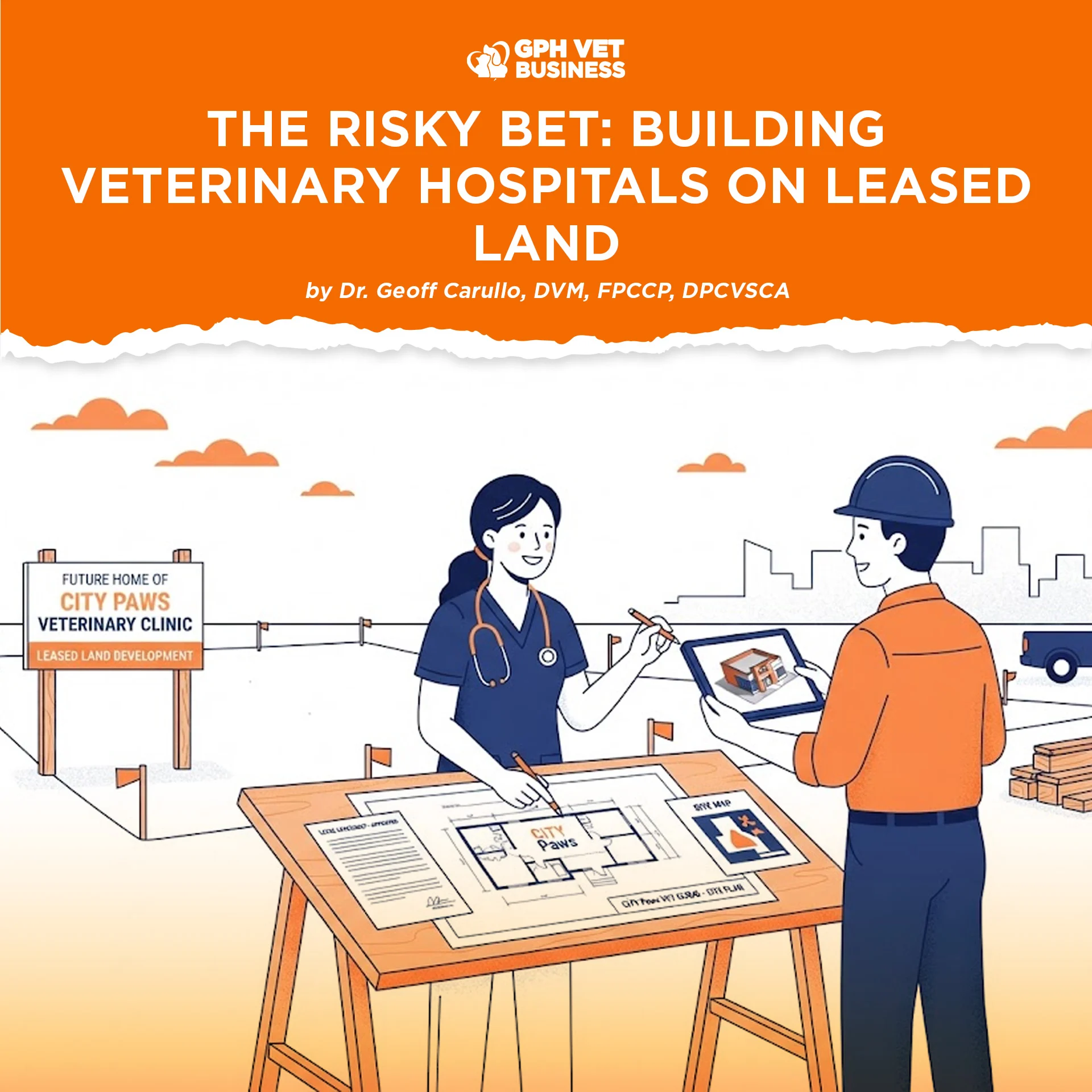
Across the country, some veterinary groups are making bold moves: they lease prime land, build massive hospitals, and use the profits to fund the next branch. It’s a cycle of growth powered by operations, not land ownership.
At first glance, it looks brilliant. Who wouldn’t want to grow fast, capture market share, and establish a brand presence in multiple cities?
But behind the glitter lies a gamble that every veterinarian must ask: Am I building a legacy—or just paying rent on borrowed ground?


Why Vets Take the Bet
- Speed Over Stability
Buying land is slow and expensive. Leasing allows hospitals to rise in high-traffic areas almost overnight. - Self-Fueling Expansion
Each branch funds the next. No giant investors. No crushing bank debt. Just reinvestment and momentum. - Prime Visibility
Leasing opens doors to the most strategic locations—beside subdivisions, malls, or main roads—that would be unaffordable if bought outright. - Easy to Replicate
Once the lease-build-operate cycle works, it can be cloned city after city. That’s how chains are born.
Where the Bet Turns Dangerous
- The Fragile Foundation
A modern hospital can stand tall—but the ground isn’t yours. A landlord’s decision or a lapsed lease can wipe away years of work. - Domino Growth Risks
When each branch finances the next, one underperforming hospital can shake the whole system. What happens when one domino falls? - Rent That Never Sleeps
Escalation clauses guarantee one thing: the rent will rise. Meanwhile, payroll, utilities, and equipment maintenance already eat margins alive. - No Equity, No Safety Net
Thirty years later, the hospital and the land may revert to the owner. You expanded, you hustled, you served thousands of pets—but what lasting asset do you really have?


Usufruct: The Safer Play?
Philippine law allows usufruct, a right to use another’s land and enjoy its benefits for a set term. Unlike a lease, it’s a real right tied to the land title—surviving even if the property is sold.
For veterinarians, usufruct means you can:
- Build and operate for 20–30 years with stronger protection.
- Secure clearer rules on what happens to your hospital afterward.
- Sleep a little better knowing the right is enforceable.
But here’s the catch: at the end, unless you negotiate otherwise, the hospital may still belong to the landowner. More secure than a lease, yes—but still temporary.
What the Risky Vet Must Ask
- Are my contracts long enough and airtight?
- Do I control what happens to my building at the end of the term?
- Am I expanding too fast, chasing growth over stability?
- Should I start owning land in parallel, to anchor my future?

Final Word: The Risky Bet
Leasing or usufruct isn’t wrong—it’s bold. It lets vets scale faster, dominate markets, and push the profession forward. But it is a bet against time, ownership, and control.
The lesson is simple: rapid expansion may build hospitals, but only careful strategy builds legacies. Every risky vet must pause and ask: Am I building an empire… or someone else’s?
Dr. Geoff Carullo is a Fellow and the current President of the Philippine College of Canine Practitioners.
Sharing this helps others understand what it really means to be a vet. Like and follow if you’re with us.