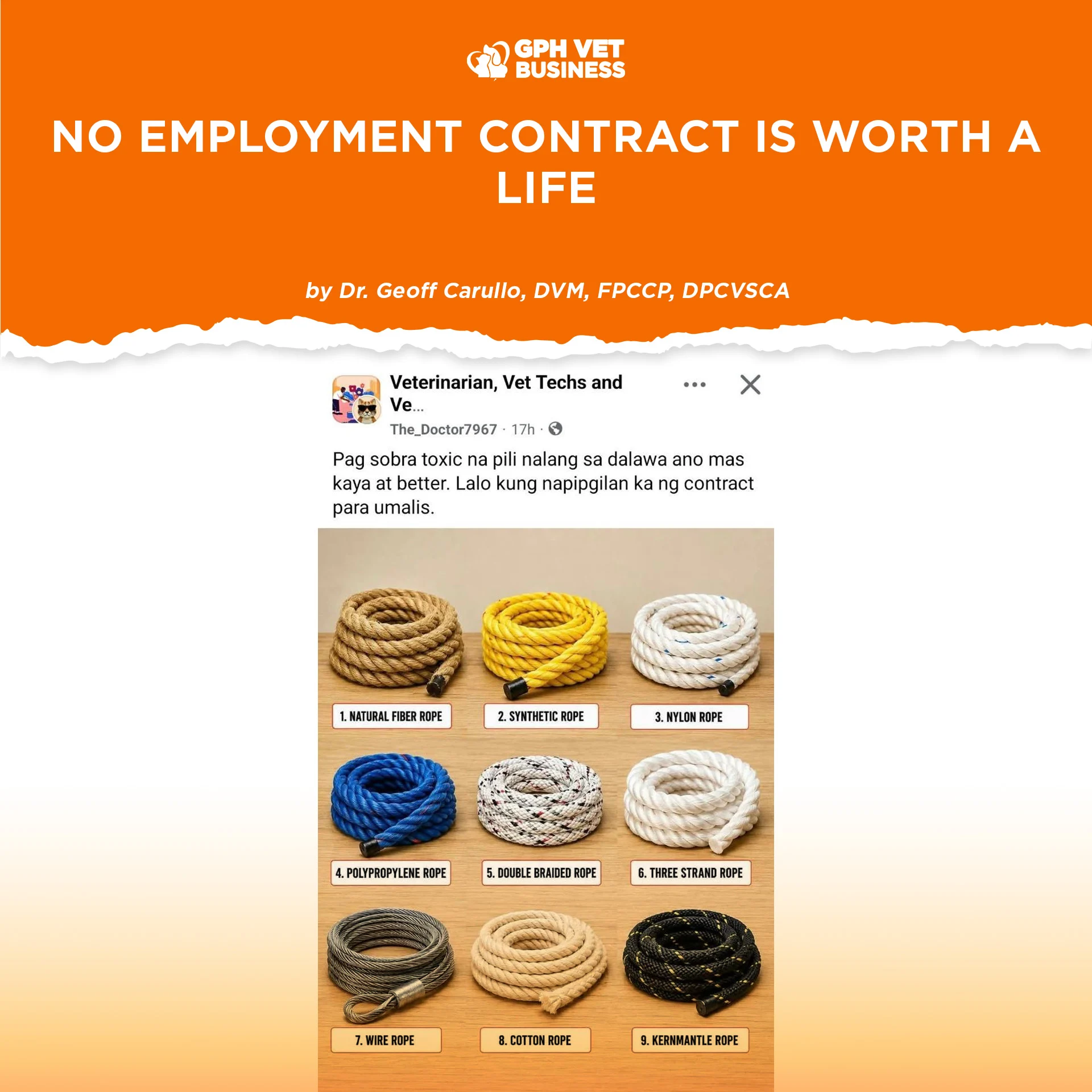
“If you leave, you will breach your contract.”
But what if the employee answers:
“Doc, hindi ko na talaga kaya. I’m already thinking of hurting myself.”
At that point, are we still talking about employee retention?
Or are we already talking about saving a person?
The veterinary profession is demanding. Long hours, difficult clients, emotionally heavy cases, toxic work relationships, fatigue, financial pressure, and burnout can accumulate quietly.
And sometimes an employee stays not because they still want the job, but because they believe they are trapped by the contract.
That is why I think employment contracts should have something we rarely talk about:
A humane exit clause.
An exit clause does not mean an employee can simply disappear whenever work becomes difficult.
It does not erase accountability.
It means the contract clearly explains how a person can leave when continuing the employment relationship has become seriously harmful or untenable.


WHAT THE LAW ALREADY PROVIDES
Under the Philippine Labor Code, an employee already has a statutory route to resign. Article 300 provides that an employee may ordinarily terminate employment by giving at least one month written notice. The law also recognizes circumstances where an employee may leave without that notice, including serious insult, inhuman and unbearable treatment, crimes or offenses committed against the employee, and analogous causes. Department of Labor and Employment
So an employment contract should not create the impression that:
“You signed for two years, therefore you have no way out for two years.”
That is not how employment should be understood.
Contracts can contain notice requirements, legitimate training obligations, turnover procedures, confidentiality provisions, or consequences permitted by law. But those provisions should be written clearly and reviewed carefully, especially when training bonds or fixed-term commitments are involved.
More importantly, there should be a process for extraordinary situations.
For example, an employment policy can provide mechanisms for shortened or waived notice when there is a serious medical or psychological emergency, subject to appropriate documentation, assessment, and applicable law.


WHEN AN EMPLOYEE IS IN CRISIS
Because when an employee is already showing signs of a severe mental-health crisis or possible self-harm, the answer cannot simply be:
“Tapusin mo muna contract mo.”
The Philippine Mental Health Act specifically requires employers to develop workplace mental-health policies, address stigma and discrimination, identify workers who need support, and facilitate access to treatment and psychosocial services. Lawphil
DOLE likewise requires private workplaces to establish mental-health programs that include confidentiality, accommodation, treatment, rehabilitation, and referral mechanisms. Department of Labor and Employment
And as recently as 2026, DOLE again emphasized strengthening workplace protocols for severe stress, anxiety, depression, and other psychosocial risks. Department of Labor and Employment
But there is an equally important warning:
A “mental-health exit clause” should protect employees, not become a weapon against them.
It should never mean:
“May depression ka? Sige, tanggal ka.”
Mental-health concerns should not become an easy excuse for employers to remove inconvenient employees or bypass due process.

A HUMANE EXIT POLICY
A humane exit policy should instead say:
If staying has become dangerous, there is a dignified way to ask for help, seek accommodation, take appropriate leave, request an earlier separation, or ultimately leave.
No humiliation.
No threats.
No feeling that the person must choose between breaching a contract and surviving another day at work.
As employers, of course we invest in people.
We train them.
We depend on them.
And when someone suddenly resigns, operations suffer.
I understand that completely.
But employment contracts are supposed to protect relationships. They should never feel like handcuffs.
If an employee reaches the point where the discussion involves possible suicide or self-harm, we are no longer dealing with an ordinary HR inconvenience.
We are dealing with a human being in crisis.
We can replace a staff member.
We can adjust a schedule.
We can renegotiate a notice period.
We can hire again.
A life cannot be replaced.
Maybe it is time for veterinary clinics, hospitals, and other workplaces to review their contracts and ask one uncomfortable question:
Does our employment contract explain how people can enter our organization, but make it almost impossible for them to leave?
Because sometimes the most humane provision in a contract is not the clause that keeps someone working.
It is the clause that gives them a safe way out.
This is a general discussion of workplace policy, not individual legal advice. Specific fixed-term contracts, training bonds, damages, and resignation disputes should be reviewed with Philippine labor counsel.
Dr. Geoff Carullo is a Fellow and the current President of the Philippine College of Canine Practitioners.
Sharing this helps others understand what it really means to be a vet. Like and follow if you’re with us.