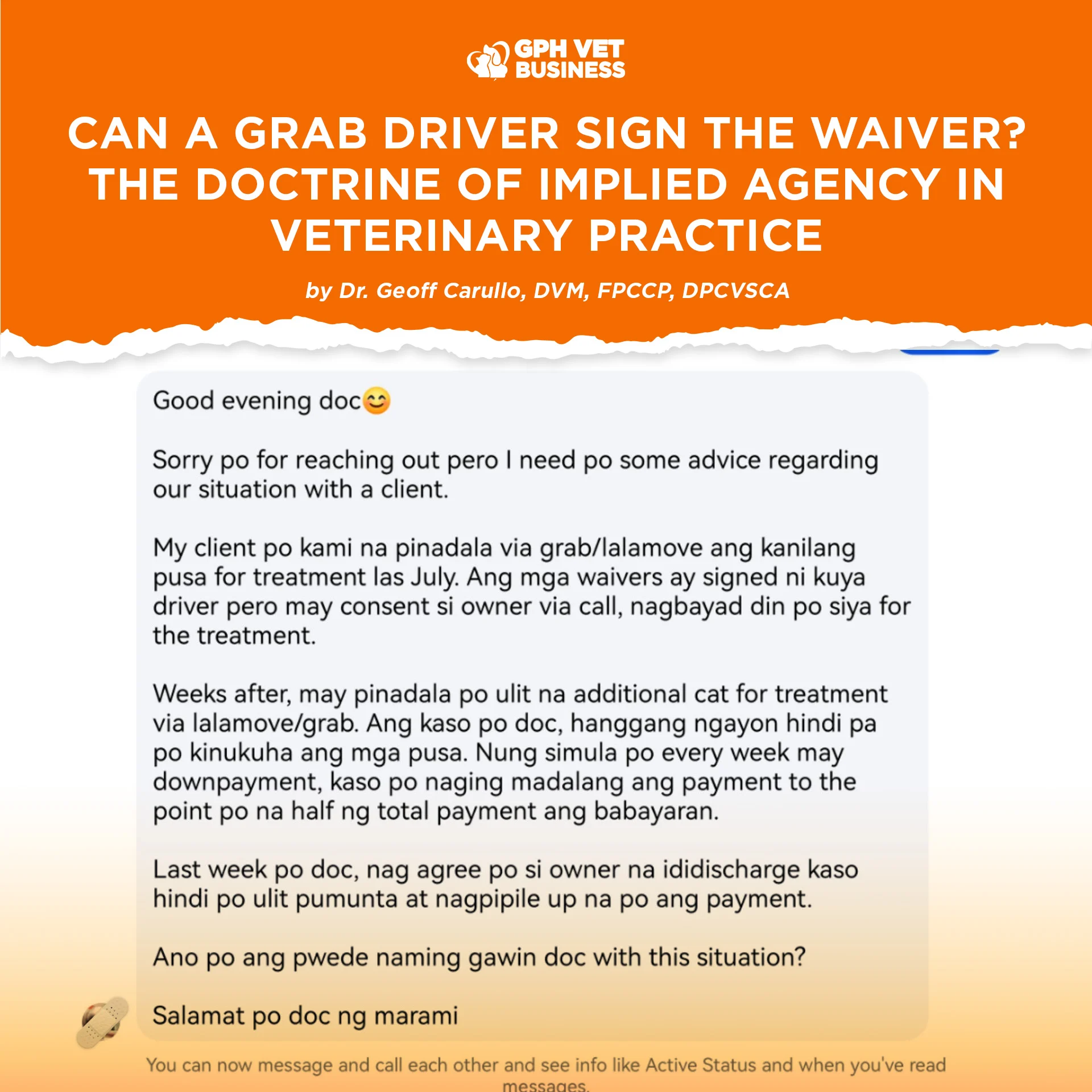
In veterinary practice, the pet owner is not always the person who physically brings the patient to the clinic.
Sometimes it is a spouse, relative, household staff member, driver, rescuer, or even a Grab or Lalamove rider.
Then when a billing or treatment dispute comes up, the owner may suddenly say:
“But I never signed the waiver.”
Does that automatically end the discussion?
Not necessarily.
Under the concept of implied agency, a person may be considered authorized to act for another not only through a written appointment, but also through the principal’s conduct, acceptance, silence, or failure to object.
In simple terms, the owner does not always have to formally declare:
“I appoint this person as my representative.”
Sometimes, the owner’s own actions already show that authority was given.


WHEN CONDUCT CAN SHOW AUTHORITY
Imagine this scenario:
The owner sends the pet to the clinic through another person.
The clinic contacts the owner directly.
The owner approves the treatment.
The owner pays the bill or makes partial payments.
Later, the owner sends another pet using the same arrangement and continues communicating with the clinic.
Then months later:
“But I wasn’t the one who signed.”
That statement does not automatically erase everything that happened before it.
The owner’s later actions may also amount to ratification, meaning that even if the representative’s authority was unclear at the beginning, the owner may later confirm or accept the arrangement through conduct.


AUTHORITY STILL HAS LIMITS
But this does not mean that any Grab driver, Lalamove rider, or companion automatically has unlimited authority to sign every waiver.
That is the important distinction.
A person merely transporting the animal should not automatically be presumed to have authority to approve major surgery, euthanasia, expensive diagnostics, prolonged confinement, or substantial financial obligations.
Authority still has limits.
So can a Grab driver sign the waiver?
Possibly, but the more important question is:
Did the owner actually authorize that person to act on his or her behalf, and can that authority be shown by the surrounding circumstances?

DOCUMENT THE ENTIRE PATTERN OF CONDUCT
This is why veterinary clinics should document everything carefully:
- who brought the patient,
- who was contacted,
- who approved treatment,
- what estimates were discussed,
- what payments were made, and
- what instructions were given.
Because when a dispute eventually happens, the strongest evidence may not be one signature on one piece of paper.
It may be the entire pattern of conduct.
The pet was sent.
Treatment was authorized.
Updates were received.
Payments were made.
The arrangement was repeated.
And no one objected until the bill became a problem.
Sometimes, consent is not found only at the bottom of a waiver.
Sometimes, it is written all over what the owner actually did.
For general discussion only. This is not legal advice for any specific case.
Dr. Geoff Carullo is a Fellow and the current President of the Philippine College of Canine Practitioners.
Sharing this helps others understand what it really means to be a vet. Like and follow if you’re with us.