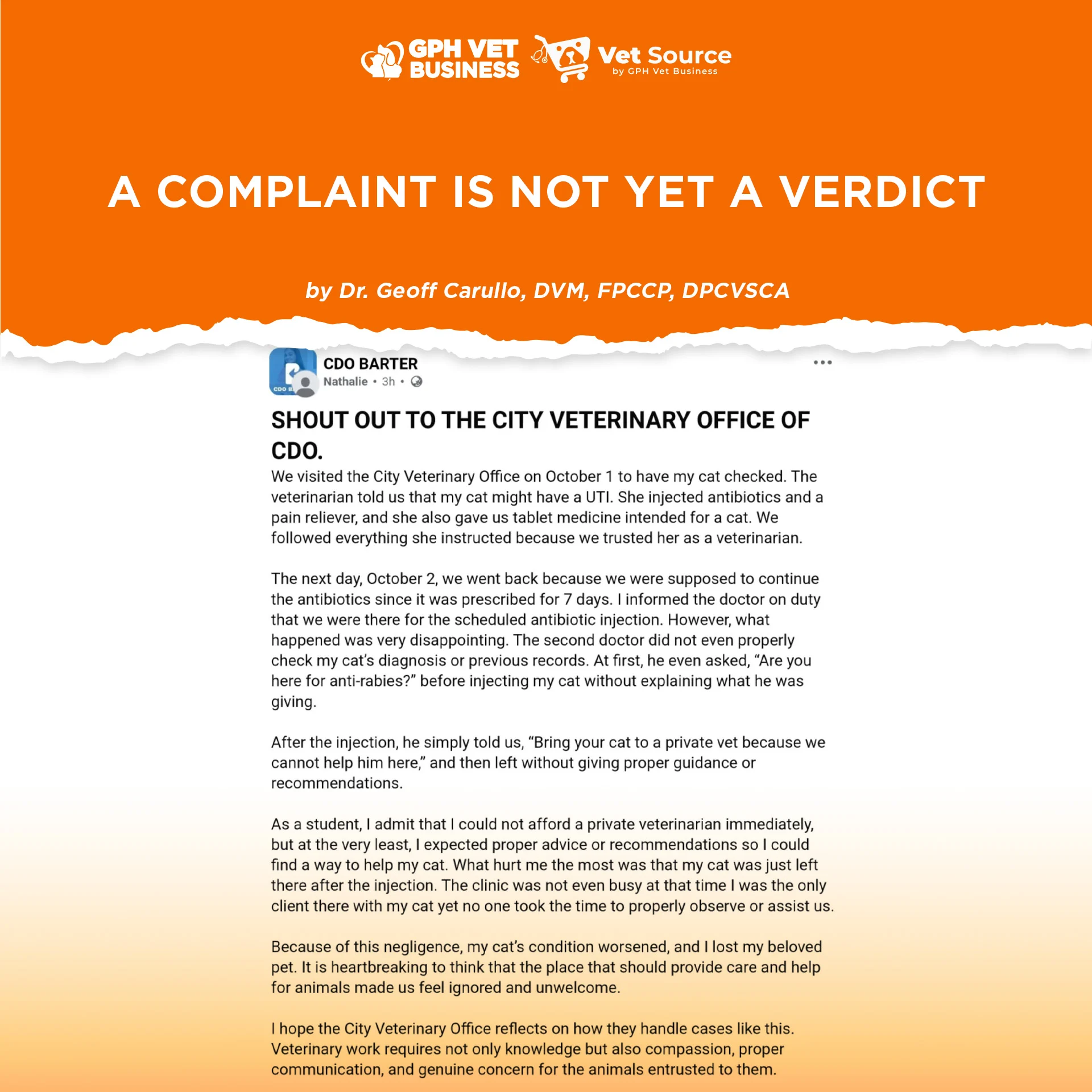
I read the post calling out the City Veterinary Office of CDO.
The owner lost a beloved cat. The frustration and grief are understandable. If communication was poor, if instructions were unclear, or if the owner felt dismissed, those concerns deserve to be addressed.
But there is one part of this story that bothers me.
We are already using the word “negligence” when we have only heard one side.
That is a very serious accusation to make against any professional.
A Facebook post can describe what a client experienced. It can tell us what the client remembers, what was said from their perspective, and how they felt during the encounter.
But it is not yet the complete record of what happened.
WHERE IS THE OTHER SIDE?
Where is the veterinarian’s account?
Where are the treatment records?
What exactly was explained?
What was documented?
Why was referral advised?
What happened between leaving the City Veterinary Office and the eventual death of the patient?
Those questions matter before publicly concluding that somebody was negligent.


REFERRAL IS NOT AUTOMATICALLY ABANDONMENT
“Bring your cat to a private vet” is not automatically abandonment.
This statement seems to be one of the biggest reasons the owner felt dismissed.
But veterinarians must also recognize the limitations of the facility where they work.
There are cases a government veterinary office may not be equipped, staffed, or structured to continue managing. Telling a client to seek care somewhere else can sound unpleasant, particularly when the owner is financially struggling.
But the mere act of referring a patient elsewhere should not automatically be interpreted as:
“Ayaw ka naming tulungan.”
Sometimes it simply means:
“Hanggang dito lang ang kaya naming gawin dito.”
And there is nothing inherently wrong with admitting that limitation.
In fact, pretending that a facility can provide something it cannot would be far more troubling.
THE BIGGER ISSUE MAY BE COMMUNICATION
The bigger issue may actually be communication.
If the account is accurate, this is where the City Veterinary Office should reflect.
A referral should not simply be:
“Dalhin mo sa private.”
Explain why.
Tell the owner what needs to happen next.
Explain whether the case is urgent.
Tell them what signs to watch for.
Document the recommendation.
Even when resources are limited, communication is still part of service.
That is a fair criticism.
But there is a huge difference between saying:
“The communication could have been handled better.”
and saying:
“Because of their negligence, my pet died.”
The second statement assigns responsibility for a death.
That requires much more than disappointment with how someone was spoken to.


LIMITED RESOURCES DO NOT AUTOMATICALLY MEAN PERSONAL NEGLIGENCE
Being unable to afford private veterinary care is a real problem. But it does not automatically transfer unlimited responsibility to the government veterinarian.
This is an uncomfortable part of the discussion.
The owner openly said that, as a student, private veterinary care was difficult to afford.
That deserves empathy.
But veterinarians cannot create services, equipment, personnel, hospitalization capacity, diagnostics, or funding simply because a client has nowhere else to go.
Government veterinarians are often expected to become the final safety net for every animal whose owner cannot afford private treatment.
And when they cannot provide everything being requested, the veterinarian can suddenly become the villain.
That is not a sustainable expectation.
Accessibility is a public-service issue.
Resources are a government-management issue.
But a veterinarian working inside a limited system should not automatically carry personal blame for every limitation of that system.
ACCOUNTABILITY SHOULD WORK BOTH WAYS
Accountability should work both ways.
If there was inappropriate treatment, investigate it.
If a medication was administered incorrectly, determine what happened.
If there was poor documentation, address it.
If communication was disrespectful, improve it.
But the veterinarian should also be allowed to present the records and explain the circumstances before social media decides the conclusion.

SOCIAL MEDIA SHOULD NOT BECOME THE COURTROOM
This is especially important today because once words like “negligence,” “namatay dahil sa kanila,” or “pinabayaan” are posted publicly, the reputational damage can happen long before anyone sees the other side.
And even if the accusation eventually turns out to be incomplete or incorrect, screenshots remain.
We can demand better service without immediately condemning the people providing it.
The owner deserves answers.
The City Veterinary Office should review the incident.
The veterinarians involved should explain what happened.
And if mistakes were made, they should be acknowledged and corrected.
But that process should begin with facts, records, and both sides of the story.
Not with a Facebook verdict.
A COMPLAINT IS NOT YET A VERDICT
Because there is an important principle we should remember, whether the complaint involves a private clinic or a government veterinary office:
A bad experience deserves to be heard.
A complaint deserves to be investigated.
But an accusation is still not proof.
And grief, however genuine, should not remove the veterinarian’s right to be heard.
Dr. Geoff Carullo is a Fellow and the current President of the Philippine College of Canine Practitioners.
Sharing this helps others understand what it really means to be a vet. Like and follow if you’re with us.