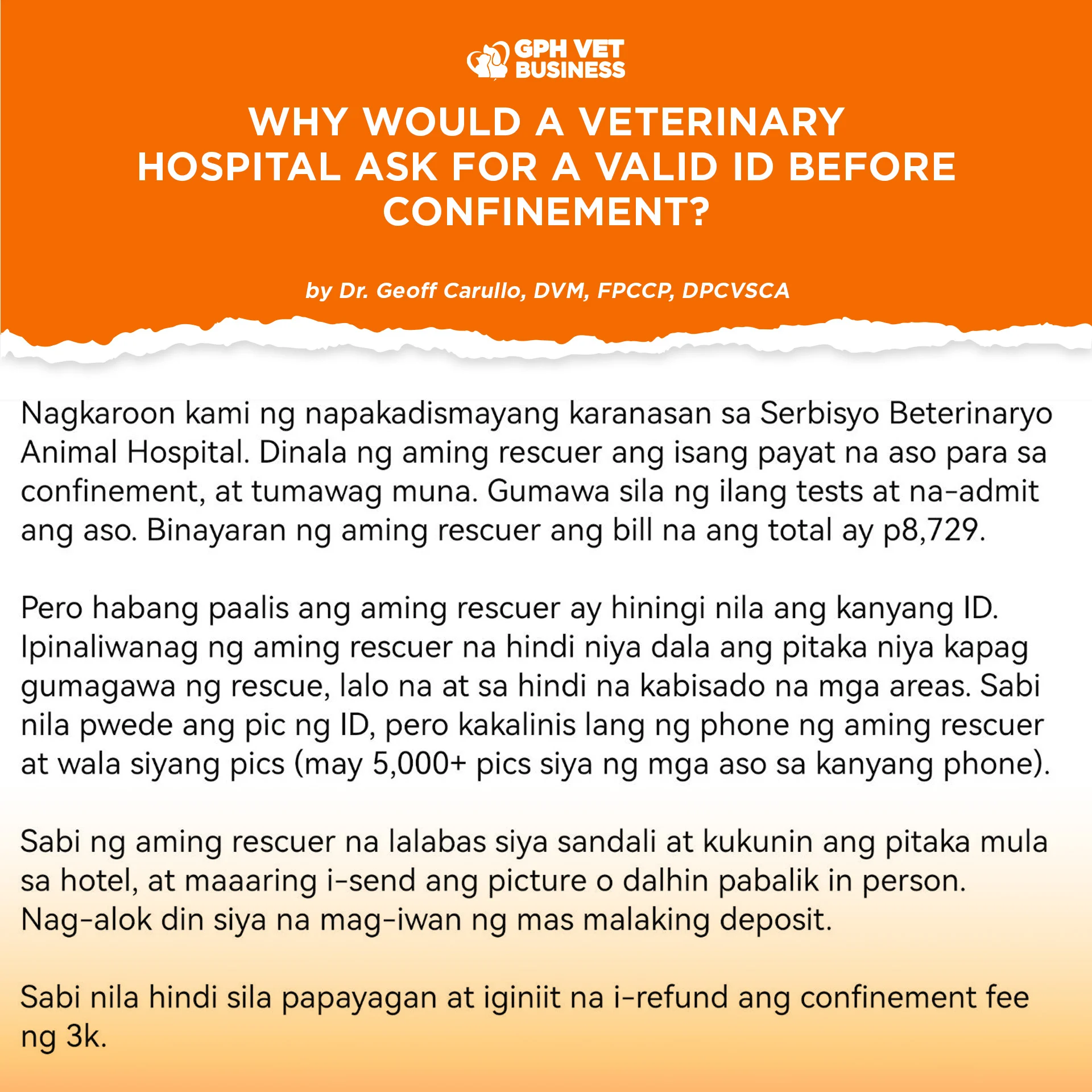
When a veterinary hospital asks for a valid ID before admitting an animal for confinement, some people may see it as unnecessary bureaucracy.
But confinement is not the same as a quick consultation.
Once an animal is left inside a hospital, the veterinary team assumes custody of a living patient. Treatment decisions may have to be made. Procedures may need authorization. Bills may accumulate. The patient’s condition may deteriorate. The animal may need to be transferred, discharged, or, unfortunately, may die while confined.
So the hospital needs to know one very basic thing:
Who exactly is the person entrusting this animal to us and assuming responsibility for the decisions being made?


Is a valid ID required by law?
This distinction is important.
There does not appear to be a Philippine national regulation specifically stating that every client must present a government-issued ID before a dog or cat may be confined in a private veterinary hospital.
The Bureau of Animal Industry’s Administrative Order No. 54, Series of 2000, which sets standards for veterinary clinics and hospitals for small companion animals, requires veterinary facilities to maintain clinical records and establishes requirements for hospitals and confinement facilities. But it does not expressly make a client’s government-issued ID a universal prerequisite for admission.
So it would be inaccurate to say:
“The law requires every veterinary hospital to get your ID.”
Generally, it does not.
But there is a significant difference between something being required by national law and something being a reasonable hospital admission policy.


A hospital may have its own admission requirements
Veterinary confinement creates a professional and contractual relationship between the hospital and the person presenting the animal.
Under the Civil Code, parties may establish reasonable terms and conditions provided these are not contrary to law, morals, good customs, public order, or public policy.
This is why veterinary hospitals may establish their own requirements regarding deposits, consent forms, emergency authorization, contact information, identification, discharge procedures, and financial responsibility.
A valid-ID requirement can therefore be a legitimate internal policy.
And there are very practical reasons for it.
Who is responsible for the patient?
Imagine admitting a dog for several days.
The person leaves only a name and cellphone number.
Later, the number cannot be reached.
Who authorized the treatment?
Who agreed to the estimated expenses?
Who can authorize surgery if the patient’s condition suddenly deteriorates?
Who is permitted to claim the patient upon discharge?
Who should receive the medical records?
And what happens if another person arrives claiming that the animal belongs to them?
Identification gives the hospital a verifiable connection between the person signing the admission documents and the person actually presenting the animal.
This may become even more important when the person presenting the patient is a rescuer rather than the acknowledged owner.
Being a rescuer does not make someone less deserving of veterinary service.
But from the hospital’s perspective, documentation may become even more important because the hospital must establish who is authorizing treatment, who will receive updates, and who is accepting responsibility for the patient while confined.
It can also protect against abandonment
Veterinary hospitals sometimes encounter another difficult reality:
Animals are occasionally left behind.
A patient may be admitted, expenses accumulate, and the person who brought the animal becomes unreachable.
The hospital may then be left caring for an animal whose ownership, financial responsibility, and eventual disposition become complicated.
An ID does not completely prevent abandonment.
But it creates a stronger level of accountability.

It protects the client too
Identification is not merely for the protection of the veterinary hospital.
It may also protect the person presenting the animal.
It helps reduce the risk of another person impersonating the client, improperly obtaining medical information, authorizing procedures without authority, or attempting to claim the animal upon discharge.
When hospitalization involves significant medical and financial decisions, knowing exactly who gave consent can protect both the hospital and the client.
But there is also a data-privacy responsibility
A veterinary hospital cannot simply collect unlimited personal information without a legitimate purpose.
Under the Data Privacy Act, the processing of personal information should follow the principles of transparency, legitimate purpose, and proportionality.
The information collected should be relevant and reasonably necessary for the purpose for which it is being obtained.
That means there can also be an important distinction between:
Verifying a person’s ID
and
Keeping a photograph or photocopy of that ID in the hospital’s records.
Retaining a copy involves additional personal information and therefore requires appropriate justification, safeguards, access controls, and retention practices.
Hospitals asking for identification should therefore also be prepared to explain why the information is needed and how it will be protected.
Where hospitals should also be careful
If identification is an admission requirement, good practice is simple:
- Tell the client before confinement whenever reasonably possible.
- Put it in the admission policy.
- Explain it at reception.
- Mention it when admission requirements are discussed over the phone.
- Request it before completing the admission process rather than introducing the requirement only after payment and paperwork have already been completed.
Clear policies prevent unnecessary conflict.
A policy is easier to understand when it is disclosed, consistent, reasonable, and applied equally.
In genuine emergencies, clinical urgency should also be considered. Administrative requirements should be managed in a way that does not unnecessarily delay appropriate assessment and stabilization of a critically ill patient.
So is asking for an ID unreasonable?
By itself, no.
A veterinary hospital asking for identification before taking custody of an animal for hospitalization can have legitimate reasons involving consent, accountability, patient security, record accuracy, and financial responsibility.
But it should be described correctly:
It is generally a hospital admission policy, not a universal legal requirement imposed on every veterinary hospital in the Philippines.
And like every good hospital policy, it should be reasonable, consistently applied, properly disclosed, and compliant with data-privacy requirements.
Because when you leave an animal inside a veterinary hospital, you are not merely leaving a dog or cat in a cage.
You are entrusting a living patient to a medical institution.
Knowing who entrusted that patient to the hospital is not an unreasonable question.
Sometimes, it is simply responsible documentation.
Sources
Bureau of Animal Industry, Administrative Order No. 54, Series of 2000, Code of Standards for Veterinary Clinics and Hospitals for Small Companion Animals.
Republic Act No. 10173, Data Privacy Act of 2012.
Republic Act No. 386, Civil Code of the Philippines, particularly Article 1306.
Republic Act No. 9268, Philippine Veterinary Medicine Act of 2004.
Dr. Geoff Carullo is a Fellow and the current President of the Philippine College of Canine Practitioners.
Sharing this helps others understand what it really means to be a vet. Like and follow if you’re with us.