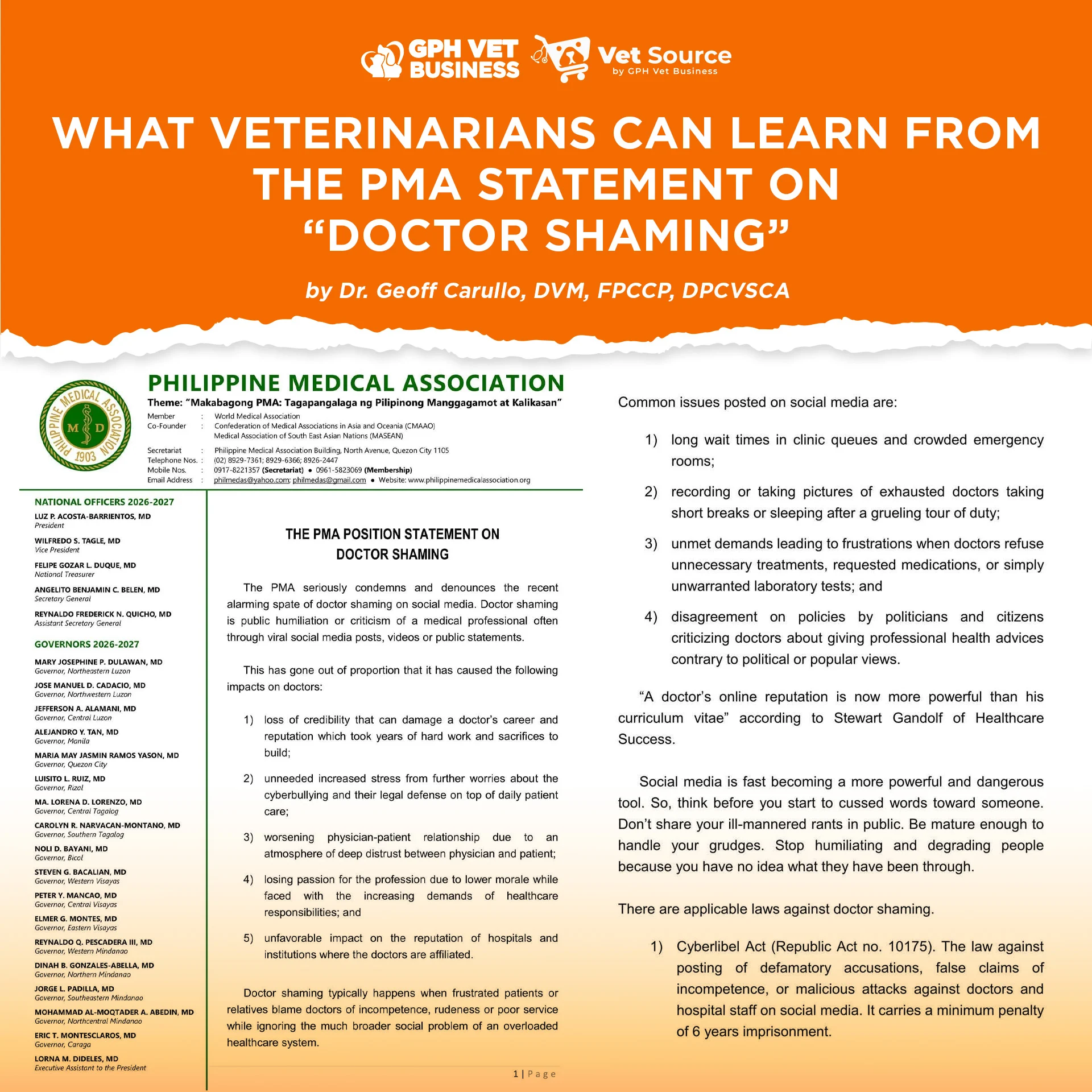
The Philippine Medical Association recently released a position statement condemning what it calls “doctor shaming” on social media.
Reading the four-page statement, one thing immediately stands out:
Almost everything they described in human medicine is already happening in veterinary medicine.
And perhaps there is something we veterinarians can learn from the way the medical profession is beginning to address it.


WHAT IS “DOCTOR SHAMING”?
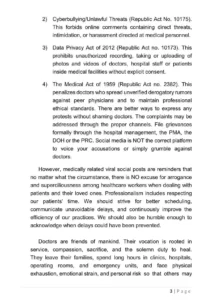
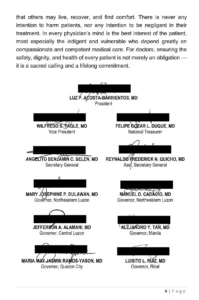
The PMA defines doctor shaming as the public humiliation or criticism of a medical professional, often through viral social media posts, videos, or public statements.
Their concern is not simply that doctors are being criticized. Criticism is part of professional accountability.
Their concern is what happens when an accusation becomes a public conviction before the complete facts are known.
The PMA identified five consequences.
According to the statement, doctor shaming can damage a doctor’s credibility and a reputation that took years to build.
It can create additional stress because the physician must worry about cyberbullying and possible legal defense while still attending to patients.
It can worsen the doctor-patient relationship by creating an atmosphere of distrust.
It can lower morale to the point that doctors begin losing their passion for the profession.
And finally, the damage can extend beyond the individual physician to the hospital or institution where that doctor works.
Now replace doctor with veterinarian.
Replace hospital with veterinary clinic.
Replace patient with pet.
Suddenly the document becomes very familiar.
THE SAME PROBLEM EXISTS IN VETERINARY MEDICINE
Interestingly, the PMA also listed the situations that commonly trigger online attacks.
One is long waiting times and crowded facilities.
Veterinarians know this very well.
A client may see herself waiting for two hours.
What she may not see is the veterinarian simultaneously handling an emergency, a hospitalized patient crashing inside, laboratory results requiring interpretation, and three consultations waiting outside.
Another example mentioned by the PMA is people photographing or recording exhausted doctors who are resting after long duties.
Again, familiar.
Social media sees five minutes.
It rarely sees the twelve hours that came before those five minutes.


WHEN PROFESSIONAL RESPONSIBILITY MEANS SAYING NO
The statement also discusses patients becoming angry when doctors refuse requested medications, unnecessary treatments, or unwarranted diagnostic tests.
Veterinarians experience the same conflict.
Sometimes professional responsibility means saying no.
- No, antibiotics are not automatically needed.
- No, we cannot prescribe something without examining the patient.
- No, a particular procedure may not be medically indicated.
- No, we cannot guarantee that a sick animal will survive.
But online, a professional refusal can easily be retold as:
“Ayaw kami tulungan ng vet.”
THE CLINICAL WORLD VS. THE SOCIAL-MEDIA WORLD
Perhaps the biggest lesson is that professional disputes now happen in two different worlds.
There is the clinical world, where decisions are based on history, physical examination, laboratory findings, imaging, treatment response, prognosis, medical records and informed consent.
Then there is the social-media world, where an entire medical case can sometimes be summarized in one photograph, one video and one emotional caption.
The problem is that the second world moves much faster than the first.
Before the veterinarian has even reviewed the records, thousands of people may already have commented:
“Kasuhan yan.”
“Tanggalan ng lisensya.”
“Name the clinic.”
And most of those people have never seen the patient.
DEFENDING VETERINARIANS DOES NOT MEAN DEFENDING EVERY VETERINARIAN
But there is another important part of the PMA statement that veterinarians should not ignore.
The PMA did not merely defend doctors.
It also reminded doctors to examine themselves.
The statement says there is no excuse for arrogance and poor treatment of patients.
It encourages better scheduling, better communication regarding delays, improved efficiency and enough humility to acknowledge situations that could have been handled better.
That is probably the most important lesson for veterinary medicine.
Defending veterinarians does not mean defending every veterinarian in every situation.
We can oppose public shaming while still demanding professional accountability.
We can protect colleagues from trial by social media while still recognizing genuine negligence.
We can ask clients to use proper complaint mechanisms while simultaneously improving the way we communicate with them.
Those principles are not contradictory.
They actually strengthen each other.

COMPLAINTS SHOULD BE HANDLED THROUGH PROPER CHANNELS
The PMA also reminds the public that there are proper channels for complaints.
Its statement points to hospital management, professional organizations, government agencies and regulatory bodies rather than immediately turning every disagreement into a social-media spectacle.
For veterinary medicine, the same principle is worth discussing.
If there is a legitimate allegation of malpractice or unethical conduct, let the records be examined.
Let qualified people evaluate the case.
Let both sides explain.
Let evidence determine what happened.
Because Facebook comments cannot perform a necropsy.
Shares cannot interpret an X-ray.
Reactions cannot review an anesthesia record.
And a viral post cannot substitute for a proper professional investigation.
VETERINARY MEDICINE MAY NEED TO HAVE THIS CONVERSATION
There is also a warning here for veterinary organizations.
The PMA did something significant simply by issuing this statement.
It told physicians:
We recognize that this is happening.
That alone matters.
Veterinary medicine may eventually need its own clearer institutional discussion about online shaming, recording inside clinics, public accusations, professional confidentiality, complaint mechanisms, and the responsibilities of both veterinary professionals and clients.
Not because veterinarians should be protected from criticism.
We shouldn’t be.
But criticism and accountability are very different from public humiliation without due process.
THE STRONGEST LESSON
Perhaps that is the strongest lesson we can take from the PMA statement.
Protect the profession, but never abandon accountability.
Protect the public, but never assume that virality equals truth.
And before deciding that someone is guilty based on a thirty-second video or a Facebook post, remember that a medical case usually contains far more information than social media will ever show.
Maybe it is time for veterinary medicine to have the same conversation.
Dr. Geoff Carullo is a Fellow and the current President of the Philippine College of Canine Practitioners.
Sharing this helps others understand what it really means to be a vet. Like and follow if you’re with us.