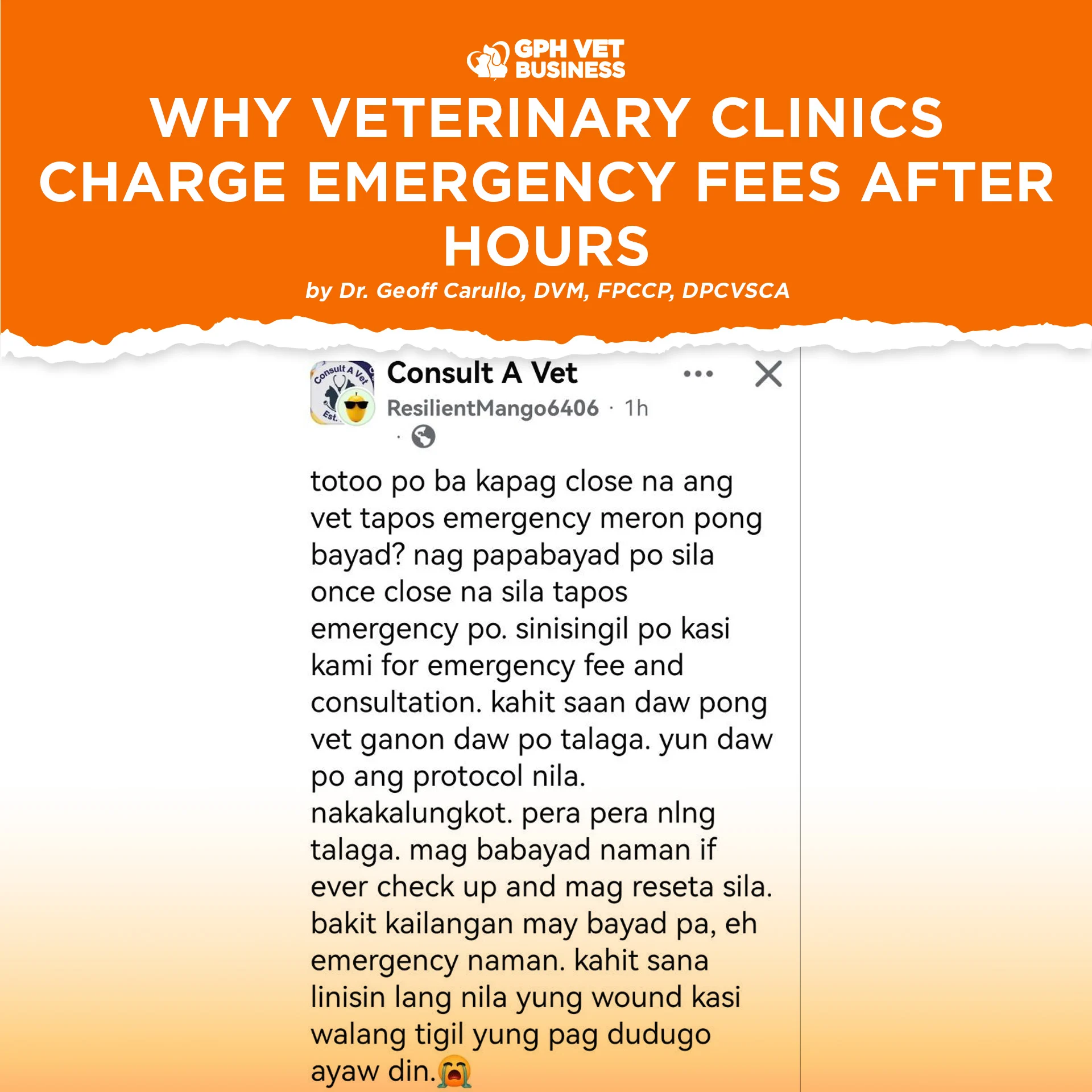
A pet owner recently asked why a veterinary clinic charged both a consultation fee and an emergency fee when the clinic was already closed.
The concern is understandable. When your pet is bleeding, in pain, or seriously ill, the last thing you want to think about is another fee.
But there is an important distinction that pet owners should understand:
An emergency fee is not an additional charge simply because your pet is sick. It is a charge for accessing veterinary services outside the clinic’s regular operating hours.
The Consultation Fee and Emergency Fee Pay for Different Things
A consultation fee generally covers the veterinarian’s professional assessment.
The veterinarian examines the patient, evaluates the problem, determines how serious the situation is, considers possible diagnoses, recommends treatment, and discusses the medical plan with the owner.
The emergency fee, on the other hand, compensates for providing that service outside normal clinic hours.
If a clinic normally closes at 8:00 PM and an emergency patient arrives at 11:00 PM, someone has to respond.
The veterinarian may have to return to the clinic. Veterinary nurses or assistants may need to stay beyond their scheduled hours or be called back. Equipment must be prepared. Lights, oxygen, laboratory machines, monitoring equipment, medications, and other resources may need to be activated.
That availability has a cost.


“But It’s an Emergency. Why Should I Pay More?”
Precisely because it is an emergency.
Emergency veterinary medicine requires a clinic to provide personnel and resources at a time when those resources would normally no longer be operating.
Think of it this way.
You are not merely paying for the few minutes that someone cleans a wound.
You are paying for the fact that a veterinary professional is available when the clinic would otherwise be closed.
There is a significant difference between treating a patient during regular clinic hours, when the entire team is already working, and asking people to extend their shifts or return to work late at night.
“Lilinisin Lang Naman Yung Sugat”
What appears to be “just cleaning a wound” to an owner may not be medically simple.
A continuously bleeding wound may require assessment of the source and severity of bleeding. The veterinarian may need to determine whether a blood vessel has been damaged, whether there is a deeper injury, whether suturing is necessary, whether sedation or anesthesia is appropriate, and whether the animal is developing shock.
Sometimes wound cleaning really is all that is needed.
But someone still has to make that medical determination.
That is part of the consultation.
The veterinarian is not paid only for physically touching the wound. You are also paying for the professional judgment that determines what needs to be done and, equally important, what does not need to be done.


Emergency Veterinary Care Is Not Automatically Free Care
There seems to be a misconception that because something is an emergency, healthcare professionals should somehow become obligated to provide their services without additional compensation.
Urgency does not eliminate the cost of providing care.
In many cases, urgency actually increases it.
Veterinary clinics have employees to compensate, equipment to maintain, medicines and supplies to stock, utilities to pay, and veterinarians whose time outside their scheduled working hours also has value.
A veterinarian responding at midnight is still a veterinarian at midnight.
Does Every Veterinary Clinic Charge the Same Emergency Fee?
No.
Veterinary clinics are independently operated practices. Their operating hours, staffing models, emergency policies, professional fees, and capabilities differ.
Some hospitals operate 24 hours and structure their fees accordingly. Others operate only during specific hours but may accommodate emergencies after closing. Some may have veterinarians permanently assigned to night duty, while others may need to call a veterinarian back to the hospital.
This is why it is inaccurate to say that every veterinary clinic follows exactly the same emergency-fee policy.
What matters is that the clinic clearly communicates its charges whenever circumstances permit.
It Is Also Okay to Ask Before Proceeding
Pet owners have every right to ask:
- “How much is the emergency fee?”
- “How much is the consultation?”
- “What treatment does my pet need?”
- “How much will the proposed procedure cost?”
A responsible veterinary clinic should be willing to explain its fees and proposed treatment.
And when the patient’s condition allows time for discussion, owners should be given an opportunity to understand the estimated cost before proceeding.
Transparency is important.
But charging for emergency veterinary services, by itself, does not mean a clinic is “pera-pera.”

Behind Every Emergency Fee Is Someone Who Stayed
When most people have already gone home, someone is still answering the telephone.
Someone is opening the clinic again.
Someone is examining the patient.
Someone is controlling the bleeding.
Someone is preparing medications.
Someone is monitoring the animal.
And sometimes that veterinarian or veterinary nurse is doing all of this at midnight, on a weekend, during a holiday, or after already completing a full day’s work.
That is what an emergency fee helps compensate.
We can certainly discuss whether a particular fee is reasonable. We can advocate for transparency. We can ask for an estimate.
But we should not assume that professionals who charge for providing services outside normal working hours care only about money.
An emergency does not make veterinary care free. It makes veterinary care urgent. And keeping veterinary professionals available when everyone else has gone home is itself a service worth recognizing.
Sharing this helps others understand what it really means to be a vet. Like and follow if you’re with us.
Dr. Geoff Carullo is a Fellow and the current President of the Philippine College of Canine Practitioners.