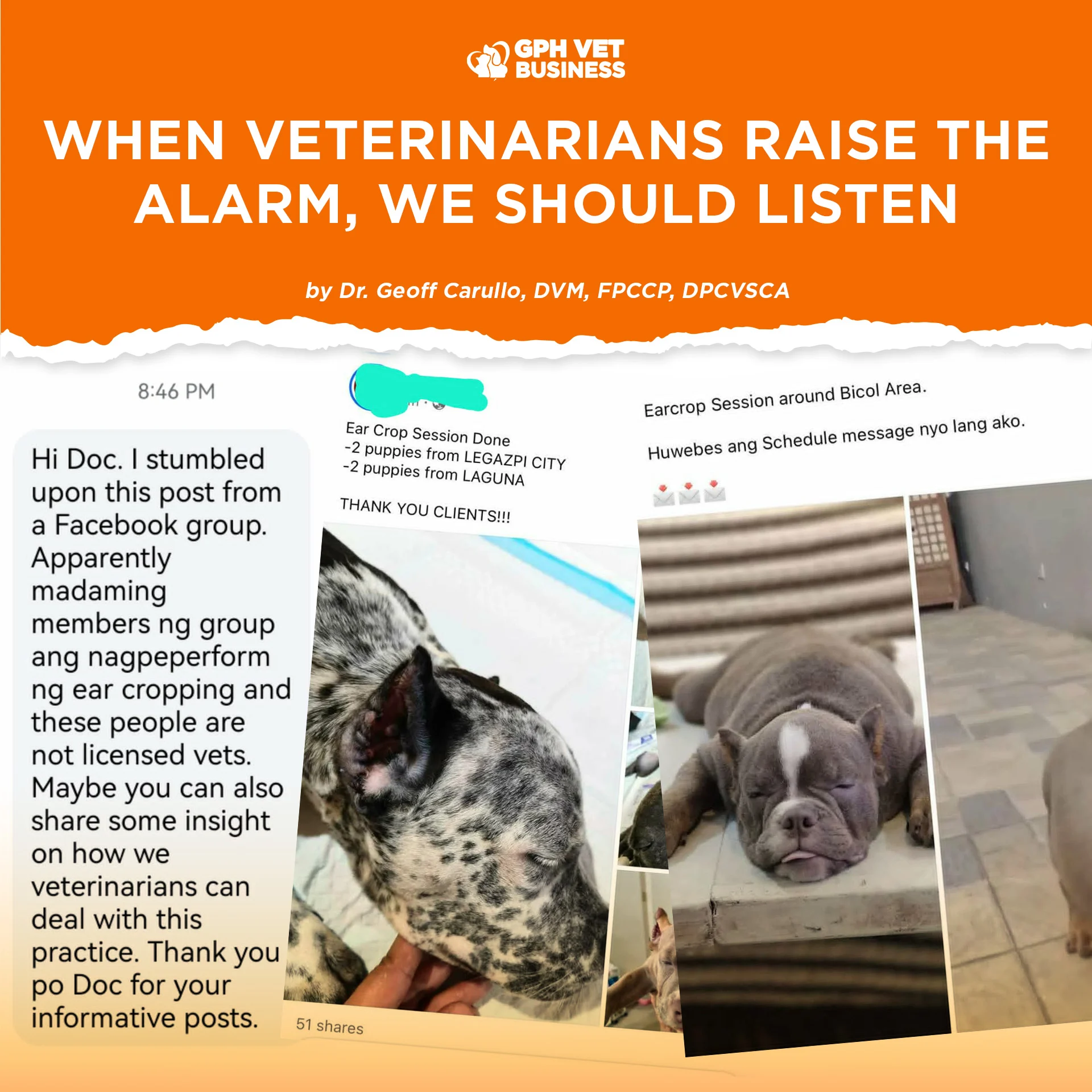
Recently, a fellow veterinarian privately sent me screenshots of social media posts advertising ear cropping services allegedly being performed by individuals who are not veterinarians. She asked if I could share my thoughts on how our profession should respond to this growing concern.
Her message was simple:
“How can we, as veterinarians, deal with this practice?”
It is a question worth discussing.
This is not about criticizing a particular individual or creating an online spectacle. It is about addressing a practice that has implications for animal welfare, public safety, and the integrity of veterinary medicine.


Ear cropping is not a grooming procedure. It is surgery.

It involves anesthesia or sedation, surgical removal of tissue, control of bleeding, suturing, pain management, and post-operative care. Every one of these steps requires medical knowledge and clinical judgment.
That is why veterinary medicine is a regulated profession.
People sometimes ask,
“If the ears look good, what’s the problem?”
The answer is simple. Good results in some cases do not eliminate the risks in all cases. The true measure of competence is not only performing the procedure when everything goes well, but also recognizing complications and managing them appropriately when they occur.
Veterinarians spend years studying anatomy, physiology, pharmacology, anesthesia, surgery, pathology, pain management, and emergency medicine. We are licensed, regulated, and professionally accountable because surgery carries real risks.


Respond with Education, Not Public Shaming
This discussion should never become a personal attack against any individual.
If there are concerns that someone is illegally practicing veterinary medicine, those concerns should be addressed through the proper authorities and supported by evidence, not by trial on social media.
At the same time, we should not remain silent.
Our responsibility is to educate the public that surgical procedures should be entrusted to licensed veterinarians. Pet owners deserve to know who is treating their animals and to make informed decisions based on safety, competence, and accountability.
A Shared Responsibility
I appreciate the colleague who reached out to me. Her message reflects a concern shared by many veterinarians across the country. Rather than responding with anger, we should respond with education, professionalism, and a continued commitment to protecting animal welfare.

At the end of the day, this conversation is not about protecting veterinarians. It is about protecting the animals entrusted to our care.
Every pet deserves surgery performed by someone with the education, training, legal authority, and ethical responsibility to do it safely.
Dr. Geoff Carullo is a Fellow and the current President of the Philippine College of Canine Practitioners.
Sharing this helps others understand what it really means to be a vet. Like and follow if you’re with us.