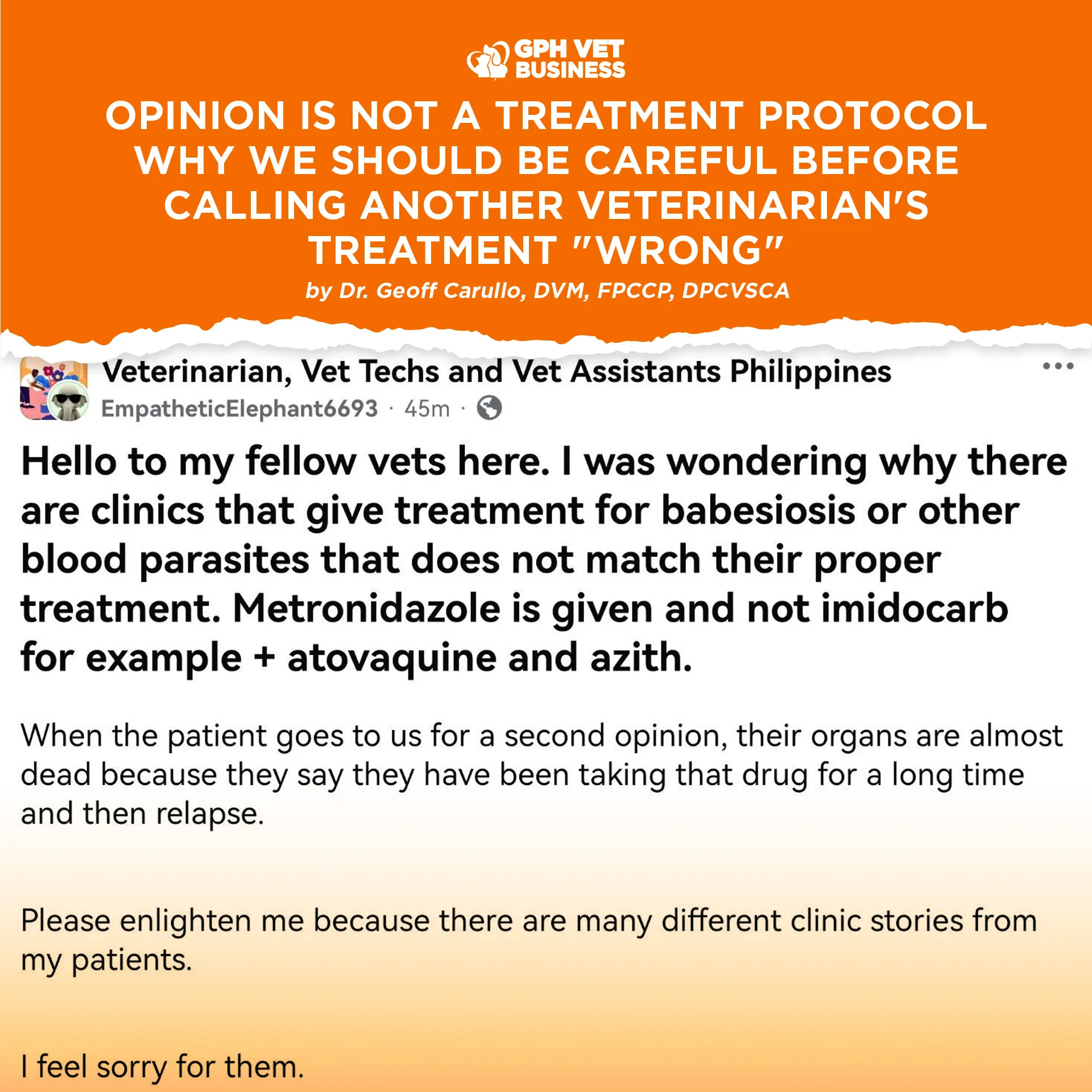
A recent anonymous post circulating in a veterinary Facebook group questioned why some clinics treat canine babesiosis with medications such as metronidazole instead of imidocarb dipropionate or atovaquone plus azithromycin. The post further suggested that these patients later seek second opinions with severe organ damage because they supposedly received the “wrong” treatment.
It is a question worth discussing.
However, the assumptions behind it deserve a closer look.
1. The First Question Should Be: Which Babesia Species?
Before criticizing a treatment protocol, veterinarians should first ask an important diagnostic question:
Was the organism identified as Babesia vogeli (formerly classified under Babesia canis) or Babesia gibsoni?
This distinction matters because treatment recommendations differ significantly.
For Babesia vogeli, the large Babesia species most commonly identified in the Philippines, imidocarb dipropionate remains the traditional first-line treatment, together with appropriate supportive care.
For Babesia gibsoni, however, treatment is more challenging. Combination therapy, most commonly atovaquone with azithromycin, is generally recommended because imidocarb alone has limited efficacy against this species.
Without identifying which Babesia species is involved, declaring that another veterinarian used the “wrong” medication is scientifically unsound.


2. There Is No Single Babesiosis Protocol
Babesiosis is not managed using a one-size-fits-all approach.
Treatment depends on several factors, including:
- The Babesia species involved
- Severity of anemia
- Platelet count
- Liver and kidney function
- Concurrent tick-borne infections
- Drug availability
- Owner finances
- The patient’s overall clinical condition
Two veterinarians managing different patients may appropriately choose different treatment plans.
3. Metronidazole Is Not a Primary Anti-Babesia Drug
It is true that metronidazole is not considered a standard anti-Babesia medication.
However, its presence on a prescription does not automatically mean the veterinarian was treating babesiosis incorrectly.
Metronidazole may be prescribed because the patient also has:
- Gastrointestinal disease
- Anaerobic bacterial infection
- Protozoal enteritis
- Another concurrent condition requiring treatment
Without reviewing the complete medical record, no one can determine why it was prescribed.


4. Organ Failure Is Often Caused by the Disease Itself
The post implies that the patient’s organs deteriorated because the wrong medication was used.
That conclusion is not supported simply by knowing which drugs were prescribed.
Babesiosis itself can cause:
- Severe hemolytic anemia
- Thrombocytopenia
- Disseminated intravascular coagulation (DIC)
- Acute kidney injury
- Liver dysfunction
- Systemic inflammatory response
- Multiple organ dysfunction syndrome
Many patients are presented only after several days of illness, when organ damage has already begun.
Disease severity, delayed presentation, and host response frequently have a greater impact on prognosis than the specific drug selected.
5. Client Narratives Are Not Complete Medical Records
Veterinarians frequently hear statements such as:
“The previous clinic only gave this medicine.”
But owners often cannot recall every medication administered, every injection given, every laboratory result, or every recommendation made.
A second-opinion veterinarian should always remember that the client’s recollection is not the same as reviewing the complete medical record.
6. Second Opinions Should Help the Patient, Not Judge Colleagues
Second opinions are an important part of veterinary medicine.
However, they should focus on improving patient care rather than assigning blame based on incomplete information.
Different veterinarians practice under different circumstances, including:
- Limited drug availability
- Financial constraints
- Delayed referral
- Advanced disease
- Owner refusal of recommended diagnostics and hospitalization
These realities often influence treatment decisions.

7. Professional Discussions Should Be Evidence-Based
Healthy scientific discussion is encouraged.
But discussions should be based on:
- Accurate diagnosis
- Identification of the infecting organism
- Laboratory findings
- Published evidence
- Complete medical records
Not assumptions drawn from anonymous social media posts or incomplete client stories.
Final Thoughts
Veterinary medicine is rarely as simple as asking whether one drug is right and another is wrong.
Before questioning another veterinarian’s management of babesiosis, we should first ask:
- Was the diagnosis confirmed?
- Which Babesia species was identified?
- What was the patient’s clinical status?
- Were there concurrent infections?
- What supportive care was provided?
Only after considering the entire clinical picture can treatment decisions be fairly evaluated.
Professionalism requires more than knowing which drug to prescribe. It also requires humility to recognize that every case has a story, and that story is found in the medical record—not in a single prescription or a single social media post.
Sources
- World Small Animal Veterinary Association. WSAVA Global Guidelines for the Recognition, Diagnosis and Management of Vector-Borne Diseases in Dogs and Cats. 2020.
- Companion Vector-Borne Disease World Forum. Guidelines for the Diagnosis, Treatment and Prevention of Canine Babesiosis.
- Greene’s Infectious Diseases of the Dog and Cat. Elsevier. Chapters on Canine Babesiosis and Tick-Borne Diseases.
- Canine and Feline Infectious Diseases. Elsevier. Babesia infections in dogs.
- American College of Veterinary Internal Medicine. Consensus statements and reviews on canine vector-borne diseases.
- Solano-Gallego L, Sainz Á, Roura X, Estrada-Peña A, Miró G. A review of canine babesiosis: the European perspective. Parasites & Vectors. 2016.
- Irwin PJ. Canine babesiosis: from molecular taxonomy to control. Parasites & Vectors. 2009;2(Suppl 1):S4.
- Birkenheuer AJ, Levy MG, Breitschwerdt EB. Development and evaluation of a seminested PCR for detection and differentiation of Babesia gibsoni and Babesia canis DNA in canine blood samples. Journal of Clinical Microbiology. 2003.
- Boozer AL, Macintire DK. Canine babesiosis. Veterinary Clinics of North America: Small Animal Practice. 2003;33(4):885–904.
Dr. Geoff Carullo is a Fellow and the current President of the Philippine College of Canine Practitioners.
Sharing this helps others understand what it really means to be a vet. Like and follow if you’re with us.