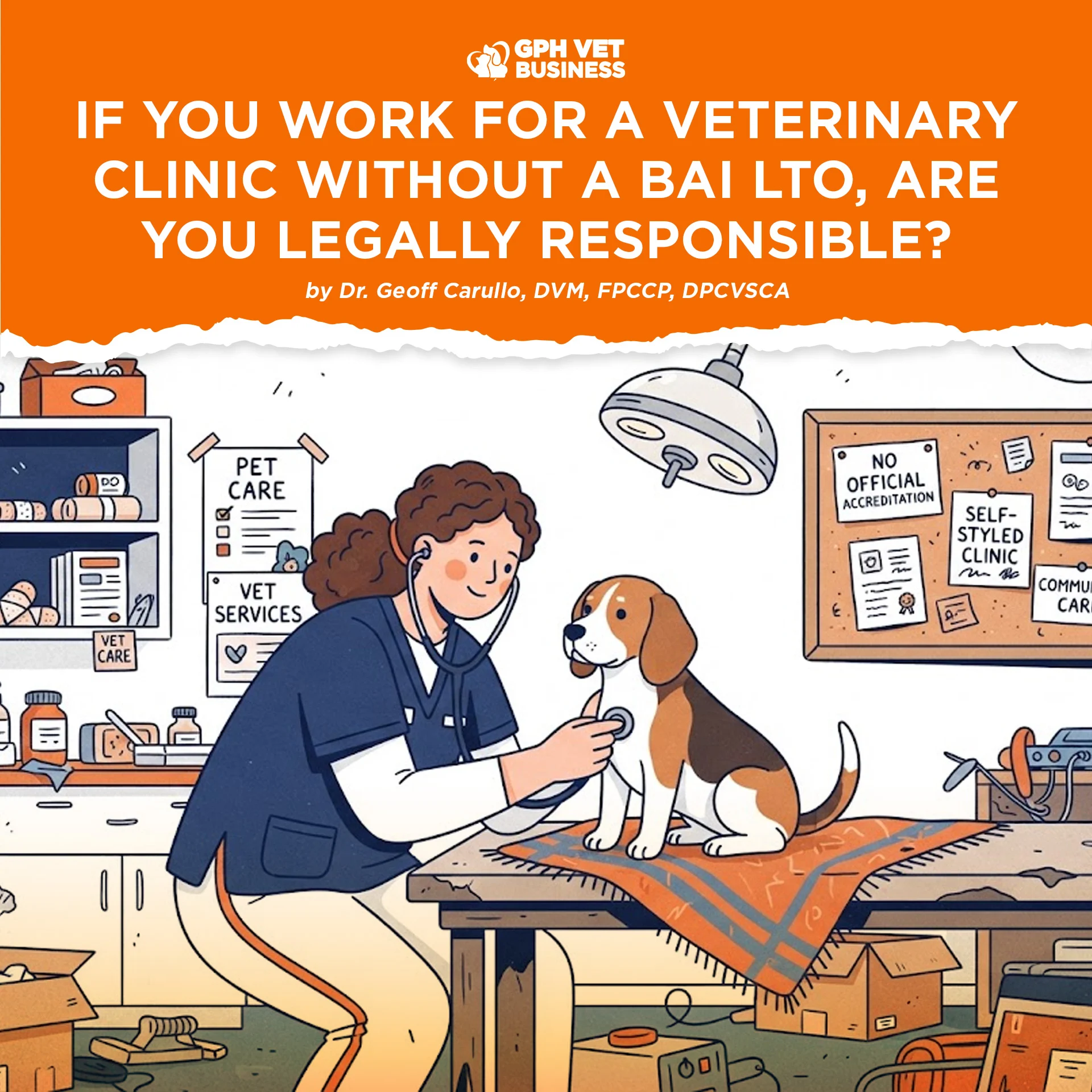
Suppose you discover that the veterinary clinic or hospital employing you has no valid Bureau of Animal Industry License to Operate or Certificate of Registration.
Are you automatically legally liable simply because you work there?
No. Employment alone does not automatically make every veterinarian, veterinary assistant, receptionist, or employee personally liable for the facility’s lack of a BAI LTO.
But the answer can change depending on what role you play, what you know, and what you actually do.


Under Section 2 of Republic Act No. 8485, the Animal Welfare Act, a veterinary clinic or veterinary hospital cannot be established, maintained, or operated without first securing the required Certificate of Registration from the Bureau of Animal Industry. (Lawphil)
BAI currently refers to this registration as the License to Operate as an Animal Facility. Only facilities issued such a license or certificate are recognized as BAI-registered animal facilities. (Bureau of Animal Industry)
So if a veterinary hospital or clinic operates without the required registration, there may clearly be a regulatory violation.
But who is responsible?
Being an employee is not the same as being the operator.
The law does not say that every person receiving a salary from an unregistered clinic automatically becomes personally guilty of the establishment’s violation.
There is a significant difference between:
- a receptionist who reports for work,
- a veterinary assistant following ordinary lawful instructions,
- an employed veterinarian treating patients,
and
- the owner, operator, manager, corporate officer, or person actually responsible for keeping the establishment operating without the required license.
Republic Act No. 10631, which amended the Animal Welfare Act, specifically provides that when a violation is committed by a juridical person, the officer responsible shall serve the imprisonment imposed under the law. It also states that penalties may apply to other violations of the Animal Welfare Act depending on the act or omission involved. (Lawphil)
That wording is important.
The law speaks of the responsible officer, not automatically every employee appearing on the payroll.
But employment is not a blanket protection either.
A person’s exposure increases when that person goes beyond merely being employed and actively participates in, directs, enables, conceals, or misrepresents the unlawful operation.
For example, the legal situation may become different if a person:
- owns or controls the facility;
- acts as its responsible manager or corporate officer;
- represents to clients or government agencies that the facility is properly licensed when it is not;
- submits false documents or certifications;
- knowingly allows his or her professional credentials to be used merely to make an unqualified or unlawful operation appear legitimate; or
- personally participates in another violation of the Animal Welfare Act.


Under general criminal law principles, liability ordinarily depends on participation in the prohibited act, whether as a principal or, where applicable, through cooperation in its commission. Mere association with someone who violates a law does not by itself establish criminal liability. (Lawphil)
Licensed veterinarians have an additional professional responsibility.
For veterinarians, there is another layer of law.
Republic Act No. 9268, the Philippine Veterinary Medicine Act of 2004, authorizes the Professional Regulatory Board of Veterinary Medicine to investigate violations of veterinary law, professional rules, the Code of Ethics, and technical standards.
Among the grounds for disciplinary action is a veterinarian having a professional connection with or lending his or her name to an illegal practitioner of veterinary medicine. The law also penalizes a veterinarian who assists an unqualified person in illegally practicing veterinary medicine. (Lawphil)
This does not mean that simply working in a clinic without a BAI LTO automatically results in suspension of one’s PRC license.
It means veterinarians should be particularly careful about what they knowingly authorize, sign, certify, or permit others to do under their professional name.
Interestingly, BAI itself recognizes employment contracts.
BAI’s registration requirements for animal facilities include, when applicable, a copy of the employment contract or Memorandum of Agreement between the veterinarian and the facility. (Bai.gov.ph)
This reinforces an important distinction:
The employment relationship and the facility’s BAI registration are separate legal matters.
The absence of a BAI LTO does not automatically erase the employment relationship, nor does the existence of an employment contract automatically make the employee personally responsible for the employer’s regulatory failure.
So, are you legally responsible?
The better answer is:
Not merely because you are employed there.
Responsibility depends on your position, authority, knowledge, participation, representations, and specific acts or omissions.
An ordinary employee who had no responsibility for licensing is in a very different legal position from an owner or responsible officer who knowingly operates the establishment without registration.
Likewise, a veterinarian simply providing legitimate veterinary care is in a different position from someone who knowingly lends his professional name, signs false regulatory documents, or helps conceal an unlawful operation.

The important lesson
A clinic’s failure to obtain a BAI License to Operate can be a serious regulatory issue.
But the law does not work by guilt through employment.
Working for an establishment that has a compliance problem does not automatically make every employee the violator.
Legal responsibility still has to be connected to the person who committed, directed, authorized, participated in, or was legally responsible for the prohibited act.
For veterinarians, however, once you become aware of a licensing problem, it is prudent to document the situation and insist that management correct it. Your professional license is your own, and it should never be casually placed at risk because of somebody else’s failure to comply with regulatory requirements.
This article is for general legal and professional discussion and is not a substitute for advice from counsel based on the specific facts of a case.
Sharing this helps others understand what it really means to be a vet. Like and follow if you’re with us.
Dr. Geoff Carullo is a Fellow and the current President of the Philippine College of Canine Practitioners.