Veterinarians face one of the highest occupational risks for rabies exposure. That’s why pre-exposure rabies vaccination (PrEP) is a must for all practicing vets. But once you’re fully vaccinated, how often should you get the shot again?
Primary Pre-Exposure Series
The standard pre-exposure vaccination for rabies is given as:
- 3 doses on Day 0, Day 7, and Day 21 (or 28).
This provides baseline protection for people in high-risk professions such as veterinarians, animal handlers, and lab workers.
Booster Recommendations for Vets
The need for boosters depends on your risk level and vaccine monitoring:
If you are a practicing vet with constant animal exposure:
You do not need a yearly full repeat series.
What’s recommended is either:
- A booster dose every 2–3 years, OR
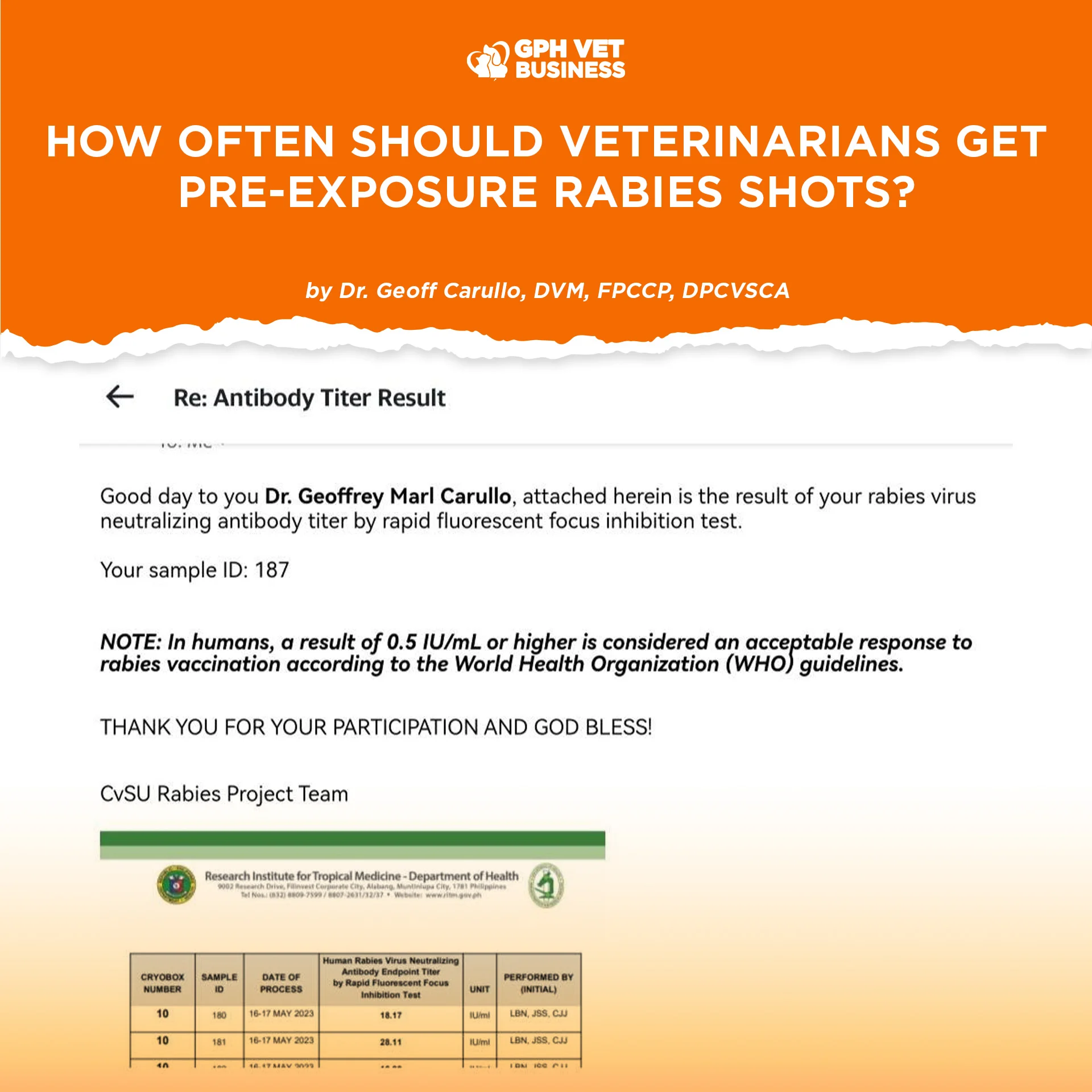
- A rabies antibody titer check every 2 years.
If antibody levels drop below protective range, a single booster is given.


If you get vaccinated annually anyway:
This is not harmful, but it’s unnecessary. Once you’ve completed your 3-dose primary series, yearly boosters are excessive unless your antibody test shows you need it.
If you are exposed to a high-risk rabies lab environment:
More frequent antibody testing (every 6 months) may be recommended, but for vets in practice, every 2 years is sufficient.
Why Titers Matter
The World Health Organization (WHO) and the Philippine DOH guidelines emphasize that antibody testing is the best way to decide if you need a booster. A protective level is ≥0.5 IU/mL. If your titer is above this, you don’t need another shot yet.


Final Thoughts
For veterinarians:
- Initial series (3 doses) → done once in a lifetime
- Booster every 2–3 years OR antibody test every 2 years
- No need for yearly full shots if you’re already updated
The key is monitoring, not over-vaccinating. Staying updated ensures protection against rabies while avoiding unnecessary injections.

Sharing this helps others understand what it really means to be a vet. Like and follow if you’re with us.
Dr. Geoff Carullo is a Fellow and the current President of the Philippine College of Canine Practitioners.