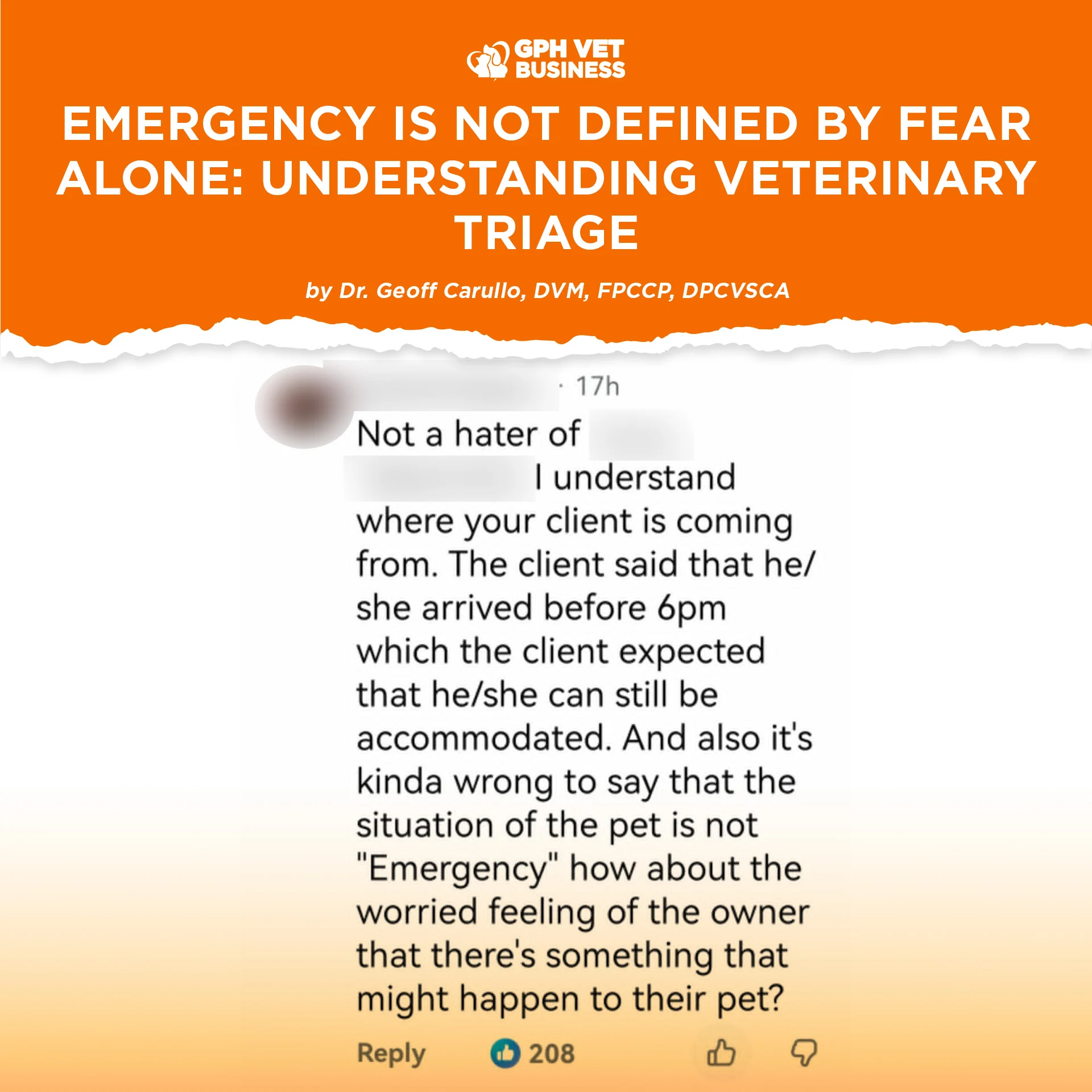
A recent online discussion raised an important question that many pet owners ask:
“If I’m worried about my pet, doesn’t that automatically make it an emergency?”
The concern is understandable. Every pet owner loves their companion, and when something seems wrong, anxiety naturally follows. However, in veterinary medicine, emergency care is determined by the patient’s medical condition, not by the level of worry of the owner.
This is where triage comes in.


What is triage?
Triage is the rapid assessment and prioritization of patients according to the severity of their medical condition.
Its purpose is simple: identify which patient needs immediate medical attention first.
In Tagalog, it can be described as:
“Mabilis na paunang pagsusuri at pagbibigay ng prayoridad sa mga pasyente batay sa tindi ng kanilang kondisyon.”
The goal of triage is not to determine who arrived first or who is most anxious. It is to determine whose life is in the greatest danger.
Anxiety and emergency are not always the same
A pet owner may be extremely worried because their dog vomited once.
Another owner may calmly carry a dog that is quietly struggling to breathe.
From a medical standpoint, the second patient is far more critical, even if the owner appears calm.
This illustrates an important principle:
The urgency of treatment depends on the patient’s physiological condition, not on the owner’s emotional state.


Arriving before closing time
Many clients also assume that arriving before clinic closing time guarantees consultation.
In reality, many clinics have a cut-off time because examinations, diagnostics, treatments, surgery, and hospitalization often extend well beyond business hours.
If a patient is identified during triage as requiring immediate lifesaving intervention, veterinarians will often continue working beyond clinic hours. However, if the case is stable and the clinic has already reached its capacity, the team may recommend returning the next day or visiting a 24-hour emergency hospital.
This decision is usually based on patient safety, staff availability, and the ability to provide proper care rather than rushing an incomplete consultation.
Why triage is fair
Imagine three patients arriving at nearly the same time:
- A dog that has stopped breathing.
- A cat hit by a vehicle.
- A healthy puppy scheduled for vaccination.
Although the puppy may have arrived first, no reasonable person would expect vaccination to take priority over lifesaving care.
That is the essence of triage.
Veterinary teams are trained to treat the sickest patient first, regardless of arrival order.

A Shared Responsibility
Good communication can reduce frustration on both sides.
Veterinary clinics should explain their triage policy clearly and compassionately.
Likewise, pet owners should understand that waiting does not necessarily mean they are being ignored. It may simply mean another animal is fighting for its life.
At the end of the day, veterinarians and pet owners share the same goal: to provide the best possible care for every animal.
Sometimes, that means making difficult decisions about who needs help first.
Those decisions are not based on convenience or favoritism.
They are based on medicine.
Dr. Geoff Carullo is a Fellow and the current President of the Philippine College of Canine Practitioners.
Sharing this helps others understand what it really means to be a vet. Like and follow if you’re with us.