What if the disease we discover is less dangerous than the procedures we perform to investigate it?
In veterinary medicine, we are taught that more diagnostics mean better medicine.
But what if that isn’t always true?
There is a medical phenomenon called OVERDIAGNOSIS, and Filipino veterinarians need to talk about it.


The Labrador That Died From a Diagnosis
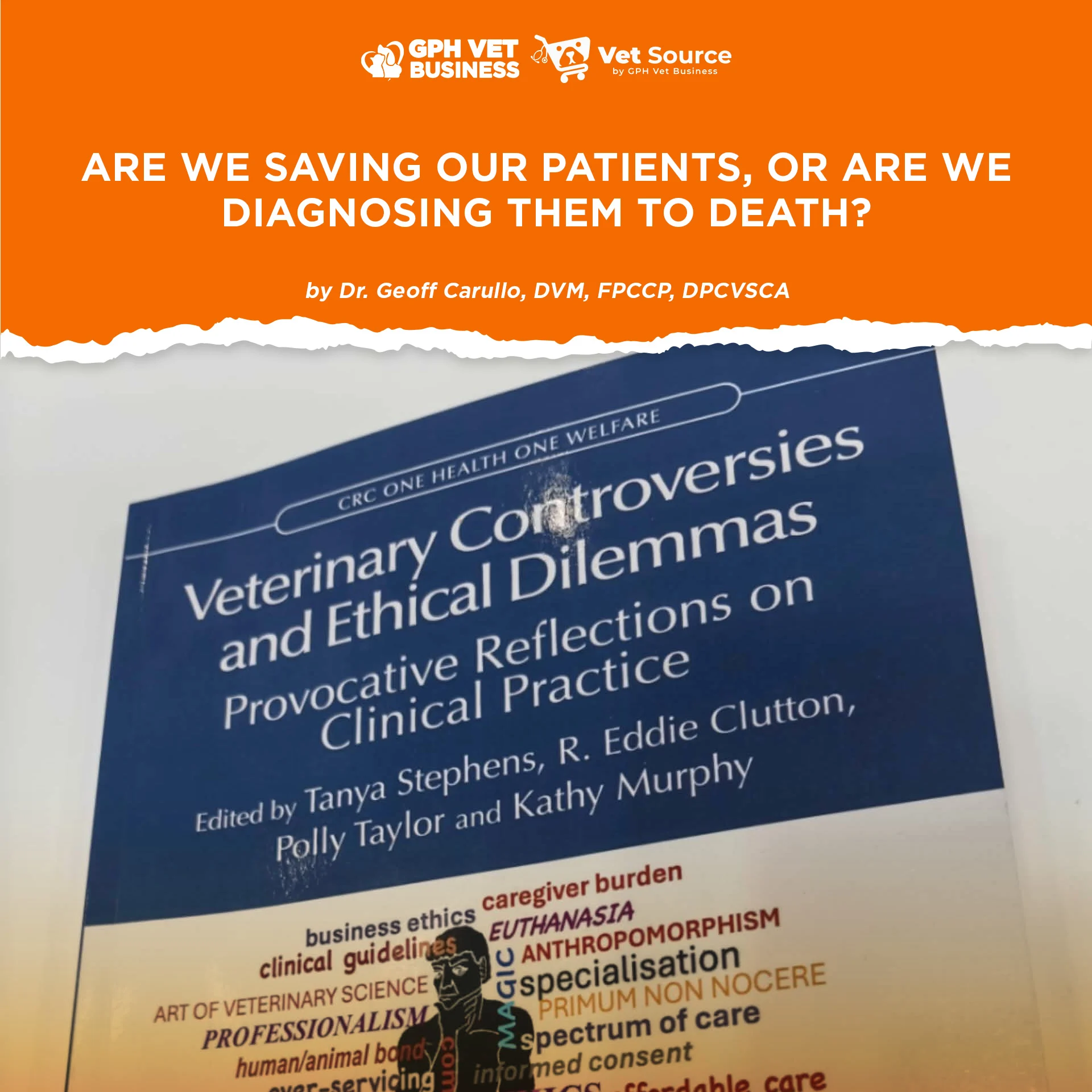
In the book Veterinary Controversies and Ethical Dilemmas, veterinarian Brennen McKenzie discusses a disturbing case.
Jake, a five-year-old Labrador Retriever, was scheduled for surgery to repair a ruptured cranial cruciate ligament.
Routine preoperative blood tests revealed elevated liver enzymes.
An ultrasound followed. Small liver nodules were discovered.
Concerned about cancer, the veterinary team performed an ultrasound-guided biopsy.
The results? Benign nodular hyperplasia.
But Jake never got to celebrate the good news.
He died the following day from hemorrhage associated with the biopsy.
The liver condition wasn’t killing him. The investigation of that condition did.
Are We Practicing Medicine or Practicing Fear?
Let’s be clear. Diagnostic tests save lives.
But not every abnormal laboratory result requires an aggressive investigation.
Not every incidental ultrasound finding requires a biopsy.
And not every disease we discover will eventually harm the patient.
Sometimes, we investigate because we are afraid of missing something.
Afraid of complaints. Afraid of being accused of negligence. Afraid of being called incompetent.
Ironically, we are frequently criticized for failing to diagnose diseases, but rarely questioned for diagnosing conditions that never needed intervention.


The Filipino Veterinary Reality
In the Philippines, where many pet owners struggle financially, this becomes even more important.
Imagine spending ₱10,000 investigating an incidental finding that would never have affected the patient’s quality of life.
That money could have been used to treat the primary illness.
More diagnostics do not automatically mean better veterinary care. More expensive medicine does not automatically mean better medicine.
The challenge is knowing which tests will genuinely benefit our patients.
And sometimes, carefully monitoring a low-risk abnormality is more appropriate than immediately pursuing invasive diagnostics.
The Question Every Veterinarian Should Ask
Before ordering another test, ask yourself:
“Will knowing the answer actually change how I treat this patient?”
If the answer is no, perhaps we should reconsider.
This is not an argument against diagnostic testing or early disease detection. Serious findings must never be casually dismissed.
It is an argument for clinical judgment, proportional investigation, and evidence-based medicine.

Because veterinary competence should not be measured by how many diseases we discover or how many tests we perform.
Sometimes, the mark of an excellent veterinarian is not knowing what else to do.
It is knowing when to stop.
And that may be one of the hardest lessons in modern veterinary medicine.

SOURCE:
McKenzie, Brennen. Overdiagnosis. Chapter 7, pp. 50–58, in Veterinary Controversies and Ethical Dilemmas: Provocative Reflections on Clinical Practice.
Edited by Tanya Stephens, R. Eddie Clutton, Polly Taylor, and Kathy Murphy.
CRC Press, Taylor & Francis Group.
DOI: https://doi.org/10.1201/9781003449300-9
Sharing this helps others understand what it really means to be a vet. Like and follow if you’re with us.
Dr. Geoff Carullo is a Fellow and the current President of the Philippine College of Canine Practitioners.