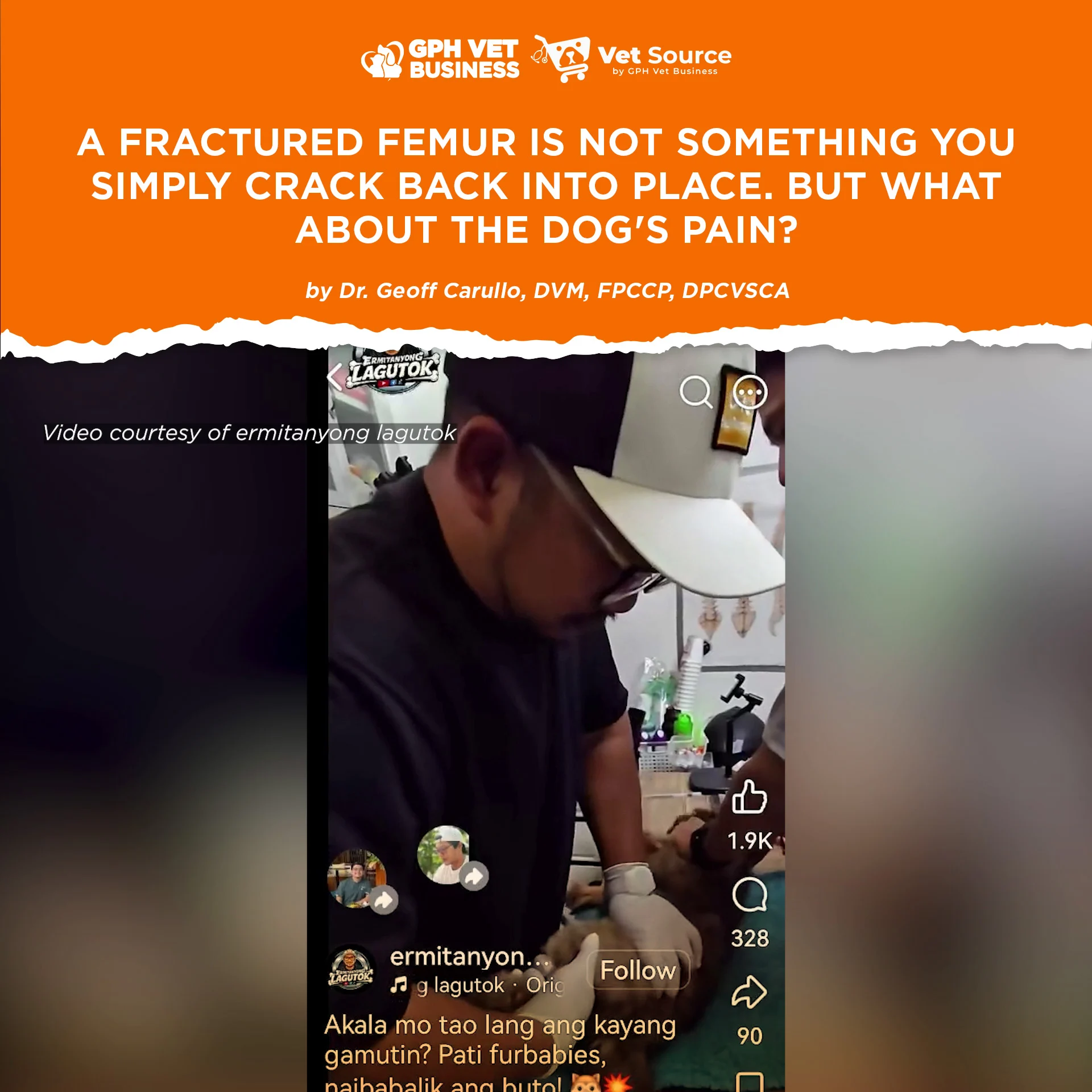
A viral Facebook video recently caught my attention.
It shows a man apparently performing manual bone manipulation on a Shih Tzu. Behind him are anatomical charts and certificates, including one identifying him as a “Certified Bone Setter.”
The video’s caption proudly declares:
“Akala mo tao lang ang kayang gamutin? Pati furbabies, naibabalik ang buto!”
But something bothered me.
The radiograph displayed on a cellphone raises concern for a possible femoral fracture, although the exact injury cannot be established from the screenshot alone.
Then I watched the apparent manipulation being performed.
And as a veterinary surgeon, one question immediately came to mind.


HOW MUCH PAIN WAS THAT SHIH TZU EXPERIENCING?
1. Imagine Having a Broken Thigh Bone and Someone Starts Manipulating It
A femoral fracture is among the more painful orthopedic injuries a dog can experience.
The femur is surrounded by substantial muscle tissue. When it fractures, the injury may involve the periosteum, muscles, blood vessels, nerves, and surrounding soft tissues.
Even slight movement of an unstable fracture can produce intense pain.
Now imagine someone firmly holding the injured limb, applying pressure, twisting, or attempting to reposition the fractured bone.
Without adequate analgesia, such manipulation could produce severe, potentially excruciating pain.
There is also the possibility of further displacement, additional soft-tissue damage, bleeding, and aggravation of an existing injury.
This is why veterinarians do not simply grab a fractured limb and attempt to straighten it.
We assess the patient, administer appropriate analgesia, evaluate the radiographs, and determine the safest method of stabilization.
Fracture reduction is a medical procedure, not a demonstration of someone’s ability to make bones crack.


2. Where Was the Sedation? Where Was the Pain Management?
One particularly concerning aspect of the video is that no administration of sedation, anesthesia, or analgesic medication is shown.
To be fair, the footage does not establish whether medications were administered before recording.
Nevertheless, the question deserves an answer.
Was this Shih Tzu provided appropriate pain relief before the manipulation?
According to the American Animal Hospital Association’s 2022 Pain Management Guidelines, acute traumatic injuries require early and appropriate analgesia, with treatment matched to the severity of the injury.
The guidelines emphasize proactive pain management rather than waiting until an animal exhibits obvious distress. (AAHA)
For painful orthopedic procedures, veterinarians may use opioid analgesics, sedation, anesthesia, and other pain-management techniques according to the patient’s clinical condition.
It is also important to understand that sedation and analgesia are not interchangeable.
A sedated dog is not necessarily a pain-free dog.
Some sedatives reduce awareness or movement without providing sufficient pain relief.
Conversely, an animal may remain conscious while receiving appropriate analgesia.
The important question is whether pain was adequately assessed, controlled, and monitored.

3. Just Because the Dog Does Not Scream Does Not Mean It Is Not Suffering
This is something many pet owners fail to understand.
Dogs do not always vocalize when experiencing severe pain.
Some become unusually quiet. Others freeze, resist movement, tremble, or exhibit subtle changes in breathing and behavior.
A frightened or restrained animal may remain still despite significant discomfort.
The AAHA guidelines specifically caution that the absence of an obvious painful response does not mean pain is absent. (AAHA)
And that is precisely why veterinary pain assessment requires training.
We cannot simply interpret a quiet dog as a comfortable dog.
The absence of screaming is not evidence of painless treatment.
This Shih Tzu cannot tell us how much it hurts.
It cannot explain whether the manipulation is making its injury worse.
That responsibility falls on the person performing the procedure and the owner who entrusted the animal to that person’s care.
4. Is This Illegal Veterinary Practice?
Republic Act No. 9268, otherwise known as the Philippine Veterinary Medicine Act of 2004, defines activities constituting veterinary practice.
Section 29 includes the examination, diagnosis, and treatment of animal injuries.
Section 30 prohibits the unauthorized practice of veterinary medicine.
Under Section 33, individuals convicted of unlawful veterinary practice may face fines ranging from ₱50,000 to ₱100,000, imprisonment of one to five years, or both, depending on the court’s determination. (Lawphil)
A certificate in bone setting or human chiropractic practice does not automatically authorize someone to diagnose and treat animal fractures.
The individual’s veterinary qualifications have not been independently verified, and the complete circumstances surrounding this case remain unknown.
However, if an unlicensed individual is independently treating a dog’s fracture, the matter warrants investigation by the appropriate authorities.
5. What About the Pet Owner? Is There Legal Responsibility?
Yes, potentially.
Under Republic Act No. 8485, as amended by Republic Act No. 10631, animal welfare includes protection from unnecessary pain, distress, cruelty, and maltreatment.
The law also recognizes the responsibility to provide adequate care.
Individuals found guilty of animal cruelty, maltreatment, or neglect may face criminal penalties. (Lawphil)
But ownership alone does not establish criminal liability.
An owner who unknowingly seeks treatment from an unqualified practitioner is not automatically guilty of animal cruelty.
The circumstances matter.
Was the owner aware of the seriousness of the injury?
Was appropriate veterinary treatment available?
Did the owner knowingly permit an unnecessarily painful procedure?
Was the animal subjected to avoidable suffering?
These are questions that investigators would need to examine.
Consent from a pet owner does not automatically excuse animal cruelty or authorize illegal veterinary practice.
6. Perhaps This Is Why We Need the ALAGA Act
House Bill No. 11495, known as the proposed Animal Life Advocacy and Guardianship Act or ALAGA Act, seeks to strengthen animal welfare enforcement in the Philippines.
Among its proposals is the creation of a National Commission on Animal Welfare, along with stronger penalties for animal cruelty. (GMA Network)
The proposal deserves serious discussion.
Not because every questionable procedure automatically constitutes animal cruelty.
But because animals cannot file complaints.
They cannot identify incompetent practitioners.
They cannot explain that someone manipulated an injured limb without adequate pain relief.
They depend entirely on responsible owners, qualified professionals, and effective enforcement of animal welfare laws.
The ALAGA Act remains a proposed measure, while RA 9268 and the existing Animal Welfare Act already provide relevant legal protections.
7. Why Are Veterinarians Held Accountable While Others Can Apparently Do the Same Procedures?
When a licensed veterinarian performs an orthopedic procedure, people expect radiographs, anesthesia, pain management, sterile technique, and appropriate stabilization.
If something goes wrong, the veterinarian may face professional, civil, or criminal accountability depending on the circumstances.
And that is how a regulated profession should operate.
But what happens when someone outside the veterinary profession performs a similar procedure?
Who verifies the qualifications?
Who checks whether appropriate analgesia was administered?
Who evaluates whether the animal suffered unnecessarily?
And who determines whether the procedure actually corrected the injury?
Veterinary medicine is regulated not to protect veterinarians from competition, but to protect animals from unsafe and unqualified treatment.
Final Thoughts
I am not declaring that the person in the video committed illegal veterinary practice or animal cruelty. His qualifications, the dog’s diagnosis, and any medications administered must first be established.
But I remain deeply concerned about the welfare of the Shih Tzu.
The video raises a legitimate question about whether an injured animal was subjected to painful manipulation without appropriate veterinary safeguards.
And that concern should not be dismissed merely because the person performing the procedure appears confident.
A cracking sound does not mean a fractured bone has healed.
A quiet dog does not mean a painless procedure.
And a certificate hanging on the wall does not automatically make someone qualified to practice veterinary medicine.
Before celebrating someone’s ability to manipulate an animal’s bones, perhaps we should first ask whether the animal was properly diagnosed, adequately protected from pain, and given medically appropriate treatment.
Because ultimately, this is not about veterinarians versus bone setters.
This is about a Shih Tzu that cannot speak for itself.
And if we genuinely care about animal welfare, we should be just as concerned about the pain animals experience outside veterinary clinics as we are about the treatment they receive inside them.
An animal’s suffering should never become entertainment, a marketing strategy, or proof of someone’s supposed healing abilities.
References
- Republic Act No. 9268, Philippine Veterinary Medicine Act of 2004
- Republic Act No. 10631, Animal Welfare Act Amendments
- AAHA 2022 Pain Management Guidelines for Dogs and Cats
- WSAVA Global Guidelines for the Recognition, Assessment and Treatment of Pain
- GMA News, House Bill Proposes National Commission on Animal Welfare, September 29, 2026
Sharing this helps others understand what it really means to be a vet. Like and follow if you’re with us.
Dr. Geoff Carullo is a Fellow and the current President of the Philippine College of Canine Practitioners.