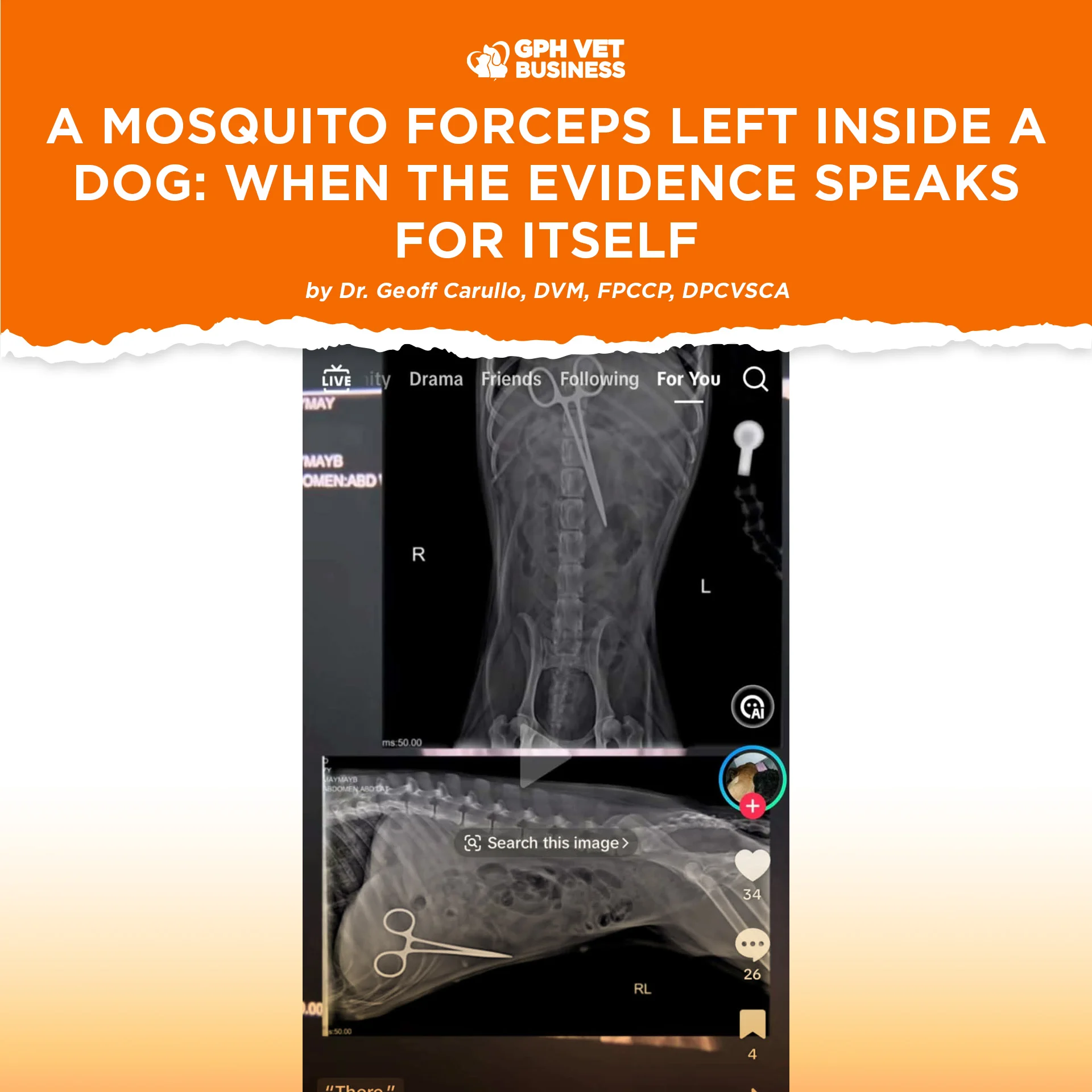
A mosquito forceps was reportedly left inside the abdomen of a Belgian Malinois named Maymay after surgery.
Months later, an X-ray found it.
Sometimes, that is exactly what lawyers mean by res ipsa loquitur.
“The thing speaks for itself.”
According to Maymay’s owner in a TikTok video, she underwent open surgery for pyometra on January 31, 2026. Months later, after developing intermittent discomfort and changes in posture, her owners pushed for an X-ray.
What appeared on the radiograph was not constipation.
Not gas.
Not a vague post-operative change.
It was a mosquito forceps inside the abdomen.
In a later update, the owner said the veterinarian acknowledged that the instrument had been left inside, apologized, and offered to shoulder the expenses for corrective treatment.
That account has not been presented here as a court or regulatory finding.
But it raises a very difficult question:
How does a surgical instrument end up inside a patient after the abdomen has already been closed?


THIS IS WHERE RES IPSA LOQUITUR BECOMES RELEVANT
Not every bad surgical outcome means malpractice.
Patients can develop infection. Anesthesia can have complications. Wounds can dehisce. Sometimes things go wrong even when proper care was given.
But a retained surgical instrument is different.
A mosquito forceps is placed into the surgical field by the surgical team.
It is supposed to come out before closure.
The patient certainly did not put it there.
That is why cases like this may fit the logic behind res ipsa loquitur: the circumstances themselves can point strongly toward negligence even before every technical detail is explained.


THERE IS A HUMAN MEDICAL PARALLEL
The Philippine Supreme Court has already dealt with a similar retained-object case in human medicine.
In Professional Services, Inc. v. Agana, surgical gauzes were left inside a patient after an operation at Medical City General Hospital.
The Court discussed retained surgical material as powerful evidence of negligence.
The facts are not identical to Maymay’s case.
But the practical lesson is the same:
What goes into the surgical field must be accounted for before the patient is closed.
FOR FELLOW VETERINARIANS, THIS HAS BEEN A DEMORALIZING WEEK
There seem to be several veterinary cases surfacing almost one after another where owners appear to have serious grounds to question what happened and, in some situations, to pursue a formal complaint.
That is difficult to see as a veterinarian.
It can be demoralizing for an entire profession.
But perhaps the better response is not defensiveness. It is to become even more careful.
For surgeries, whenever possible, do not operate completely alone. Have another veterinarian or properly trained surgical team member present. Use instrument and gauze counts. Document important steps. Let another set of eyes verify before closure.
Not because we expect something to go wrong.
Because when something does go wrong, good systems protect the patient, the owner, and the veterinarian.

THE MOST IMPORTANT PART OF MAYMAY’S STORY
This should not simply be a story about blame.
It should be a reminder.
Count your instruments.
Count your gauze.
Check before closure.
Check again if there is doubt.
A basic surgical count can prevent a devastating mistake.
And if a mistake is discovered, what happens next also matters.
Do you hide it?
Do you avoid the owner?
Or do you acknowledge it, explain what happened, protect the patient, and take responsibility?
According to Maymay’s owner, the veterinarian eventually apologized and offered to cover the corrective care.
That does not erase the error.
But accountability still matters.
THE X-RAY SAID WHAT MAYMAY COULD NOT
Maymay cannot explain what happened inside that operating room.
She cannot tell us who forgot the forceps.
She cannot ask why it was not counted.
But the radiograph preserved one undeniable fact:
the instrument was still there.
That is why this case is such a powerful illustration of res ipsa loquitur.
Sometimes the patient cannot speak.
But the evidence can.
Resources
Professional Services, Inc. v. Agana, G.R. Nos. 126297, 126467 & 127590, January 31, 2007, Supreme Court of the Philippines. Human medical case involving retained surgical gauzes.
Reyno and De Vera v. Baltazar, G.R. No. 227775, October 10, 2022, Supreme Court of the Philippines. Discussion of the doctrine of res ipsa loquitur.
Republic Act No. 9268, Philippine Veterinary Medicine Act of 2004. Philippine law regulating veterinary practice and professional accountability.
The details involving Maymay are based on the owner’s publicly shared video account and are not presented as findings of a court, the PRC, or another regulatory body.
Dr. Geoff Carullo is a Fellow and the current President of the Philippine College of Canine Practitioners.
Sharing this helps others understand what it really means to be a vet. Like and follow if you’re with us.