Are most Filipino veterinarians working in small animal clinics?
Or are there actually more veterinarians working in government, livestock farms, laboratories, and public health?
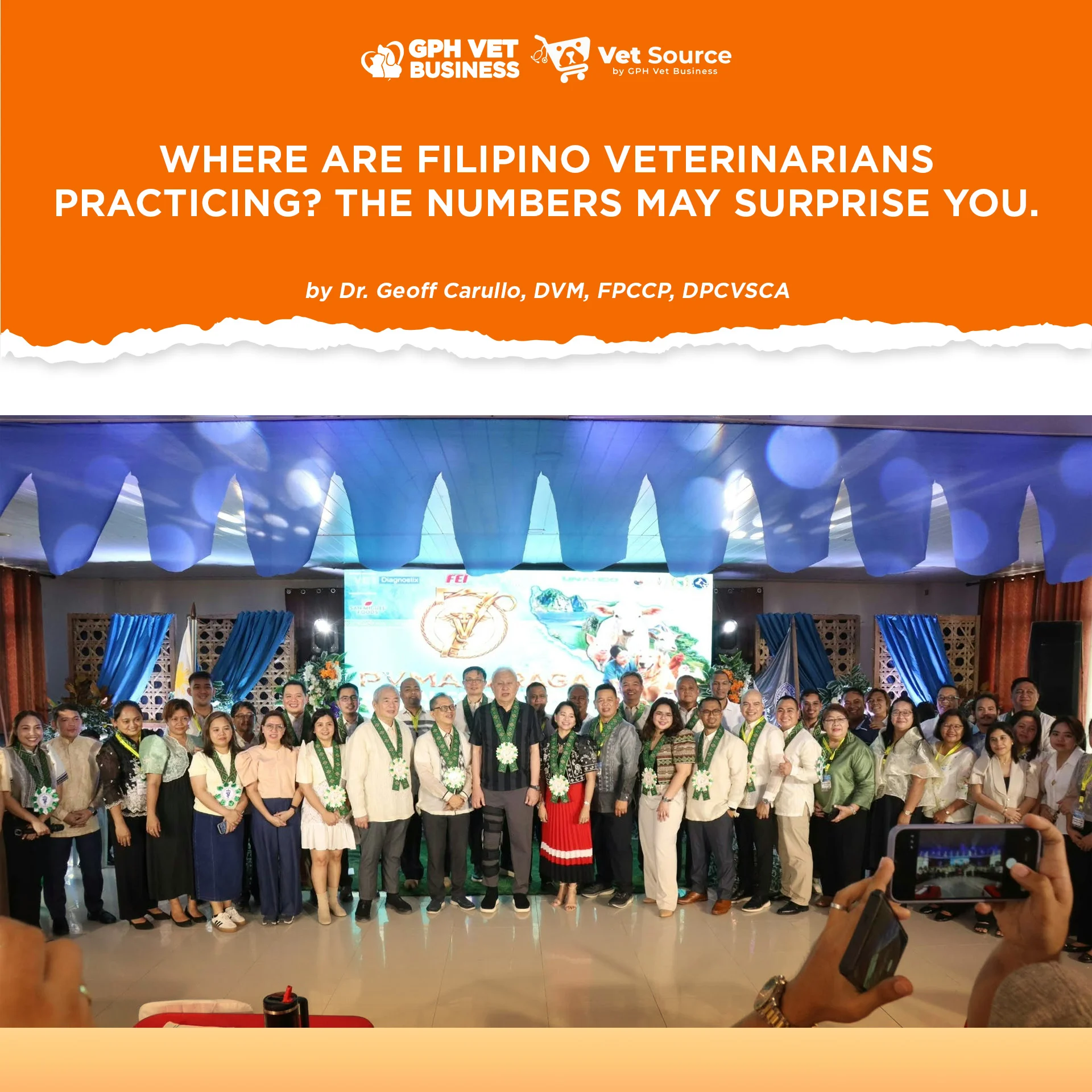
During the 7th PVMA CARAGA Annual Convention and Scientific Conference held in Cagwait, Surigao del Sur, on October 22, 2026, Dr. Reildrin G. Morales presented an interesting overview of the distribution of veterinary professionals in the Philippines.
The presentation, titled Veterinary Workforce Distribution, provided a glimpse into where Filipino veterinarians are employed and how veterinary facilities are geographically distributed.
Dr. Morales is a former Officer-in-Charge Director of the Bureau of Animal Industry (BAI), former Executive Director of the National Meat Inspection Service, and former Chief Veterinary Officer of the Philippines.
He was also recognized as the 2026 Outstanding Veterinarian of the Year by the Professional Regulation Commission for his contributions to veterinary public health, animal disease control, and veterinary governance.
His presentation raised an important question.
Do we actually know how our veterinary workforce is distributed across the country?


THE ESTIMATED 7,000 ACTIVE FILIPINO VETERINARIANS
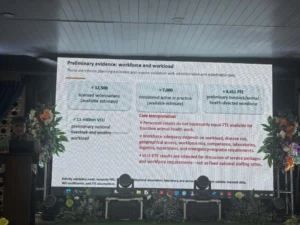
According to the figures presented by Dr. Morales, the Philippine veterinary workforce was estimated at approximately 7,000 active veterinarians.
For purposes of the presentation, the term active referred to veterinarians who maintained or renewed their professional licenses.
The estimated distribution was as follows:
| Area of Practice | Number of Veterinarians |
|---|---|
| Animal Health | 2,062 |
| Public Health | 307 |
| Laboratories | 356 |
| Academic and Training | 398 |
| Private Veterinary Clinics | 2,000 |
| Private Farms | 1,877 |
| TOTAL | 7,000 |
The first four categories were further divided into public and private employment.
These categories accounted for 3,123 veterinarians, consisting of 2,023 in the public sector and 1,100 in the private sector.
The remaining estimates included approximately 2,000 veterinarians working in private clinics and 1,877 working in private farms.
Interestingly, this would mean that only around 28.6% of the estimated veterinary workforce works in private veterinary clinics.
Meanwhile, approximately 26.8% were estimated to be employed in private farms.
These figures suggest that veterinary medicine in the Philippines remains a profession with substantial involvement in livestock production, disease prevention, food safety, public health, and government regulatory functions.
However, Dr. Morales emphasized an important limitation.
The figures are estimates that still require further validation.
In particular, the estimates for private veterinary clinics and private farms were not supported by the same detailed employment-sector breakdown available for the other categories.
They should therefore not be interpreted as the results of a comprehensive national veterinary employment census.
ARE THERE REALLY ONLY 7,000 ACTIVE VETERINARIANS?
Another important distinction concerns the definition of an active veterinarian.
A veterinarian holding a valid PRC Professional Identification Card is not necessarily working in clinical practice or even employed in the Philippines.
Some licensed veterinarians may be working overseas, employed in non-veterinary occupations, or temporarily inactive.
Consequently, the number of veterinarians maintaining valid professional licenses is different from the number actually practicing veterinary medicine within the country.
The PRC’s annual statistical reports provide licensing information, but a separate workforce assessment is necessary to establish actual employment and geographical distribution.
This distinction is important when evaluating whether the Philippines has enough veterinarians to meet its animal health and public health requirements.


WHERE ARE VETERINARY FACILITIES LOCATED?
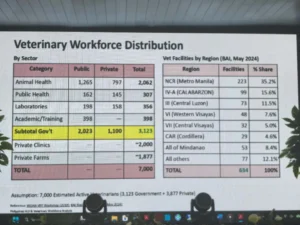
The second part of Dr. Morales’s presentation examined the geographical distribution of registered veterinary facilities using BAI records from May 2024.
The figures were particularly revealing.
| Region | Registered Facilities | Share |
|---|---|---|
| NCR | 223 | 35.2% |
| CALABARZON | 99 | 15.6% |
| Central Luzon | 73 | 11.5% |
| Western Visayas | 48 | 7.6% |
| Central Visayas | 32 | 5.0% |
| Cordillera | 29 | 4.6% |
| All of Mindanao | 53 | 8.4% |
| Other Regions | 77 | 12.1% |
| TOTAL | 634 | 100% |
One observation immediately stands out.
Metro Manila alone accounted for 223 of the 634 listed facilities.
Together, NCR, CALABARZON, and Central Luzon accounted for approximately 62.3% of the registered facilities.
In contrast, the entire Mindanao island group accounted for only 8.4%.
The figures illustrate a significant concentration of registered veterinary establishments in Luzon.
But does this necessarily mean that most Filipino veterinarians are practicing in these regions?
Not exactly.
VETERINARY FACILITIES ARE NOT THE SAME AS VETERINARIANS

Dr. Morales explained that the regional figures were obtained from BAI registration data.
Further examination of BAI’s published records revealed an important detail.
The agency maintains separate registration lists for different animal facilities, including farms, kennels, animal shelters, grooming establishments, and veterinary facilities.
Notably, BAI’s May 31, 2024 document titled Registered Veterinary Clinics/Hospitals contains 634 numbered entries, corresponding to the total presented during the convention.
This strongly suggests that the regional distribution primarily reflects registered veterinary clinics and hospitals rather than every type of animal facility regulated by BAI.
Nevertheless, these records require additional examination to determine their completeness, current operating status, and whether duplicate entries exist.
More importantly, a single registered veterinary establishment may employ several licensed veterinarians.
Others may operate with only one.
Therefore, the number of registered facilities cannot automatically be translated into the number of veterinarians practicing in a particular region.

DOES THIS MEAN METRO MANILA HAS TOO MANY VETERINARIANS?
Not necessarily.
The concentration of registered veterinary facilities in Metro Manila may reflect population density, pet ownership, urbanization, and the commercial viability of veterinary services.
However, the figures alone do not establish whether a region has an oversupply or shortage of veterinarians.
To answer that question, we would need additional information.
- How many veterinarians are actually working in each region?
- How many animals are they serving?
- What proportion of the veterinary workforce is dedicated to companion animals compared with food-producing animals?
- How many veterinarians work for local government units?
- And how many communities have little or no access to professional veterinary services?
These questions are particularly relevant when discussing the future of veterinary practice in the Philippines.
WHY THIS INFORMATION MATTERS TO FILIPINO VETERINARIANS
For veterinarians planning to establish a clinic, geographical workforce information can help identify areas where veterinary services may be underserved.
For veterinary schools, it may help guide career orientation and training priorities.
For government agencies, it can support workforce planning, disease surveillance, rabies prevention, and livestock health programs.
For professional organizations such as the PVMA, it provides an opportunity to assess whether veterinary services are sufficiently accessible throughout the country.
But perhaps the greatest value of Dr. Morales’s presentation is that it highlights something our profession has not adequately established.
We still need a comprehensive and validated national database showing where Filipino veterinarians actually practice.
Not merely how many have passed the licensure examination.
Not merely how many have renewed their PRC licenses.
And certainly not just how many veterinary clinics are registered with the BAI.
We need to know where veterinarians work, what sectors they serve, and whether their geographical distribution corresponds to the country’s animal health and public health needs.
MY FINAL THOUGHTS
Dr. Morales’s presentation during the PVMA CARAGA Convention provides an important starting point for this discussion.
Although the workforce figures remain preliminary estimates and the facility data date back to May 2024, they offer a useful perspective on the diversity and geographical concentration of veterinary practice in the Philippines.
Veterinary medicine is much bigger than small animal practice.
It includes veterinarians protecting our food supply, preventing zoonotic diseases, supporting livestock production, conducting laboratory diagnostics, teaching future colleagues, and serving communities through government veterinary services.
Yet without accurate workforce information, planning the profession’s future becomes difficult.
Perhaps the real question is not whether the Philippines has enough veterinarians.
The more important question is whether our veterinarians are practicing in the places and sectors where they are needed most.
And that is something worth investigating further.
References:
- Dr. Reildrin G. Morales. Veterinary Workforce Distribution. Presentation during the 7th PVMA CARAGA Annual Convention and Scientific Conference, October 22, 2026.
- Bureau of Animal Industry. Registered Veterinary Clinics/Hospitals, May 31, 2024.
- Professional Regulation Commission. 2024 Annual Report.
- Professional Regulation Commission. 2026 Outstanding Professionals of the Year.
- Professional Regulation Commission. CPD Accreditation Records, 7th PVMA CARAGA Annual Convention and Scientific Conference.
Editorial note: The workforce figures presented are estimates requiring further cross-referencing and validation. The regional facility figures reflect historical BAI registration data and should not be interpreted as a complete census of practicing veterinarians in 2026.
Sharing this helps others understand what it really means to be a vet. Like and follow if you’re with us.
Dr. Geoff Carullo is a Fellow and the current President of the Philippine College of Canine Practitioners.