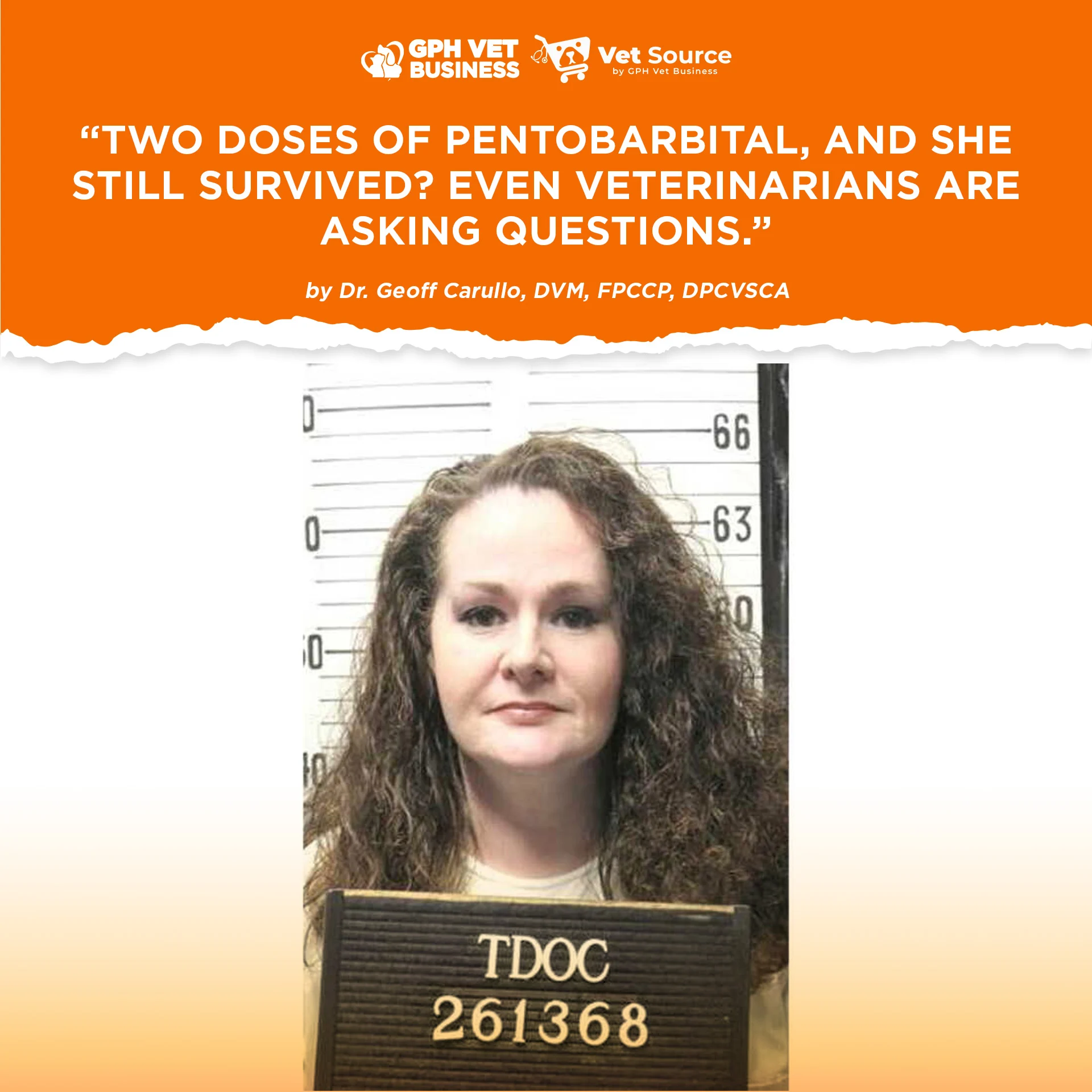
On September 30, 2026, Christa Pike, a convicted murderer on death row in Tennessee, underwent an attempted execution by lethal injection.
She was reportedly administered two doses of pentobarbital.
She did not die.
Instead, she survived, regained consciousness, and eventually recovered enough to walk with assistance. By October 10, she had been discharged from the hospital and returned to prison. (AP News)
Then came a rather dark comment from someone claiming to work in a veterinary hospital:
“Never have had a dog walk out back into its kennel.”
It sounds like dark humor.
But for veterinarians familiar with pentobarbital, the comment raises a legitimate pharmacological and procedural question.
How can a drug routinely used for animal euthanasia fail to produce its intended effect during a human execution, even after two doses?


Pentobarbital is a short-acting barbiturate that produces profound central nervous system depression. In veterinary medicine, it is commonly used in euthanasia solutions to induce unconsciousness, respiratory arrest, and ultimately cardiac arrest.
Veterinarians understand that successful administration requires more than simply injecting a calculated dose.
The drug must reach the intended circulation.
One possible explanation for Pike’s survival is intravenous extravasation, where medication leaks outside the blood vessel into surrounding tissues.
Her reported arm injuries and swelling have raised suspicions that this may have occurred. However, the precise cause remains under investigation. (Reuters)
The Veterinary Perspective
And this is where the veterinary perspective becomes interesting.
Veterinary euthanasia is not simply about administering a lethal medication.
It involves clinical judgment, knowledge of pharmacology, appropriate vascular access, proper drug administration, and confirmation of death.
Veterinarians are trained to recognize when a procedure is not progressing as expected.
Of course, veterinary euthanasia and human executions are fundamentally different practices. One is intended to relieve animal suffering. The other is an act of capital punishment.
Their ethical purposes should never be confused.


But pharmacology does not change simply because the patient is human.
A drug can be pharmacologically effective and still fail to achieve its intended clinical effect because of problems involving administration.
And perhaps that is the most important lesson from this extraordinary case.
Two doses of pentobarbital were reportedly administered.
The intended result was not achieved.
The patient survived.
For veterinarians, the incident is a reminder that technical competence, procedural safeguards, and clinical monitoring matter enormously.
And while the internet may find humor in a veterinary worker saying that no dog has ever walked back to its kennel after euthanasia, we should remember something important.
In veterinary medicine, euthanasia is a solemn medical responsibility, not an execution procedure.
We should also remember Colleen Slemmer, whose murder led to Pike’s conviction.
Regardless of where one stands on capital punishment, the medical questions surrounding this failed execution deserve serious investigation.
Because when a procedure involving a powerful anesthetic goes catastrophically wrong, the most important question is not simply how much medication was administered.
It is whether the medication was administered correctly in the first place.
And that is something every veterinarian can appreciate.

Sources
Associated Press, October 10, 2026: Christa Pike discharged after surviving execution attempt
Reuters, October 2, 2026: Pike’s condition following failed execution
American Veterinary Medical Association: Guidelines for the Euthanasia of Animals
Sharing this helps others understand what it really means to be a vet. Like and follow if you’re with us.
Dr. Geoff Carullo is a Fellow and the current President of the Philippine College of Canine Practitioners.