The controversy surrounding the October 3 low-cost spay and neuter activity in Sorsogon City has now produced statements from both the Sorsogon City Veterinary Office and SARA – Sorsogon Animal Rescue and Adoption.
After reading both sides, one thing becomes clear:
This is not as simple as one side saying “illegal” and the other side saying “may permit kami.”
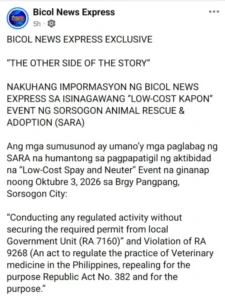
The real dispute is about whether the documents and approvals obtained actually covered the activity as it was conducted on October 3.


WHAT THE CITY VETERINARY OFFICE SAYS
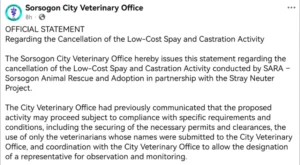
The City Veterinary Office says the organizers failed to comply with several previously communicated conditions. According to its statement, there were missing local permits or clearances, veterinarians present were different from those originally submitted, and the BAI permit reflected October 4 at Barangay Bibincahan, while the activity reportedly took place October 3 at another venue.
The City Veterinary Office also says these changes were not properly coordinated with them, preventing them from assigning a representative to observe and monitor the activity.
WHAT SARA SAYS
SARA, however, disputes the impression that it simply conducted the event without documentation.
The organization says documents had been prepared and submitted. It also explains that one veterinarian was substituted through a written communication, and that there was a timeline of coordination concerning changes in the schedule and venue.
SARA is therefore asking an important question:
What exact requirement was violated, under what law, ordinance, circular, or regulation, and what specific authority justified stopping the activity?
That is a fair question.
But the City Veterinary Office also raises a fair regulatory concern.


A BAI CLEARANCE IS NOT NECESSARILY A BLANK AUTHORIZATION
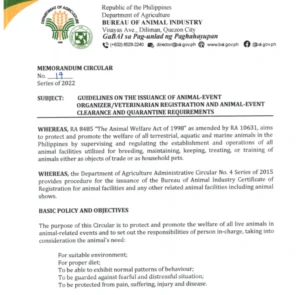
BAI Memorandum Circular No. 17, Series of 2022 provides a regulatory framework for animal-related events. It requires an Animal-Event Clearance and specifically contemplates registered organizers, registered animal-event veterinarians, event requirements, animal welfare safeguards, and coordination with competent authorities.
The circular even requires at least two BAI-registered Animal-Event Veterinarians to be present during the duration of the event.
So having a BAI document is important.
But a BAI clearance should not automatically be interpreted as a blank authorization to conduct the activity anywhere, anytime, and under materially different circumstances from those declared in the application.
REGULATORS ALSO NEED TO BE PRECISE
On the other hand, government regulators should also be precise.
If an organizer is accused of violating RA 7160, RA 9268, a local ordinance, or a BAI issuance, the public deserves to know the specific provision and how the facts supposedly violated it.
Simply mentioning the title of a Republic Act is not the same as establishing a violation.

THE ISSUE OF OFFICIAL RECEIPTS
There is another issue worth separating from the controversy.
The City Veterinary Office clarified that it was not demanding that official receipts be surrendered to the city. Its position was that because the activity involved fee-based services, proper receipts should be issued to clients.
That clarification matters because the two propositions are completely different.
THE DOCUMENTS SHOULD SETTLE THE DISPUTE
At this point, therefore, neither social media posts nor accusations should substitute for the documents.
What would settle much of this dispute is relatively straightforward: show the original BAI clearance, the approved date and venue, the list of registered veterinarians, the written substitution or amendment, the communications regarding the venue and schedule change, the local permit requirements, and whatever written authority or directive was relied upon when the activity was stopped.
Then compare them chronologically.
TWO LEGITIMATE PRINCIPLES
Because there are really two legitimate principles competing here.
Animal welfare groups should be able to conduct affordable spay and neuter programs without unnecessary bureaucratic obstruction.
But animal welfare advocacy does not exempt anyone from reasonable veterinary, animal welfare, tax, local government, and event regulations.
Likewise, regulators have a duty to enforce rules.
But regulation must also be clear, consistent, documented, and based on an identifiable legal authority.
THIS SHOULD NOT BECOME GOVERNMENT VS. RESCUERS
This should not become a battle between “government versus rescuers.”
Both sides supposedly want the same thing: fewer unwanted animals, responsible veterinary care, and better animal welfare.
The question now is much narrower:
Were the approvals and conditions valid for the actual October 3 activity, or had the event changed enough that new coordination or amended approvals were required?
That is the issue that the documents, not Facebook arguments, should ultimately answer.
Dr. Geoff Carullo is a Fellow and the current President of the Philippine College of Canine Practitioners.
Sharing this helps others understand what it really means to be a vet. Like and follow if you’re with us.