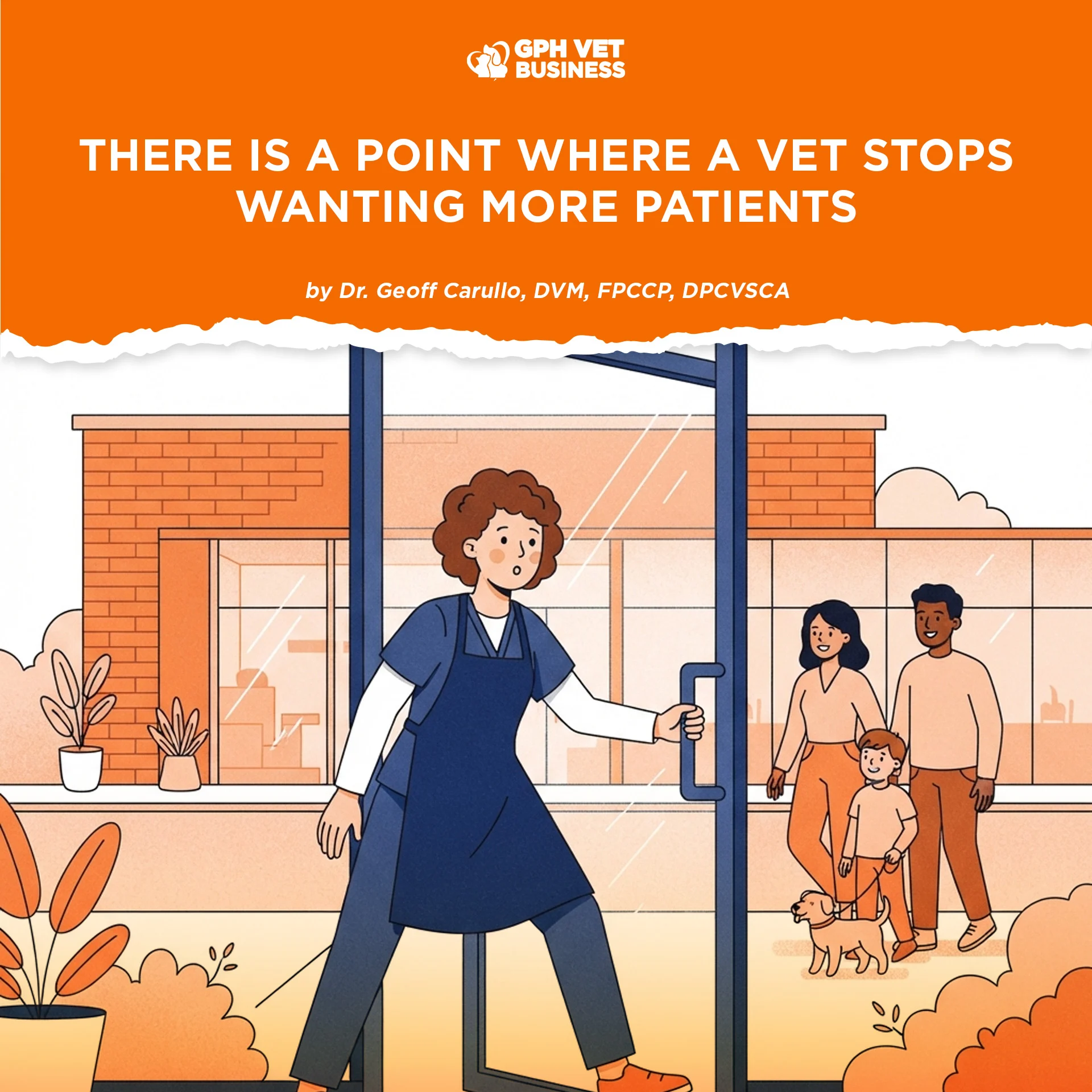
There is a stage in veterinary practice when a full waiting room stops feeling like success.
At first, you pray for patients.
You celebrate every consult.
Every surgery.
Every new client.
Every returning client.
You worry when the clinic is quiet.
Then years pass.
The clinic grows.
The phone never stops ringing.
The schedule is always full.
The staff keeps asking questions.
There is always another emergency.
Another confinement.
Another client waiting.
Another message you have not answered.
And one day, something strange happens.
You stop wishing for more patients.
Not because you became lazy.
Not because you stopped caring.
Not because business became bad.
But because you finally realized that there is a limit to how much medicine one human being can safely carry.


THE PART NOBODY TELLS YOUNG VETERINARIANS
That is the part nobody tells young veterinarians.
We are taught to grow.
Get more clients.
Increase the caseload.
Expand the clinic.
Buy more equipment.
Add more services.
Open longer hours.
Become busier.
Because busy looks successful.
But there is a point where growth stops feeling like growth.
It starts feeling like being buried alive by your own success.
You can have a packed clinic and still feel empty.
You can have higher sales and less peace.
You can have more patients and less time to actually think.
You can become the veterinarian everyone wants to see, while quietly wishing fewer people would ask for you.


SUCCESS HAS A CARRYING CAPACITY
That is when you begin to understand something uncomfortable:
Success has a carrying capacity.
Medicine needs attention.
Surgery needs focus.
Diagnosis needs thinking.
Clients need explanations.
Staff need guidance.
And veterinarians need recovery.
When all of these compete for the same exhausted brain, more patients are no longer automatically better.
Sometimes more patients simply mean:
- More chances to miss something.
- More rushed decisions.
- More delayed meals.
- More interrupted sleep.
- More emotional residue you bring home.
- More guilt because someone had to wait.
- More guilt because someone had to be referred.
- More guilt because you could not personally see everyone.
And that is when the definition of success starts changing.
When you are younger, success may mean:
“How many patients did we see today?”
Later, success becomes:
“Did we practice good medicine today without destroying ourselves in the process?”
That is a very different question.

WHEN SAYING NO BECOMES RESPONSIBLE MEDICINE
There is nothing impressive about being fully booked if the doctor is already mentally absent.
There is nothing admirable about accepting every case if the quality of care begins to suffer.
There is nothing noble about saying yes to everyone until you no longer have anything left for yourself, your family, your staff, or even your next patient.
Sometimes the most mature thing a veterinarian can say is:
“We are full.”
Sometimes the best decision is to refer.
Sometimes the healthiest form of growth is not adding more patients.
It is adding more boundaries.
More systems.
More doctors.
More rest.
More control over your own time.
Because the goal should never be to see the maximum number of patients possible.
The goal should be to remain good enough, present enough, and healthy enough to keep practicing medicine for years.
Maybe that is why some experienced veterinarians eventually stop chasing volume.
They have already learned the lesson younger vets are still trying to discover:
A full clinic is not always a successful clinic.
And a veterinarian who still has energy left at the end of the day has not failed to maximize business.
Sometimes, that veterinarian has finally learned how to protect the most limited resource in the entire hospital.
The person making the decisions.
Dr. Geoff Carullo is a Fellow and the current President of the Philippine College of Canine Practitioners.
Sharing this helps others understand what it really means to be a vet. Like and follow if you’re with us.