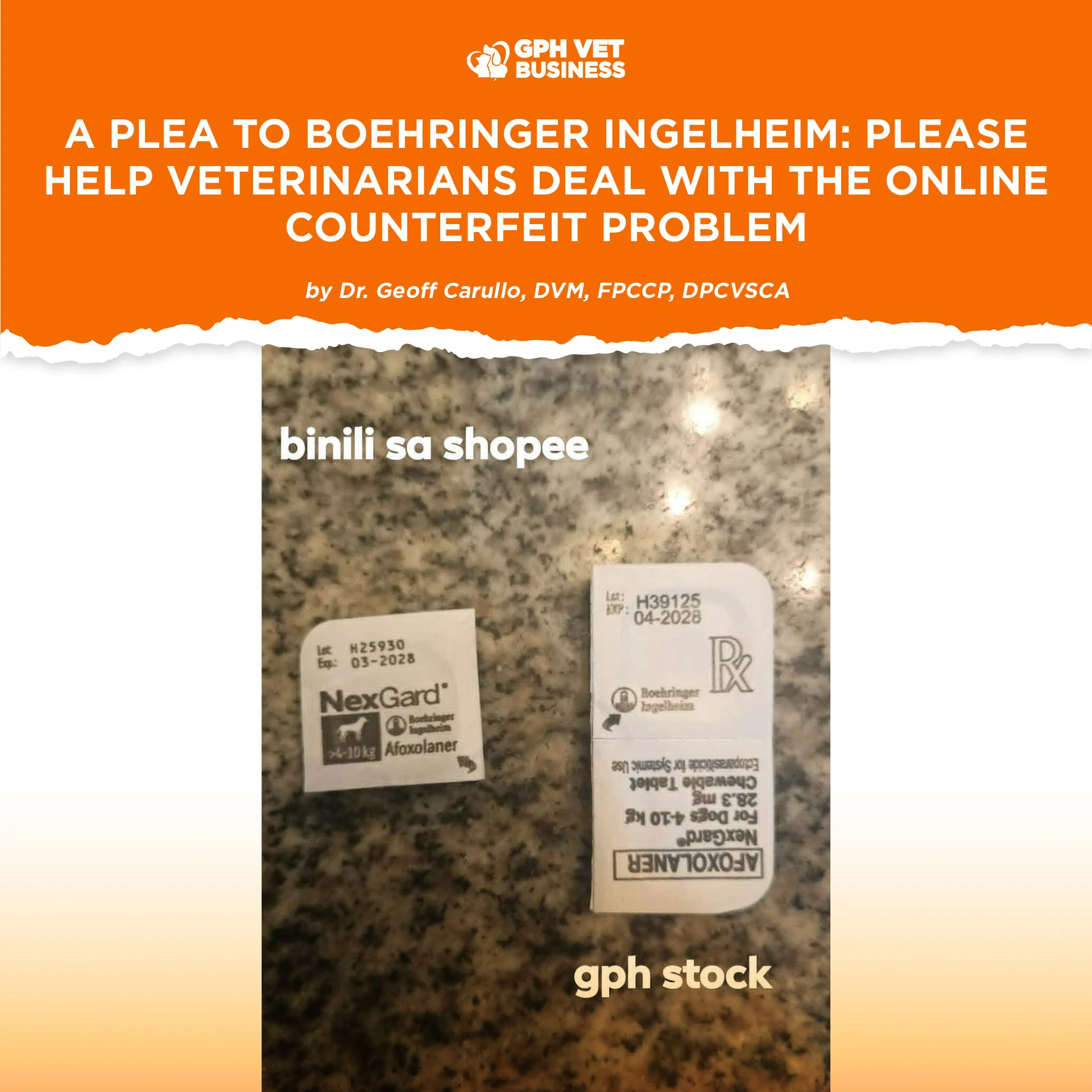
Today, one of my staff at Greenwoods Pet Hospital sent me a photo of a NexGard product brought in by a client.
The client had purchased it from Shopee.
The question from my staff was simple:
“Doc, original po kaya ito?”
Is this authentic?
And for a moment, I thought: Another thing veterinarians now have to worry about.
We already have patients to diagnose, laboratory results to interpret, treatments to monitor, clients to counsel, emergencies to manage, employees to supervise, and businesses to keep running.
Now apparently, we are also expected to become counterfeit-product investigators.


The Owner Just Wants to Know if It Is Safe
I understand why the owner asked.
If you buy a veterinary pharmaceutical product online and suddenly begin wondering whether it is genuine, of course you would hesitate to give it to your pet.
That is a legitimate concern.
But what exactly are veterinarians supposed to do?
- Compare the box?
- Inspect the foil?
- Check the printing?
- Study the lot number?
- Look at the expiration date?
- Compare it with our own stocks?
And after doing all of that, can we really give the owner a 100 percent guarantee based on appearance alone?
We cannot.
A veterinarian should not have to authenticate a pharmaceutical product purchased from an unknown online seller simply by looking at its packaging.


This Is Becoming Our Problem Too
This is why I am making a sincere appeal to Boehringer Ingelheim, particularly regarding products such as NexGard and NexGard Spectra.
Please help us.
Veterinarians are increasingly confronted with products purchased through Shopee, Lazada, Facebook, and other online channels. Some may be legitimate products. Some may have come through channels that veterinarians cannot verify. And when questions arise, the product eventually lands on our clinic table.
Then the veterinarian gets asked:
“Doc, original ba ito?”
We did not sell it.
We do not know the seller.
We do not know how it was sourced.
We do not know how it was stored before delivery.
We do not know its chain of custody.
Yet somehow, the responsibility of determining whether it is genuine is being passed to us.
It is exhausting.
We Need a System, Not Guesswork
This cannot be solved by asking veterinarians to become better at spotting fake packaging.
The manufacturer is in the best position to develop an authentication system that ordinary pet owners and veterinarians can actually use.
I hope Boehringer Ingelheim can consider stronger measures such as:
- an official online product-verification portal using lot or serial numbers;
- unique QR codes or authentication codes that consumers can verify directly;
- a publicly accessible list of authorized online sellers and distributors;
- a dedicated channel where veterinarians can submit suspicious products for verification;
- stronger coordination with Shopee, Lazada, and other marketplaces regarding unauthorized or suspicious listings;
- clearer public advisories explaining where consumers should safely purchase veterinary medicines.
Most importantly, there should be a straightforward answer when a pet owner asks:
“How can I know if the NexGard I bought online is authentic?”
The answer should not be:
“Ask your veterinarian to look at the box.”

Veterinarians Cannot Police the Entire Internet
This is not about preventing people from buying online.
Online commerce is already part of modern life, and it is not going away.
This is about protecting the integrity of veterinary medicines and giving consumers a reliable way to distinguish legitimate products from questionable ones.
Veterinarians can educate.
We can advise clients to purchase from trusted sources.
We can explain the risks of products with uncertain provenance.
But we cannot police every Shopee listing, every Lazada store, every Facebook seller, and every package that arrives at a client’s doorstep.
And we certainly should not be expected to certify a product as authentic simply because somebody brings it into our clinic.
Please Take This Burden Off the Veterinarian
So this is my plea to Boehringer Ingelheim:
Please do something more visible and decisive about your products being sold through online marketplaces.
Protect your brand.
Protect your legitimate distributors.
Protect veterinarians who prescribe and recommend your products.
Most importantly, protect the pet owners who trust the name printed on that box.
Because when confidence in a veterinary medicine becomes questionable, the problem does not stay online.
Eventually, it walks through our clinic door.
And then somebody asks us:
“Doc, original po kaya ito?”
We are tired of having to guess.
We need the manufacturer to help us answer.
Dr. Geoff Carullo is a Fellow and the current President of the Philippine College of Canine Practitioners.
Sharing this helps others understand what it really means to be a vet. Like and follow if you’re with us.