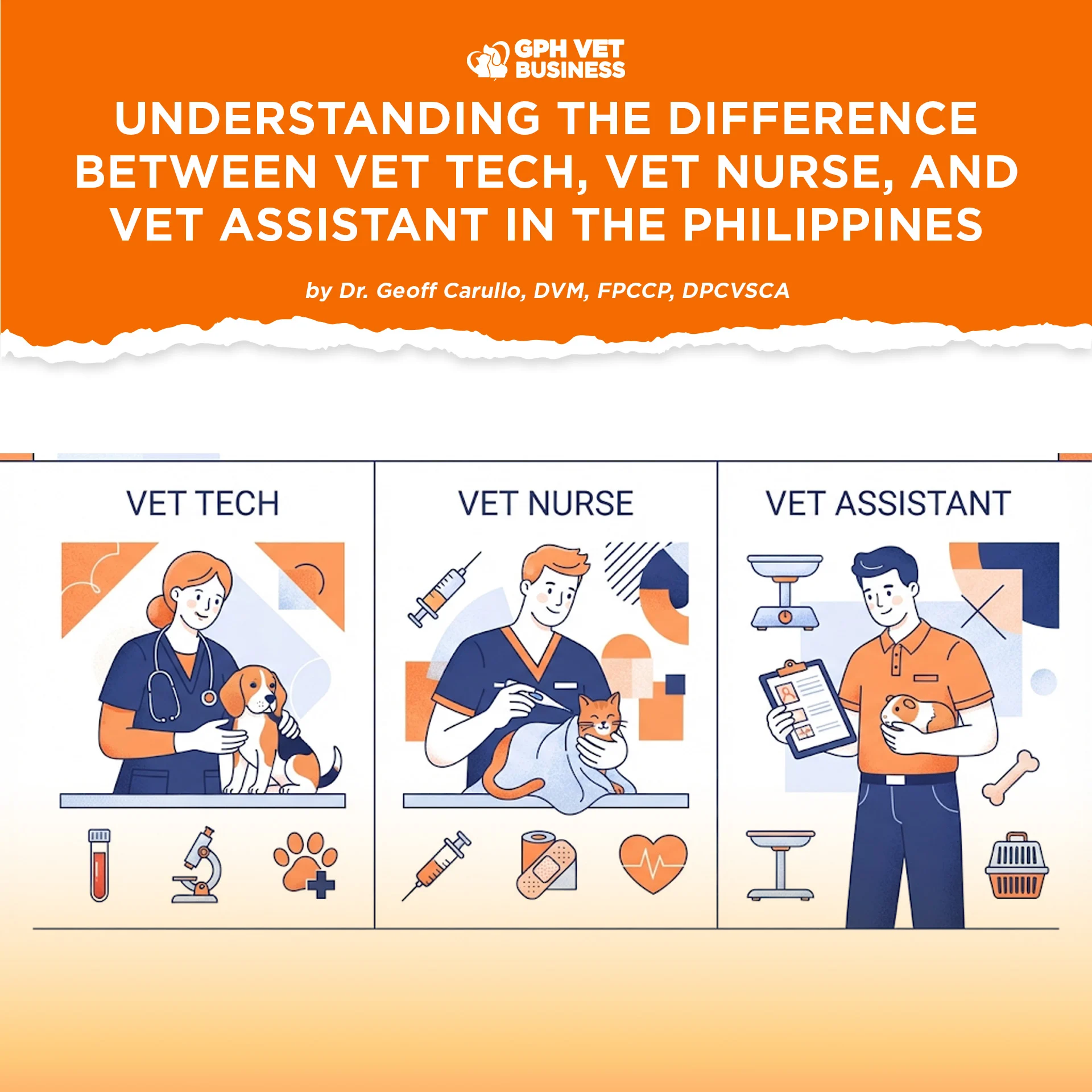
In veterinary clinics and hospitals across the Philippines, you’ll often hear terms like vet tech, vet nurse, and vet assistant used interchangeably.
But are they really the same? While the differences may seem subtle — especially in a local context where roles tend to overlap — each title actually comes with its own set of skills, training, and responsibilities.
Let’s break it down in the Philippine setting.


1. Veterinary Assistant (Vet Assistant)
Educational Background:
Usually trained on the job or through short vocational courses. Some are animal lovers who started as groomers or kennel caretakers and learned through experience.
Typical Roles in Clinics:
- Restraining pets during examination or procedures
- Cleaning kennels, exam tables, and equipment
- Assisting with basic tasks like weighing pets and taking vital signs
- Running errands (getting supplies, assisting in inventory)
- Comforting pet owners
Philippine Reality:
In many small clinics, vet assistants are the clinic’s all-around helpers. They don’t necessarily have formal education in veterinary medicine, but they play a crucial role in making day-to-day operations smooth.
2. Veterinary Technician (Vet Tech)
Educational Background:
Graduates of a Bachelor of Science in Veterinary Technology. They have a 4-year degree focused on animal health and medical procedures.
Typical Roles in Clinics:
- Assisting veterinarians in surgery
- Collecting and preparing samples for lab testing
- Performing diagnostic tests (e.g., blood smears, fecal exams, urinalysis)
- Monitoring anesthesia and vital signs
- Educating clients on pet care


Philippine Reality:
This is a highly skilled role. Vet techs are the equivalent of medical technologists or surgical nurses in human hospitals. In some clinics, their full potential isn’t maximized due to lack of awareness from practice owners. However, many vet techs are starting to gain recognition, especially in advanced or ISO-accredited animal hospitals.
3. Veterinary Nurse (Vet Nurse)
Educational Background:
In the Philippine context, “vet nurse” is not yet an officially regulated profession. However, the term is often used interchangeably with “vet tech”, especially in private hospitals that pattern their systems after Australian or UK standards, where “vet nurse” is the norm.
Typical Roles in Clinics:
Identical to that of a vet tech: assisting in surgery, handling anesthesia, conducting tests, administering medications, etc.
Philippine Reality:
Since “vet nurse” is more common in Australia, New Zealand, and the UK, the term is usually used by Filipino veterinary professionals who trained or worked abroad, or those who apply international standards in their practice. Some clinics prefer to use this title for branding or marketing (e.g., “nurse” sounds more familiar to the public than “tech”).

Final Thoughts
In the Philippine setting, the roles may overlap depending on the clinic size, budget, and management style. What matters most is that every team member is respected and empowered to do their best work — whether you’re a vet assistant supporting the clinic’s flow, a vet tech running diagnostics, or a vet nurse managing post-op care.
As our industry evolves, it’s important for practice owners, clients, and even government agencies to recognize these roles and their value in the healthcare team. Because behind every successful veterinarian is a well-trained support crew — and they deserve to be seen.
Sharing this helps others understand what it really means to be a vet. Like and follow if you’re with us.
Dr. Geoff Carullo is a Fellow and the current President of the Philippine College of Canine Practitioners.