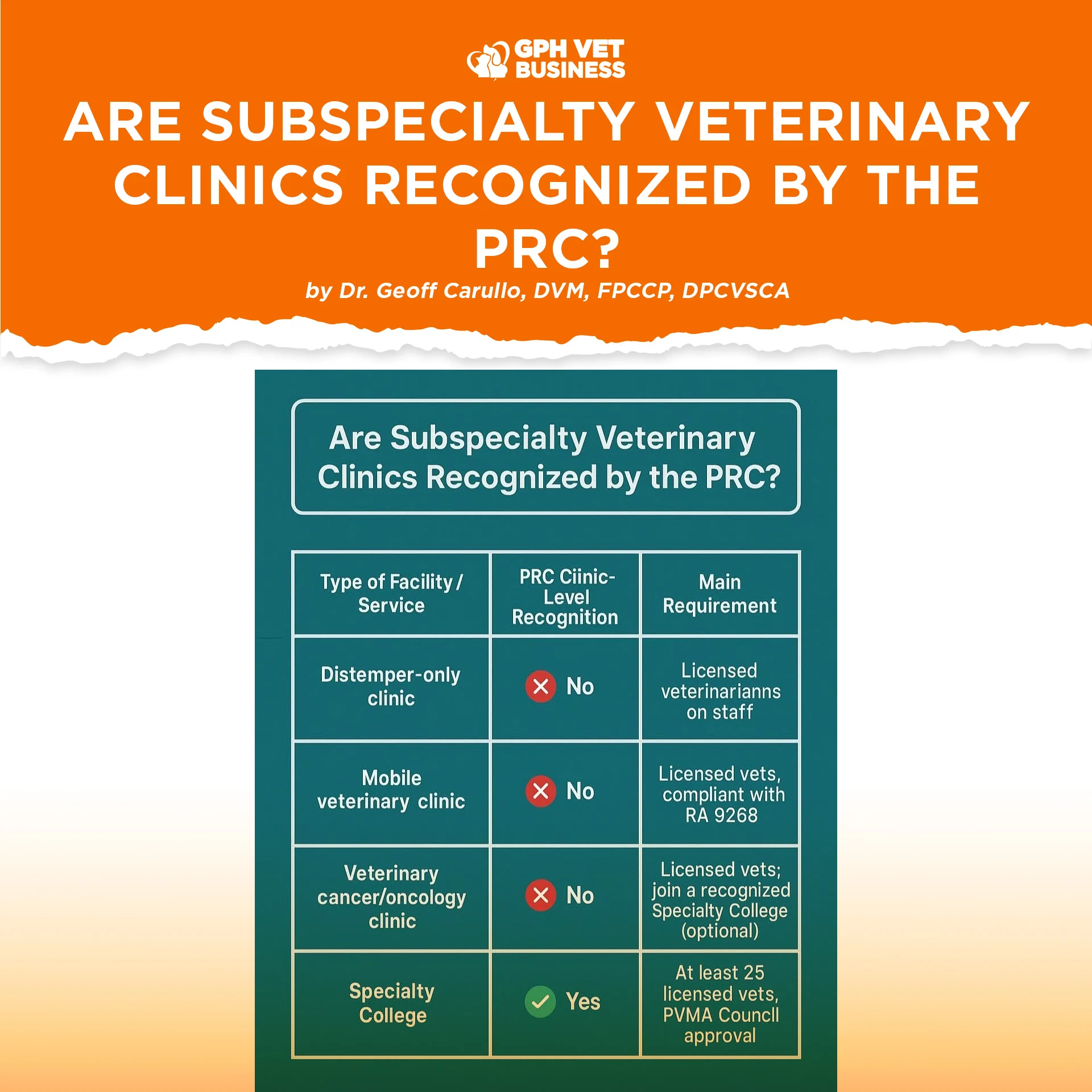
In recent years, veterinary practice in the Philippines has seen the rise of subspecialty clinics — facilities focusing on very specific areas like distemper treatment centers, mobile veterinary services, or veterinary cancer clinics.
These facilities meet a growing demand for targeted veterinary care, but one question often arises: Does the Professional Regulation Commission (PRC) officially recognize or regulate these subspecialties?


1. PRC’s Role in Veterinary Practice
The Professional Regulation Commission (PRC), through the Professional Regulatory Board of Veterinary Medicine, is responsible for:
- Licensing veterinarians in the Philippines.
- Regulating professional standards.
- Enforcing the provisions of the Philippine Veterinary Medicine Act of 2004 (RA 9268).
It is important to note: The PRC regulates veterinarians, not veterinary clinics as business entities.
This means the PRC ensures that the individual veterinarian is duly licensed and compliant with ethical and professional standards — regardless of whether they work in a general practice, a specialized facility, or a mobile unit.
2. Specialization vs. Subspecialty Clinics
While the PRC does not issue a special license for clinics that market themselves as “distemper facilities,” “mobile vet clinics,” or “cancer vet clinics,” it does recognize veterinary specialties in principle.
Specialization in veterinary medicine is formally recognized through Specialty Colleges, which are governed under the Philippine Veterinary Medical Association (PVMA) framework. A Specialty College is a non-stock, non-profit group composed of at least 25 licensed veterinarians dedicated to a specific discipline or species. Examples internationally include oncology, dermatology, and internal medicine.
If a group of veterinarians wants their specialty officially recognized, they must apply through the PVMA’s Council on Specialty Colleges, not directly through the PRC.


3. Mobile Veterinary Clinics
Mobile clinics are becoming more common, particularly for rural outreach, vaccination drives, and community spay-neuter programs.
The PRC does not have a separate category or license for “mobile” practice.
The main requirement remains: Every veterinarian working in the mobile clinic must hold a valid PRC license and comply with RA 9268 and other applicable laws.
Any special services (e.g., laboratory diagnostics, surgery) must still meet accepted veterinary standards, whether delivered in a fixed facility or on the road.
4. Practical Implications for Practice Owners
If you plan to operate a specialized facility — whether focused on a single disease like distemper, a specific service like cancer care, or a mobile platform — here’s what you need to remember:
- Licensure is key. All practicing veterinarians must have a valid PRC license.
- No “clinic-level” PRC recognition. There is no PRC-issued certification for “subspecialty” clinics.
- Specialty recognition is through PVMA. For official specialty status, organize or join a Specialty College under PVMA guidelines.
- Compliance with other laws. Beyond PRC requirements, you must comply with local business permits, Bureau of Animal Industry (BAI) regulations for certain services, and, if applicable, Department of Agriculture or FDA rules for medicines and biologics.

In conclusion:
Subspecialty veterinary clinics in the Philippines are fully permissible to operate — but they are not separately regulated or accredited by the PRC as unique facility types. Recognition of a “specialty” is given at the professional group level through PVMA, while PRC’s mandate remains the licensure and regulation of individual veterinarians.
Sharing this helps others understand what it really means to be a vet. Like and follow if you’re with us.
Dr. Geoff Carullo is a Fellow and the current President of the Philippine College of Canine Practitioners.