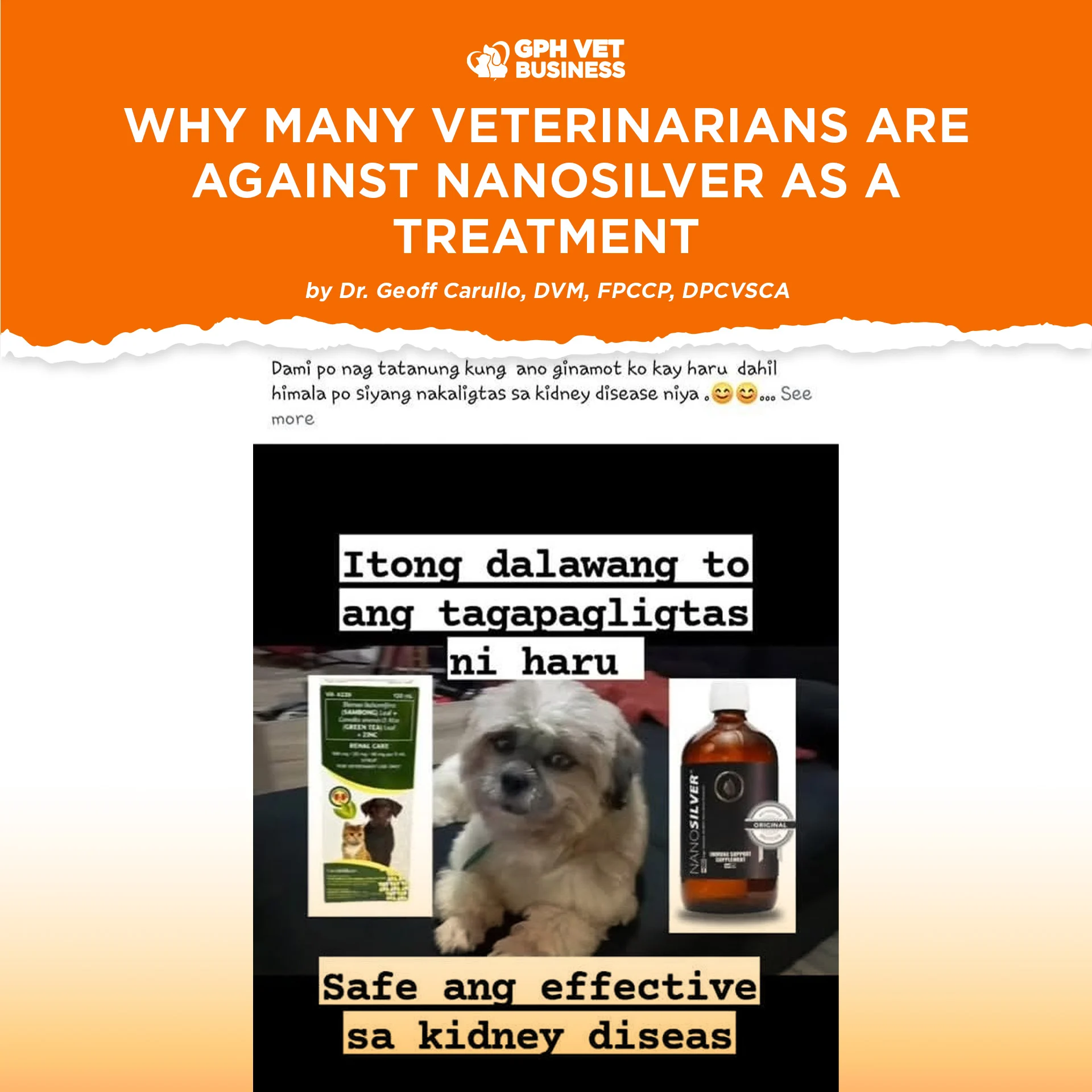
In the ever-evolving landscape of veterinary medicine, new products often arrive with promises of revolutionizing care. One such contender is nanosilver — tiny particles of silver measured in nanometers, marketed as a powerful antimicrobial that can target bacteria, fungi, and even viruses. From wound sprays to oral supplements, nanosilver has entered the veterinary market with bold claims and glossy packaging.
But despite the marketing hype, many veterinarians remain cautious — even resistant — to using nanosilver as a treatment. The reason is not stubbornness against innovation, but rather a firm commitment to evidence-based medicine, patient safety, and responsible practice.


The Allure of Nanosilver
Silver’s antimicrobial properties are nothing new; ancient civilizations used silver vessels to preserve water and prevent spoilage. Modern science has refined silver into nanoparticles, making it far more reactive and theoretically more effective at killing microbes. Supporters claim that nanosilver:
- Can eliminate a broad range of pathogens
- Prevents biofilm formation in wounds
- Offers an alternative to antibiotics in an age of antimicrobial resistance
On paper, it sounds like a breakthrough. But in the clinic, veterinarians must ask a harder question: Does it truly work, and is it safe for animals?
The Evidence Problem
For any treatment to earn a veterinarian’s trust, it must be supported by strong, peer-reviewed clinical trials — ideally in the same species being treated. In the case of nanosilver, most available data comes from laboratory (in vitro) studies or experiments in non-target species. While test tubes and Petri dishes may show antimicrobial activity, the jump to real-world veterinary patients is not straightforward.
Without large-scale, well-designed in vivo studies in dogs, cats, and livestock, the claims for nanosilver remain unproven in practical veterinary medicine.


Safety and Toxicity Concerns
Silver is not a nutrient; it serves no biological purpose in an animal’s body. In nanoparticle form, silver can enter cells more easily, potentially accumulating in vital organs such as the liver, kidneys, and spleen. Over time, this bioaccumulation could lead to:
- Argyria — a permanent bluish-gray discoloration of skin or mucous membranes due to silver deposits
- Organ damage
- Unknown long-term toxic effects
With no clearly established safe dosage for pets, the margin between “possibly helpful” and “possibly harmful” is far too narrow for comfort.
Regulatory Loopholes and Quality Issues
Many nanosilver products are marketed as “supplements” or “wellness enhancers” rather than registered veterinary drugs. This allows them to bypass the rigorous testing and approval process required for pharmaceuticals. As a result:
- Concentrations can vary wildly between brands — and even between batches
- Purity and particle size may be inconsistent
- Safety claims may be unverified
This lack of standardization makes it impossible for veterinarians to prescribe nanosilver with confidence.

The Danger of Misdirection
Some companies go beyond antimicrobial claims, promoting nanosilver as a cure for everything from skin allergies to viral diseases like parvovirus. Such claims can be dangerous — not because nanosilver is inherently evil, but because they delay proper treatment. In time-sensitive cases like parvo, every hour counts; choosing an unproven treatment can mean the difference between life and death.
Environmental Considerations
The discussion doesn’t end with the patient. Nanosilver, once excreted or washed away, can enter wastewater and disrupt beneficial microbes in the environment. Overuse could also contribute to microbial resistance, compounding one of the greatest challenges in both human and veterinary medicine.
The Veterinary Perspective
Veterinarians are not against progress. They welcome innovation — but innovation must come with proof, safety, and accountability. Without clear evidence that nanosilver is more effective, safer, or more cost-efficient than existing treatments, it cannot be justified as a first-line therapy.
For now, some vets may use nanosilver in specific, controlled situations, such as wound dressings or device coatings. But as a routine systemic treatment, it remains on the fringe, awaiting the rigorous trials that could either validate or disprove its promise.
Bottom Line
Until nanosilver meets the same scientific and regulatory standards as established veterinary medicines, most veterinarians will choose caution over risk. In a profession where every decision impacts a living being’s welfare, “better safe than sorry” isn’t just a saying — it’s a duty.
Sharing this helps others understand what it really means to be a vet. Like and follow if you’re with us.
Dr. Geoff Carullo is a Fellow and the current President of the Philippine College of Canine Practitioners.