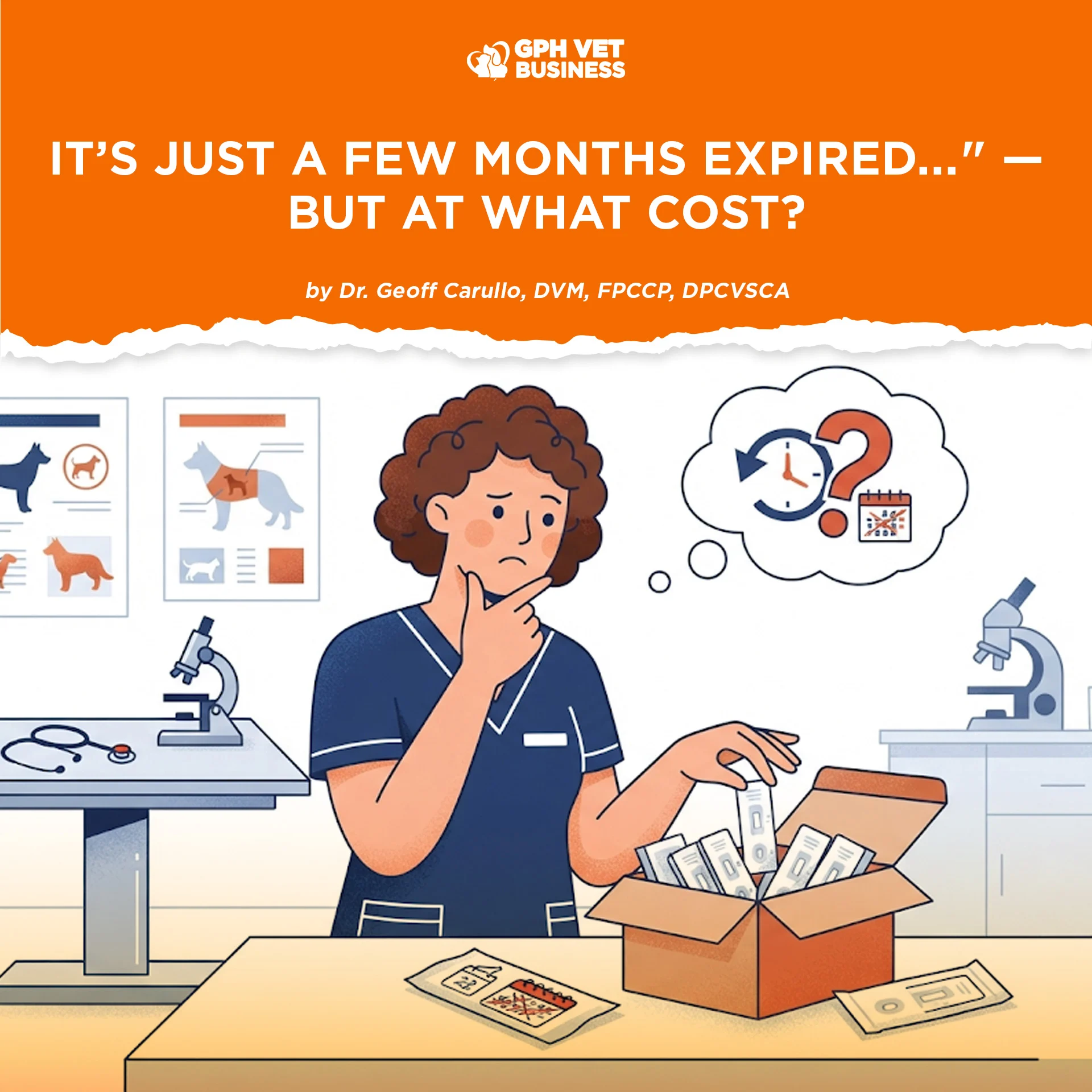
In the hustle of daily vet life, we’ve all heard it:
- “This parvo kit expired last month. It still works, right?”
- “The Co-Amoxiclav antibiotic is only 3 months past due—sayang naman.”
- “I gave my dog leftover Marbocyl meds from last year. It helped him before.”
But here’s the uncomfortable truth:
Expired doesn’t mean safe.
Expired doesn’t mean effective.
And in some cases… expired means deadly.
EXPIRED TEST KITS: You’re Not Diagnosing—You’re Gambling
Real scenario: A vet uses an expired FeLV/FIV combo kit.
Result: Negative.
Reality: The cat was actually FIV-positive.
Outcome?
The cat gets adopted into a multi-cat household. A few months later, the client returns, furious—and heartbroken—after two cats test positive. The blame? It all goes back to one expired kit.
Why it happens:
- Reagents break down and lose reactivity.
- Antigen/antibody detection becomes unreliable.
- Control lines disappear or fade.
- You could miss serious, even zoonotic, diseases.
Bottom line: A ₱500 test kit isn’t worth the risk of a misdiagnosis, lawsuit, or a dying patient.


EXPIRED INJECTABLES: What You Don’t See Can Kill
Example: You give a dog a dose of expired amoxicillin for a severe infection.
You hope it helps. The fever drops a bit… then spikes again.
The infection spreads.
The owner returns angry, the dog worse—and you’re stuck explaining why the meds didn’t work.
For vaccines:
An expired Rabisin vaccine might not stimulate immunity.
The pet gets exposed, bitten—and later dies.
The owner gets post-exposure prophylaxis and files a formal complaint.
Even sealed injectables aren’t safe past expiry.
- Potency drops.
- Preservatives degrade.
- Sterility is no longer guaranteed.
- Multidose vials can harbor bacteria.
One expired vaccine could cost a life—and your PRC license. The hard evidence on the vaccination card speaks for itself.


EXPIRED ORAL MEDS: The Illusion of Help
A client finds an old metronidazole bottle in their medicine cabinet and gives it to their vomiting dog.
The dog seems fine at first—but after two doses, develops neurological signs.
Turns out the drug had degraded and caused toxicity.
Other examples:
- Expired tetracyclines can cause kidney damage.
- Expired NSAIDs may lose potency but still cause GI irritation.
- Expired dewormers may not fully eliminate parasites—leading to reinfection and resistance.
Expired meds don’t just “not work”—they can actively harm.
Let’s Be Honest: Why Do Vets and Clients Still Use Them?
- “Sayang, mahal bili ko diyan. Nag over stock kasi.”
- “Wala pang pondo for new stocks.”
- “Walang pumapansin, wala pang reklamo.”
- “Pwede pa ‘yan up to 6 months after expiry—sabi ng med rep.”
But let me ask you:
- If something goes wrong—are you really ready to take that hit?
- Are you ready to face an irate client, a dead patient, and a PRC board complaint?
- Are you willing to risk your ethics, name, and license to save a few hundred pesos?

DO THIS INSTEAD
- Always check dates in your pharmacy, cold storage, and test kit inventory.
- Label clearly. First to expire = first to use.
- Train your team: “If it’s expired, it’s discarded. No exceptions.”
- Be transparent with clients: “We don’t compromise on safety. We never use expired products.”
You don’t become an excellent vet by taking shortcuts.
You become one by holding the line—even when no one is watching.
Safety is not optional. It’s our oath.
Using expired products isn’t “resourceful.”
It’s risky, unethical, and dangerous. Makonsyensya ka naman. Kaya ka minamalas.
If something feels wrong, it probably is.
So next time you’re tempted to use something “just a little expired,” ask yourself:
Would you give that to your own pet?
If the answer is no—then don’t give it to someone else’s. Lalo na ang paying clients.
Dr. Geoff Carullo is a Fellow and the current President of the Philippine College of Canine Practitioners.
Sharing this helps others understand what it really means to be a vet. Like and follow if you’re with us.