One question I receive surprisingly often from fellow veterinarians is:
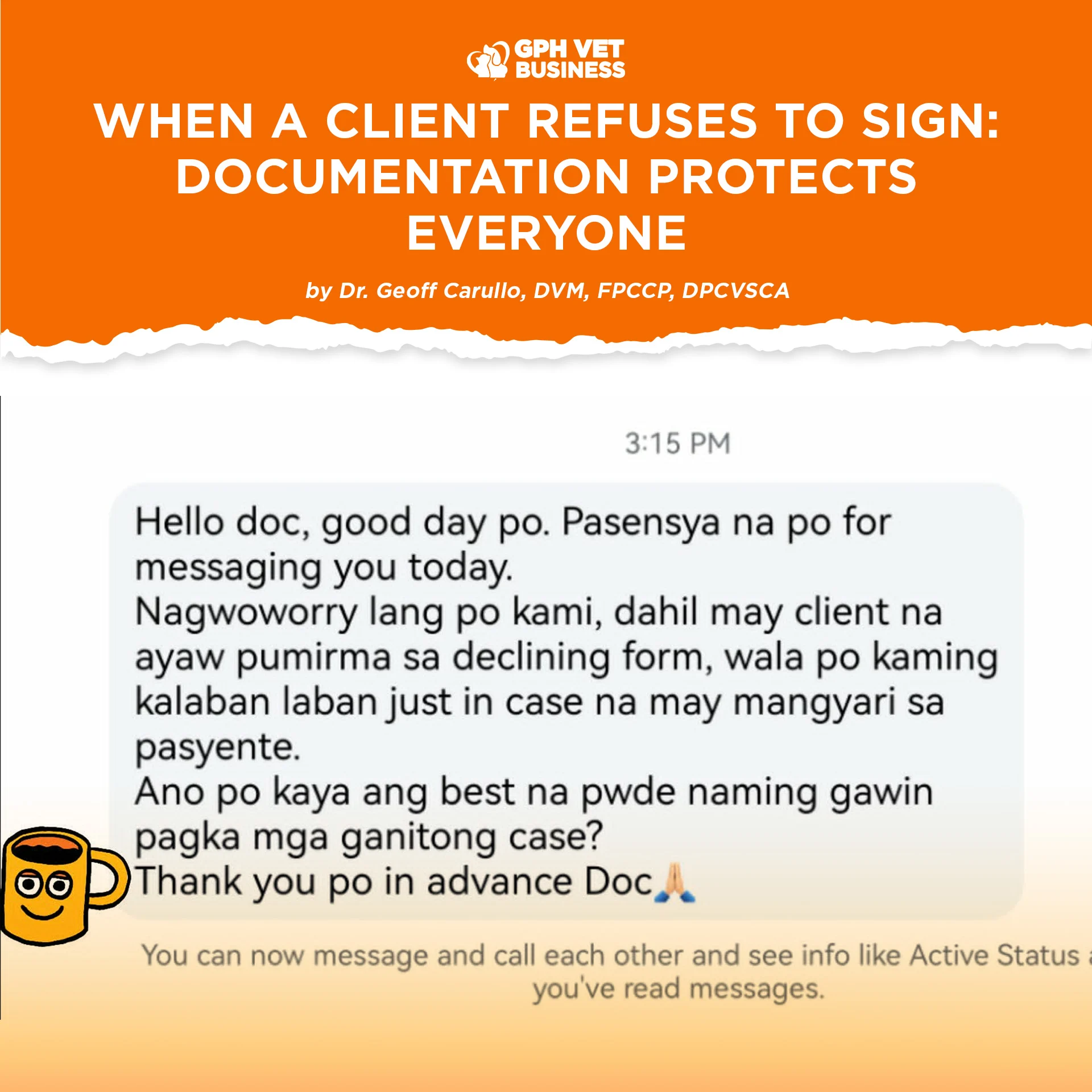
“Doc, what if the client refuses to sign our Declining Treatment Form? Wala na ba kaming protection?”
The short answer is no.
A client’s refusal to sign does not erase the fact that the veterinarian fulfilled the duty to explain the patient’s condition, recommended treatment, associated risks, and possible consequences of refusing medical advice.
What changes is how the event should be documented.
Refusing to Sign Is Not the Same as Refusing Documentation
Some clients mistakenly believe that by refusing to sign a form, there will be no record of what happened.
That is incorrect.
If a client refuses to acknowledge the discussion in writing, the veterinary clinic should immediately create its own contemporaneous record.
One practical method is an Affidavit of Refusal to Sign, executed by the attending veterinarian or clinic employee, describing exactly what transpired.
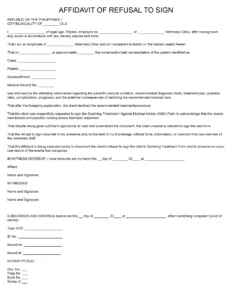
Figure 1. Sample Affidavit of Refusal to Sign a Declining Treatment Form This sample affidavit illustrates one method of documenting that a client declined to sign a Declining Treatment (Against Medical Advice) Form after receiving an explanation of the recommended veterinary care, associated risks, available alternatives, and potential consequences. The affidavit should identify the patient and client, summarize the discussion, state that the client voluntarily refused to sign the form, and be executed by the attending veterinarian or clinic representative before a notary public, when appropriate. Whenever feasible, the refusal should be witnessed by both a clinic employee and an independent witness. The event should also be recorded in the patient’s medical record, any available CCTV footage should be preserved according to the clinic’s retention policy, and any subsequent acceptance of treatment should be documented through a separate informed consent form.
The affidavit should state that:
- the patient’s condition was explained;
- the recommended diagnostics or treatment were discussed;
- the possible risks of refusing treatment were communicated;
- the client was asked to sign the Declining Treatment (or Against Medical Advice) Form;
- the client voluntarily refused to sign.
This creates a written record that the discussion actually occurred.


Have Witnesses
Whenever possible, the refusal should be witnessed.
Ideally:
- A clinic employee, such as a receptionist, veterinary assistant, or technician.
- An independent witness, when available, such as another client present in the reception area.
Independent witnesses generally carry greater evidentiary value because they have no employment relationship with the clinic.
Medical Records Matter More Than Many People Realize
Aside from the affidavit, the veterinarian should also document the encounter in the patient’s medical record.
Include details such as:
- the recommendations given;
- alternative options discussed;
- risks explained;
- questions asked by the client;
- the client’s decision to decline;
- the refusal to sign the form.
Medical records created at the time of the consultation are often among the most important pieces of evidence if questions arise later.


Documentation Is Not About Distrust
Some people become offended when asked to sign informed consent or declining treatment forms.
In reality, these documents exist to protect both parties.
They help demonstrate that the client received sufficient information to make an informed decision, while also protecting veterinarians from later claims that risks were never explained.
Good documentation does not replace good medicine.
It complements it.
The Best Protection Is Still Communication
No form can replace a respectful conversation.
Clients are far more likely to cooperate when they understand that the document is not a waiver of negligence, but simply an acknowledgment that the veterinarian has explained the available options, potential risks, and possible outcomes.
If a client still refuses to sign, remain calm.
- Document the refusal.
- Have witnesses.
- Prepare an affidavit if necessary.
- Continue practicing good medicine.
Because in veterinary practice, what is properly documented today may become your strongest evidence tomorrow.

Dr. Geoff Carullo is a Fellow and the current President of the Philippine College of Canine Practitioners.
Sharing this helps others understand what it really means to be a vet. Like and follow if you’re with us.