The recently filed lawsuit involving an Oregon Veterinary Hospital and Zoetis has captured the attention of veterinarians, pathologists, legal professionals, and the rapidly growing field of veterinary artificial intelligence. While the case centers on allegations that an AI-assisted cytology interpretation contributed to a delayed cancer diagnosis, its significance extends far beyond the individual parties involved. Because the matter is still pending, the allegations remain to be proven in court, and no final judicial determination has been made.
Regardless of its ultimate outcome, this case is likely to become a landmark legal reference for the global veterinary profession.
Not because AI is necessarily unsafe.
Not because veterinarians should stop embracing technology.
But because it forces the profession to examine a question that has long existed in medicine:
What is the legal and clinical role of a diagnostic disclaimer?
Every diagnostic test has limitations.
This principle applies equally to rapid test kits, hematology analyzers, PCR assays, imaging studies, histopathology, cytology, and now artificial intelligence.
No diagnostic platform is 100% sensitive.
No diagnostic platform is 100% specific.
Every diagnostic result carries a degree of uncertainty.
That is why manufacturers include disclaimers.
Many clinicians view disclaimers as mere legal fine print.
In reality, they are scientific statements describing the intended use, limitations, and appropriate interpretation of a diagnostic tool.
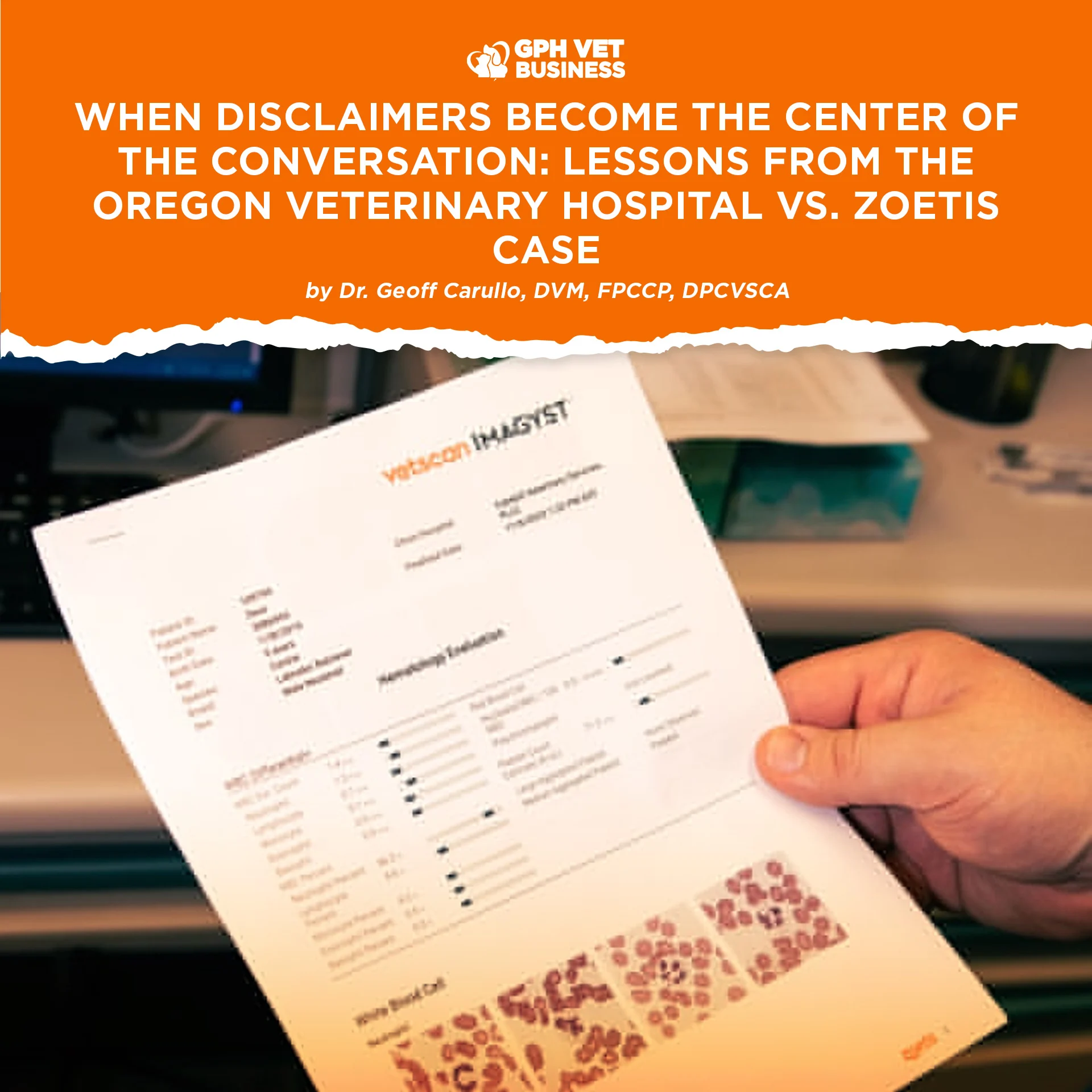
Zoetis, for example, states in its Vetscan Imagyst® documentation:
“This report and the results contained herein relate only to the section(s) of the slide(s) submitted for evaluation as received. Additional material or content present on other sections of the slide(s) or on other slide(s) not submitted for evaluation may compromise the accuracy of the diagnosis.”
The company also explains that Vetscan Imagyst is designed to provide AI-assisted diagnostic support, and that expert pathology review remains available for additional diagnostic confidence in appropriate cases.
These statements are important.
They remind veterinarians that diagnostic conclusions depend not only on the software itself but also on:
- Sample collection
- Slide preparation
- Staining quality
- Scanner performance
- Specimen representativeness
- Clinical context
Artificial intelligence cannot recognize cells that were never collected.
It cannot analyze tissue that never reached the slide.
It cannot replace clinical judgment.
From a medico-legal standpoint, disclaimers also define the intended use of a medical device.
They explain what the technology is designed to do—and, equally important, what it is not designed to do.
Courts have long examined product labeling, instructions for use, and manufacturer warnings when evaluating disputes involving medical devices.
As AI becomes increasingly integrated into veterinary practice, those disclaimers may receive greater judicial scrutiny than ever before.
This is why the Oregon case could become a trial case watched around the world.
It may influence future discussions about the legal responsibilities of manufacturers, veterinarians, hospitals, software developers, and users of AI-assisted diagnostic systems.
The litigation may also shape expectations regarding informed clinical use of AI, documentation, quality assurance, and when confirmatory testing should be pursued.


Importantly, none of this means that AI should be abandoned.
On the contrary, AI has enormous potential to improve access to diagnostics, increase workflow efficiency, reduce turnaround times, and assist clinicians in identifying abnormalities that deserve further investigation.
However, AI should be viewed as exactly what responsible manufacturers describe it to be:
A clinical decision-support tool.
Not an autonomous diagnostician.
The veterinarian remains responsible for integrating the patient’s history, physical examination, laboratory findings, imaging studies, and overall clinical picture before making diagnostic or therapeutic decisions.


Perhaps the greatest lesson from this case is one that extends beyond artificial intelligence.
As veterinarians, we often focus on the numerical result, the image, or the interpretation.
Rarely do we read the disclaimer.
Maybe we should.
Because sometimes the smallest paragraph in the report carries the biggest legal and clinical implications.
In the era of artificial intelligence, the disclaimer is no longer just fine print.
It is part of the diagnostic process itself.

References
- The Independent. Oregon vet sues AI company saying misdiagnosis of cancer tumor led to 11-year-old dog’s death. Published August 2026.
- Zoetis Diagnostics. Vetscan Imagyst® Platform Overview. Describes Vetscan Imagyst as an AI-assisted diagnostic platform intended to support veterinary decision-making.
- Zoetis. Zoetis Launches AI Masses, the New AI-Powered Cytologic Capability for Vetscan Imagyst® (June 2, 2025). Discusses AI-assisted cytology, expert clinical pathologist review, and intended clinical use.
Dr. Geoff Carullo is a Fellow and the current President of the Philippine College of Canine Practitioners.
Sharing this helps others understand what it really means to be a vet. Like and follow if you’re with us.