Artificial intelligence is transforming veterinary medicine.
From automated cytology and digital pathology to radiographic interpretation and laboratory image analysis, AI promises faster results, improved efficiency, and greater access to diagnostic support.
But a recent lawsuit in Oregon reminds us of an important truth.
Artificial intelligence should support veterinary decisions, not replace veterinary judgment.
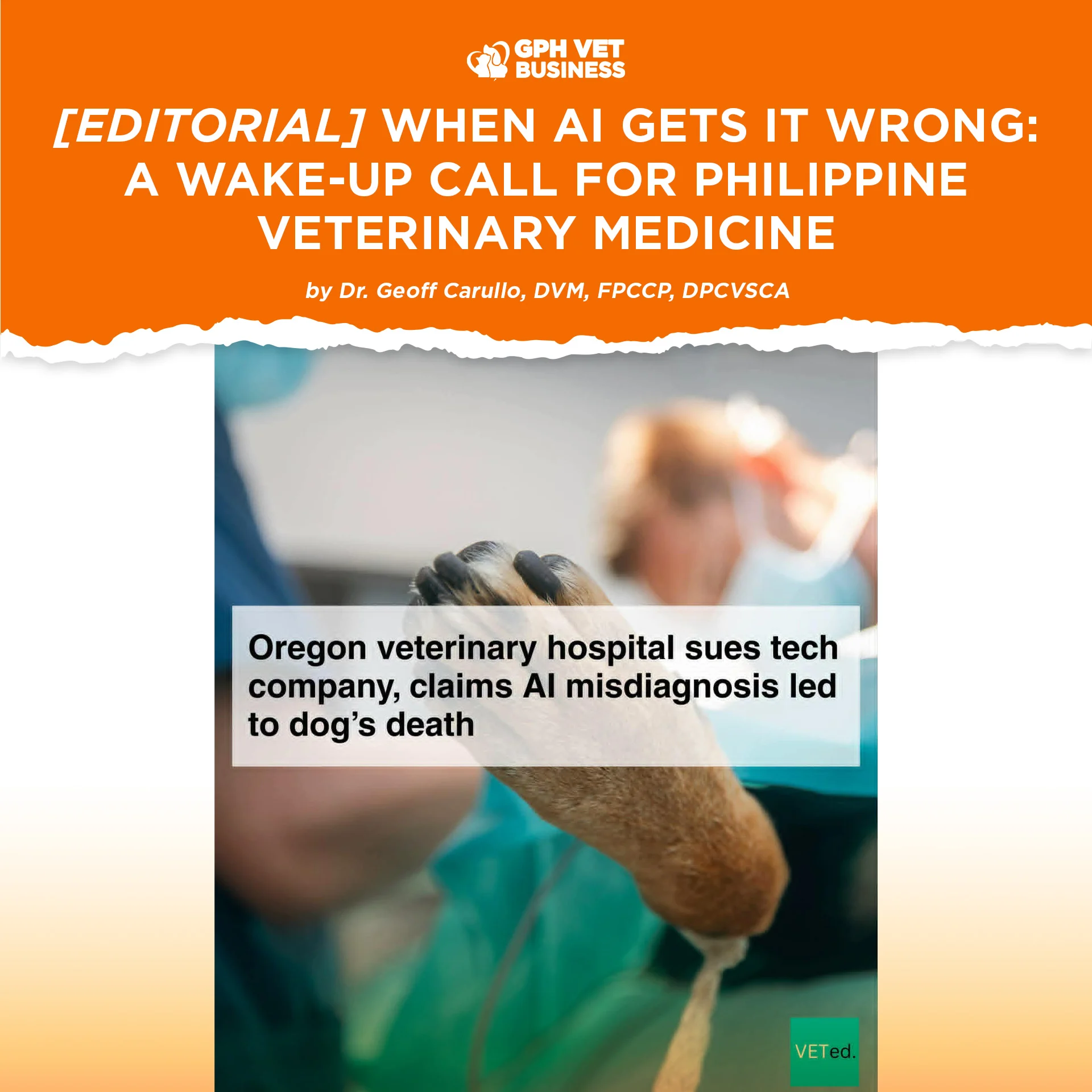
According to reports, an Oregon veterinary hospital has sued an animal health technology company after an AI-assisted cytology system allegedly classified a malignant tumor as an inflammatory lesion. The lawsuit claims this contributed to an inappropriate initial surgical approach, a second surgery, and eventually the patient’s death. The allegations remain before the courts and have not yet been proven.
Regardless of the legal outcome, the case raises an important question for veterinarians worldwide, including those in the Philippines.


AI Is a Tool, Not the Clinician
Many people think AI gives answers.
It doesn’t.
It gives interpretations based on the data it receives.
Just as a laboratory analyzer may produce an erroneous result due to poor sample quality, AI systems can also generate incorrect interpretations because of limitations in their algorithms, training data, or the information available to them.
No diagnostic tool is infallible.
That is why veterinarians are trained to integrate multiple sources of information before making clinical decisions.
A diagnosis is rarely based on a single test alone.
It combines:
- History
- Physical examination
- Laboratory findings
- Imaging studies
- Cytology or histopathology
- Clinical experience
- Professional judgment
AI is only one piece of that puzzle.
The Philippine Reality
Here in the Philippines, many veterinary clinics are beginning to adopt AI-assisted technologies.
These include automated fecal analyzers, digital cytology platforms, image recognition software, and decision-support systems.
These innovations are welcome.
They improve efficiency, reduce turnaround time, and can help standardize interpretations.
However, Philippine veterinary practice also presents unique challenges.
Many clinics operate with limited personnel.
Some rely on referral laboratories.
Some cases arrive with incomplete histories or financial limitations that prevent a full diagnostic workup.
In these situations, there may be a temptation to place too much confidence in a single AI-generated report.
That would be a mistake.


The Veterinarian Remains Responsible
An AI system cannot examine the patient.
- It cannot palpate a mass.
- It cannot appreciate subtle changes in behavior.
- It cannot discuss treatment options with the owner.
Most importantly, it cannot assume professional responsibility for the outcome.
That responsibility still belongs to the attending veterinarian.
Just as clinicians do not blindly accept every laboratory result without correlating it with the patient, AI-generated interpretations must also undergo clinical validation.
Technology Should Make Us Better, Not Less Critical
The greatest danger of AI is not that it occasionally makes mistakes.
Humans make mistakes too.
The greater danger is when clinicians stop questioning the machine.
Medicine has always relied on critical thinking.
If an AI interpretation does not match the patient’s history, physical findings, imaging, or clinical progression, veterinarians should feel comfortable questioning it, repeating the test, obtaining a second opinion, or submitting samples to another laboratory.
Good clinicians verify.
They do not simply accept.

Looking Ahead
Artificial intelligence will undoubtedly become a permanent part of veterinary medicine.
Its potential is enormous.
It may improve diagnostic accuracy, shorten turnaround times, reduce costs, and expand access to specialist-level support for clinics that would otherwise have limited resources.
But technology should never replace clinical reasoning.
Instead, it should enhance it.
The best veterinary care will not come from veterinarians competing with AI.
It will come from veterinarians who know when to trust AI, when to question it, and when the patient in front of them tells a different story.
The future of veterinary medicine is not human or artificial intelligence.
It is human intelligence, strengthened by artificial intelligence, with the veterinarian always remaining accountable for the final clinical decision.
Sources
- Independent. Oregon vet sues AI company saying misdiagnosis of cancer tumor led to 11-year-old dog’s death. Published August 2026.
- Cestonaro C, et al. Defining medical liability when artificial intelligence is applied in clinical practice: A systematic review. Frontiers in Medicine. 2023. Discusses professional responsibility and liability when AI-assisted diagnostic systems contribute to medical decision-making.
- American Veterinary Medical Association (AVMA). Principles of Veterinary Medical Ethics of the AVMA. Available at: https://www.avma.org/resources-tools/avma-policies/principles-veterinary-medical-ethics
- World Small Animal Veterinary Association (WSAVA). Guidelines and Global Standards for Companion Animal Practice. Available at: https://wsava.org
Editorial Disclaimer
This article discusses a recently filed lawsuit in Oregon involving an AI-assisted veterinary diagnostic system. The allegations remain before the courts, and no finding of liability has been made. The purpose of this editorial is to discuss the responsible integration of artificial intelligence into veterinary practice, not to determine legal fault.
Dr. Geoff Carullo is a Fellow and the current President of the Philippine College of Canine Practitioners.
Sharing this helps others understand what it really means to be a vet. Like and follow if you’re with us.