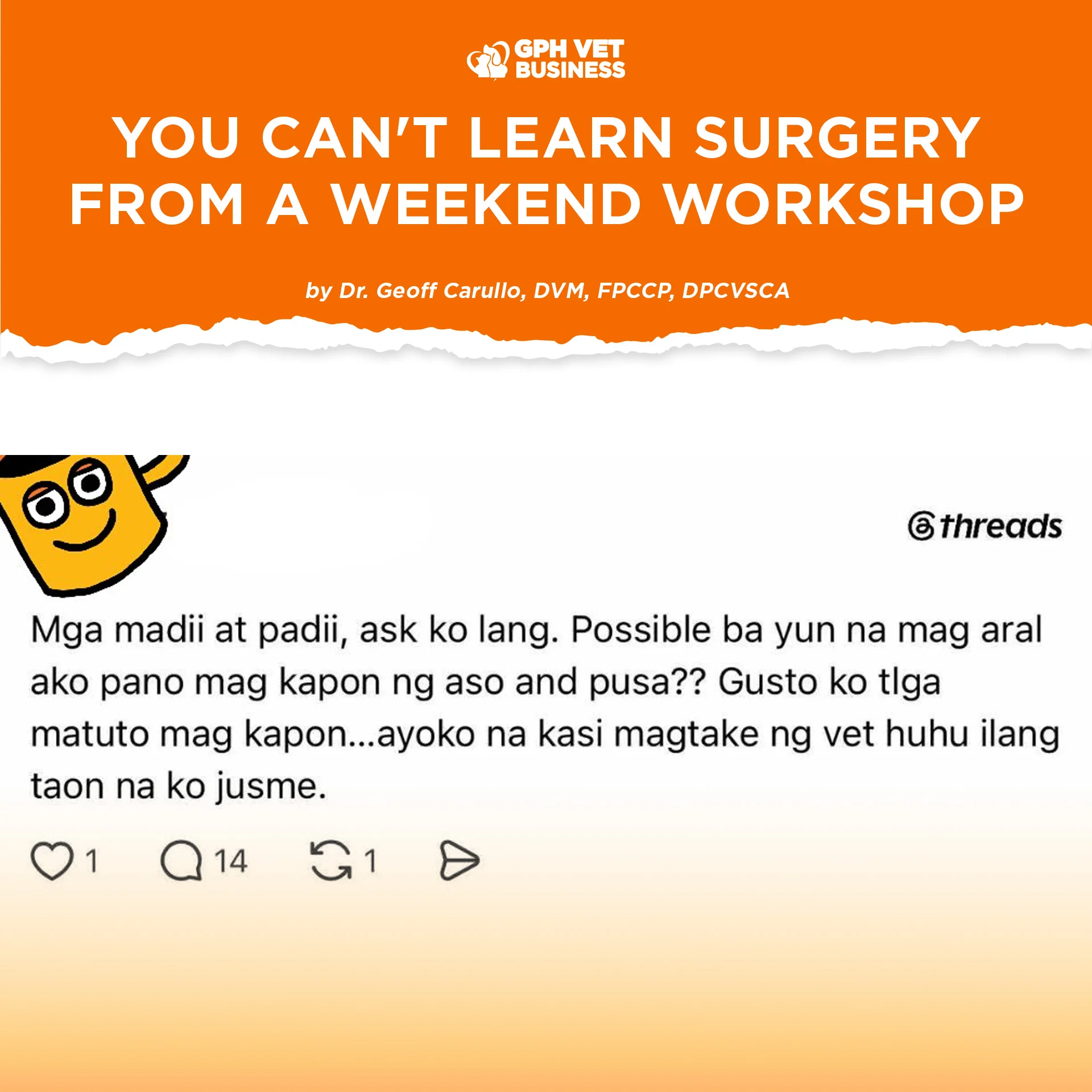
A recent social media post asked what seemed like a simple question:
“Possible ba na mag-aral ako paano magkapon ng aso at pusa? Gusto ko talagang matuto mag-kapon. Ayoko na kasi mag-take ng vet.”

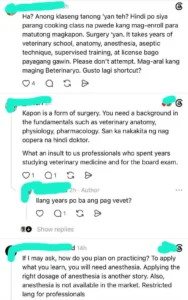
Many veterinarians reacted strongly. At first glance, some may think the reactions were harsh. But if we look beyond the emotions, there is an important lesson that the public should understand.
The issue is not about gatekeeping.
It is about patient safety.
Spaying and Neutering Are Real Surgeries
Castration (neuter) and ovariohysterectomy (spay) are surgical procedures.
They involve:
- Administering anesthesia safely.
- Understanding anatomy and physiology.
- Maintaining sterile surgical technique.
- Controlling bleeding.
- Monitoring vital signs.
- Managing pain.
- Preventing and treating complications.
- Providing proper post-operative care.
Each of these steps can determine whether an animal survives the procedure or not.
Surgery is never simply about making an incision and removing an organ.


The Part People Don’t See
Many people only see the operation itself.
What they don’t see are the years spent learning everything that happens before the first incision.
Veterinarians study subjects such as:
- Anatomy
- Physiology
- Pharmacology
- Pathology
- Microbiology
- Anesthesiology
- Surgery
- Diagnostic medicine
- Internal medicine
- Emergency and critical care
These are then followed by supervised clinical training before graduates become licensed veterinarians.
The operation itself is only the visible tip of the iceberg.
Anesthesia Is Often More Dangerous Than the Surgery
One of the biggest misconceptions is that surgery is the difficult part.
In reality, anesthesia is often where the greatest risks lie.
Every patient is different.
The correct anesthetic drugs, dosages, monitoring equipment, fluid therapy, pain management, and emergency response all depend on the patient’s:
- Age
- Breed
- Weight
- Overall health
- Existing diseases
A mistake in anesthesia can become life-threatening within minutes.


Compassion Alone Is Not Enough
Many people asking these questions genuinely want to help animals.
That intention deserves respect.
However, good intentions cannot replace professional training.
No one would ask if they could learn human surgery through a short course.
Animals deserve the same level of respect for their lives.
In the Philippines, Veterinary Practice Is Regulated
Veterinary medicine is a licensed profession.
Performing veterinary acts, including surgical procedures, without the proper qualifications and license may violate Philippine laws regulating the practice of veterinary medicine.
These regulations exist not to limit who can help animals, but to protect animal welfare and public safety.
If You Want to Help Animals, There Are Many Ways
Not everyone needs to become a veterinarian to make a difference.
You can:
- Volunteer in animal welfare organizations.
- Foster rescued animals.
- Support low-cost spay and neuter programs.
- Educate fellow pet owners about responsible pet ownership.
- Donate to rescue groups.
- Help transport animals for treatment.
These contributions save lives without placing animals at unnecessary risk.

Final Thoughts
Wanting to learn is admirable.
Wanting to help is even more admirable.
But surgery is one of the few fields where enthusiasm cannot replace education.
Every successful spay or neuter represents years of study, countless supervised procedures, clinical judgment, and a professional commitment to patient safety.
The goal is never simply to perform a surgery.
The goal is to ensure that every patient wakes up safely, goes home comfortably, and enjoys a healthier life afterward.
That is what veterinary medicine is truly about.
Dr. Geoff Carullo is a Fellow and the current President of the Philippine College of Canine Practitioners.
Sharing this helps others understand what it really means to be a vet. Like and follow if you’re with us.