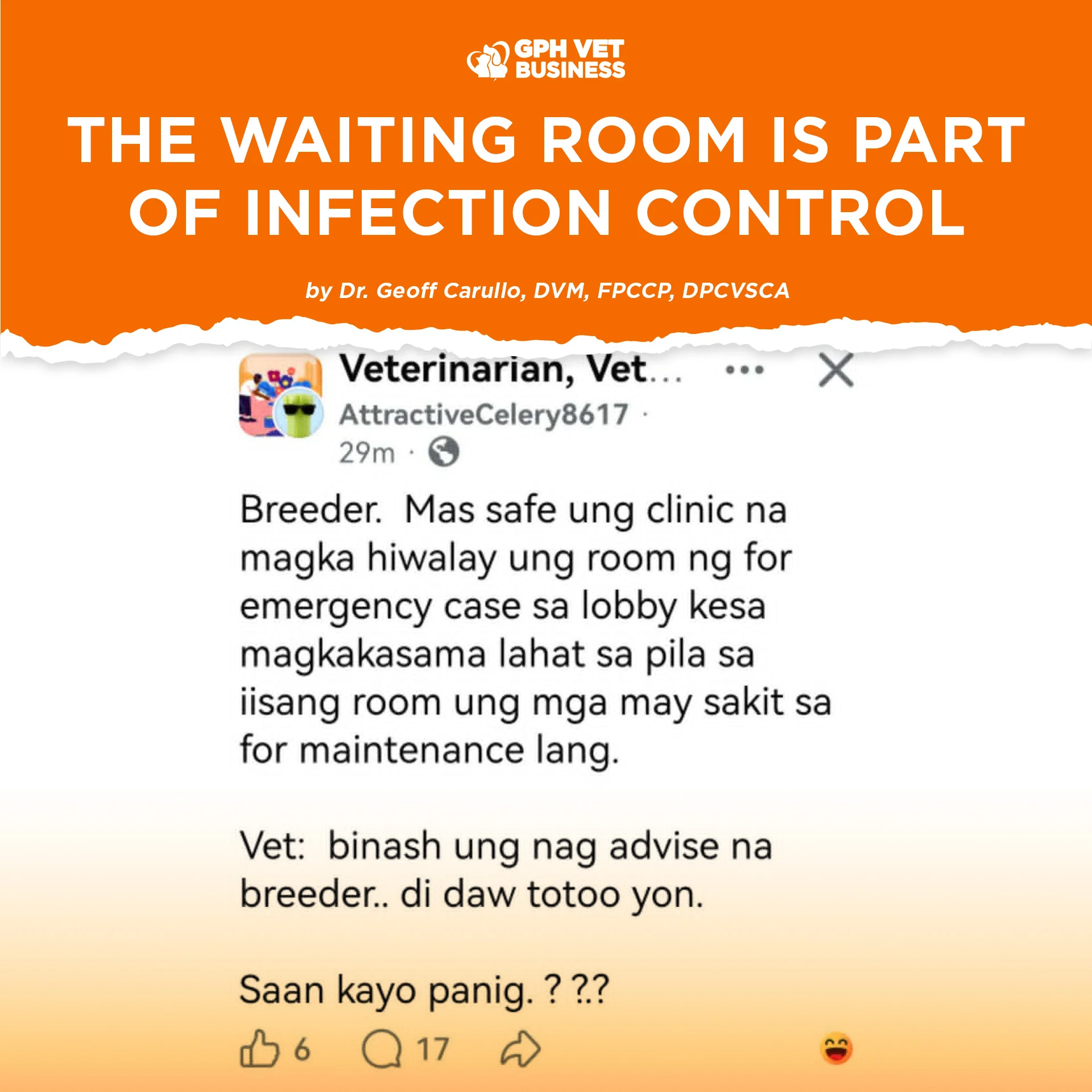
A recent social media post raised an interesting question.
A breeder suggested that veterinary clinics should have a separate room for emergency patients instead of having all patients, including those coming only for maintenance, waiting together in a single lobby. According to the post, another veterinarian allegedly dismissed that advice.
So, who is correct?
The answer is that both viewpoints have valid considerations, but from an infection control standpoint, the breeder’s concern is supported by well-established principles used in both human and veterinary medicine.
The waiting room is often the first point of contact between healthy and sick patients. Even before a veterinarian performs a physical examination, animals may already be sharing the same air, floor, furniture, and surrounding environment.
Many infectious diseases do not require direct animal-to-animal contact.
- Respiratory pathogens may spread through droplets or aerosols.
- Gastrointestinal pathogens may contaminate floors through fecal material or vomitus.
- Some organisms survive for hours or even days on surfaces, depending on the pathogen.
This is why modern veterinary hospitals increasingly practice patient segregation.


What Is Patient Segregation?
Patient segregation simply means separating patients according to their level of infectious risk.
Examples include:
- Animals with vomiting or diarrhea
- Patients with coughing or sneezing
- Suspected canine distemper
- Suspected parvovirus
- Suspected feline panleukopenia
- Animals with unknown contagious skin disease
These patients are ideally directed immediately into an isolation or designated examination room rather than remaining in the common waiting area.
Meanwhile, patients visiting for vaccination, wellness examinations, grooming clearance, or routine follow-up can wait in the regular lobby with much lower risk.
Is This Always Possible?
Not necessarily.
Many veterinary clinics in the Philippines operate in limited commercial spaces. Constructing a dedicated isolation entrance or multiple consultation rooms may simply be financially impossible.
That does not mean these clinics are practicing poor medicine.
Instead, they minimize risk through practical infection control measures such as:
- Immediate triage upon arrival
- Prioritizing potentially infectious patients
- Cleaning and disinfecting high-contact surfaces
- Using separate cages for infectious confinement
- Appropriate personal protective equipment (PPE)
- Scheduling highly contagious cases at specific times when feasible
Good infection control is not determined solely by the size of the building. It is determined by how consistently protocols are implemented.


Even Better Than Separate Rooms
In many advanced veterinary hospitals, the process begins before the patient enters the clinic.
Owners describing signs such as severe diarrhea, persistent coughing, or suspected parvovirus may be instructed to call upon arrival and remain in their vehicle until the veterinary team is ready to bring the patient directly into an examination or isolation area.
This approach minimizes exposure for other patients in the waiting room.
The Goal Is Risk Reduction, Not Risk Elimination
No clinic can completely eliminate infectious disease transmission.
However, every step that reduces unnecessary exposure contributes to safer veterinary practice.
Whether through dedicated isolation rooms, separate entrances, rapid triage, or thoughtful scheduling, the principle remains the same:
Healthy patients should not be unnecessarily exposed to potentially infectious patients.
This is not merely a breeder’s opinion or a veterinarian’s opinion.
It is a fundamental principle of infection prevention and hospital biosecurity.
As veterinary medicine continues to advance, improving patient flow and infection control should be viewed not as criticism of existing clinics, but as an opportunity to make our practices even safer for our patients, clients, and healthcare teams.

Sometimes, one of the most important treatments begins even before the consultation starts.
Dr. Geoff Carullo is a Fellow and the current President of the Philippine College of Canine Practitioners.
Sharing this helps others understand what it really means to be a vet. Like and follow if you’re with us.