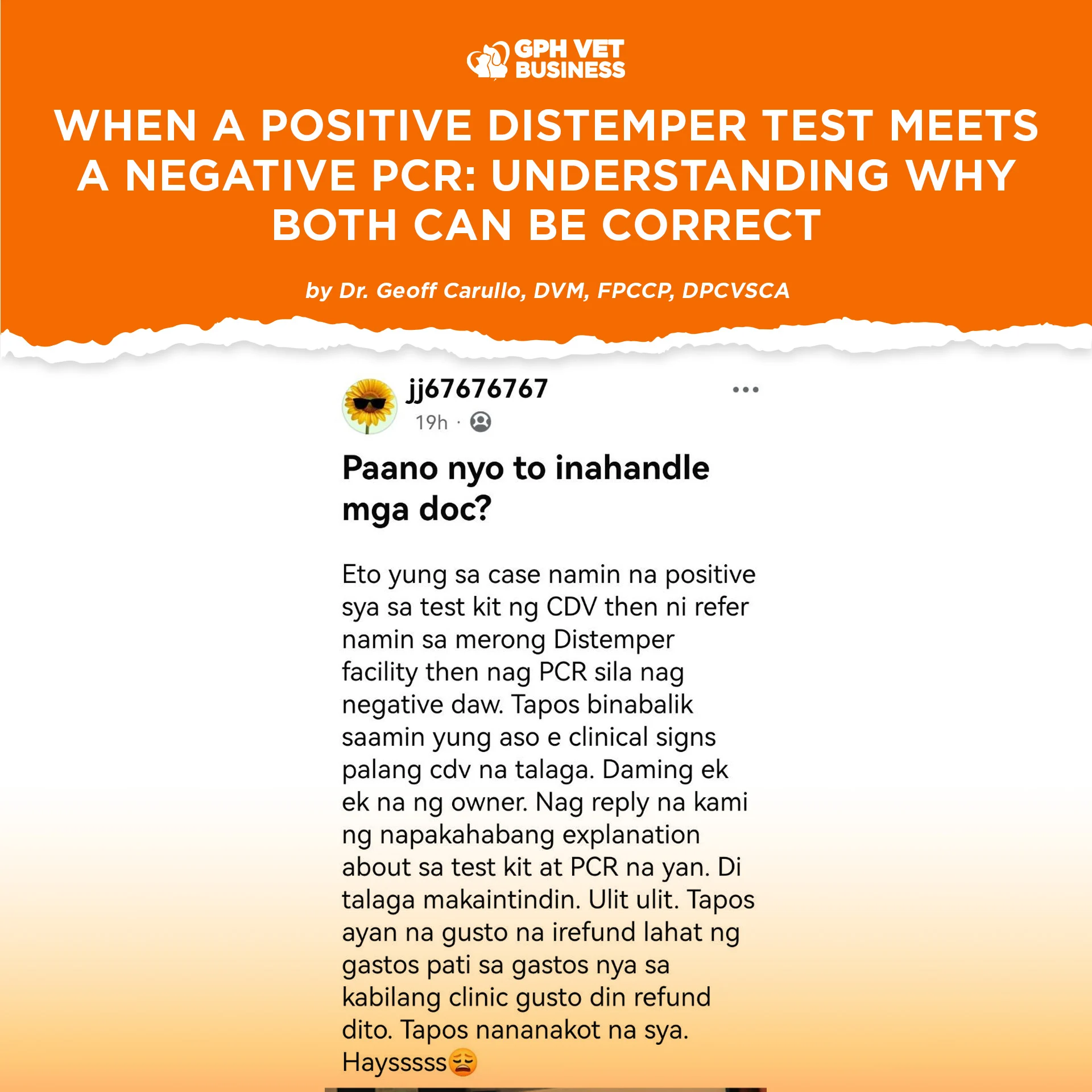
One of the most stressful situations for any veterinarian is receiving conflicting diagnostic results.
A patient tests positive on a canine distemper rapid test, is referred to a specialty facility, then comes back with a negative PCR. The owner naturally asks:
“So was the first test wrong?”
Not necessarily.
In fact, both results can be scientifically correct, depending on when the samples were collected, where they were collected from, and the stage of infection.
No Diagnostic Test Is 100% Perfect
This is one of the first principles taught in diagnostic medicine.
Every test has limitations.
Every test has:
- Sensitivity
- Specificity
- Positive predictive value
- Negative predictive value
No veterinarian should interpret any diagnostic test in isolation.
Instead, diagnosis should always combine:
- History
- Vaccination status
- Clinical signs
- Physical examination
- Laboratory findings
- Imaging (when indicated)
- Response to treatment
- Diagnostic test results
The patient should always be treated, not just the laboratory report.


Why Can PCR Become Negative?
Many people think PCR is the “gold standard,” and it is indeed highly sensitive. However, PCR only detects viral genetic material present in the sample that was collected.
Several reasons can explain a negative PCR despite a previously positive rapid antigen test:
1. Timing of Sample Collection
Distemper virus shedding changes throughout the course of infection.
Early in disease, viral loads are usually high.
Later, the amount of detectable virus may decline even though clinical disease continues because much of the damage is already caused by viral spread and immune-mediated effects.
2. Different Sample Sites
PCR results depend heavily on the sample collected.
Examples include:
- Conjunctival swabs
- Nasal swabs
- Oropharyngeal swabs
- Whole blood
- Urine
- Cerebrospinal fluid
A negative result from one site does not always exclude infection if viral shedding is occurring elsewhere.
3. Intermittent Viral Shedding
Distemper virus is not shed uniformly throughout the illness.
There are periods when viral concentration may temporarily fall below the assay’s detection limit.
4. Sample Quality
Even the best PCR laboratory cannot detect virus that is not present in the submitted sample.
Improper collection, insufficient cellular material, transport delays, or degradation can all affect results.


What About the Rapid Test?
Rapid antigen tests also have limitations.
False positives are uncommon but can occur.
False negatives are generally more common than false positives, especially when viral load is low.
However, a positive rapid test in a dog showing classic signs of canine distemper should never be dismissed automatically simply because a later PCR is negative.
Clinical Signs Still Matter
Imagine a young, unvaccinated dog presenting with:
- Fever
- Ocular discharge
- Nasal discharge
- Coughing
- Vomiting or diarrhea
- Hyperkeratosis of the nose or footpads
- Myoclonus
- Neurologic signs
If the rapid test is positive and the clinical picture strongly supports canine distemper, most experienced veterinarians would continue to keep distemper high on the list of differential diagnoses, even if a single PCR result is negative.
Medicine is about integrating evidence, not selecting one result while ignoring the rest.
Does a Negative PCR Mean the First Veterinarian Was Negligent?
Absolutely not.
A veterinarian who interprets a positive rapid test together with compatible clinical signs is practicing according to accepted diagnostic principles.
Medicine is practiced using probabilities, not absolute certainty.
This is true in both veterinary and human medicine.
A later negative PCR does not automatically prove:
- Misdiagnosis
- Negligence
- Defective test kits
- Professional misconduct
It simply means the clinician must reassess the case using all available information.

Are Refunds Automatically Required?
Not necessarily.
Veterinary services are professional services.
Clients pay not only for test kits but also for:
- Professional examination
- Clinical judgment
- Interpretation
- Medical decision-making
- Consultation
- Patient management
A diagnostic test that later appears inconsistent with another test does not automatically make the service defective or refundable.
Likewise, filing complaints with agencies such as the PRC, BAI, or DTI requires evidence of actual professional negligence or regulatory violations, not merely the existence of differing test results.
The Take-Home Message
Veterinary medicine is rarely black and white.
Conflicting diagnostic results happen in everyday clinical practice.
The role of the veterinarian is not to chase a single laboratory report but to integrate every piece of information to arrive at the most accurate diagnosis possible.
Clients deserve honest explanations, empathy, and transparency.
Veterinarians deserve the understanding that medicine is an evidence-based profession where uncertainty is sometimes unavoidable, despite everyone’s best efforts.
References
- Greene CE. Infectious Diseases of the Dog and Cat. 5th ed.
- Sykes JE. Canine and Feline Infectious Diseases. Elsevier.
- Decaro N, et al. Canine distemper virus: clinical findings, diagnosis, and prevention. Veterinary Microbiology.
- WSAVA Vaccination Guidelines Group.
- IRIS and AAHA principles on interpretation of diagnostic testing and clinical decision-making.
Dr. Geoff Carullo is a Fellow and the current President of the Philippine College of Canine Practitioners.
Sharing this helps others understand what it really means to be a vet. Like and follow if you’re with us.