The Artificial Intelligence Divide in Philippine Veterinary Practice: Why Some Clinics Will Soar — and Others Will Struggle
By Dr. Geoff Carullo, DVM, Dip. PCCP, Dip. PCVS
Artificial intelligence is no longer science fiction. It’s real, it’s here, and in the next 36 months, it will redraw the map of small animal veterinary practice in the Philippines.
Clinics that adopt artificial intelligence will be more efficient, more accurate, and more scalable.
Those that don’t? They’ll struggle to meet the rising expectations of tech-savvy pet owners — and risk falling behind in a competitive, fast-modernizing industry.
How Artificial Intelligence Will Transform Philippine Vet Practice (2025–2028)
1. Precision Diagnostics in Real Time
AI-powered diagnostic platforms are beginning to enter the local market. These tools — capable of analyzing fecal samples, blood smears, and cytology slides — deliver accurate, expert-level interpretations in just minutes.
Whether it’s identifying parasites, spotting early neoplasia, or classifying blood cell abnormalities, artificial intelligence helps vets make faster, better-informed decisions at point-of-care.


2. Smarter, Streamlined Operations
From appointment scheduling to inventory forecasting, artificial intelligence can automate and optimize workflows.
This means:
- Less human error
- Faster client communication
- Better resource allocation
- And more time spent on patients, not paperwork
As cloud-based practice management platforms integrate artificial intelligence, solo clinics and chain practices alike will benefit from smart analytics, financial tracking, and KPI monitoring.
3. Enhanced Client Engagement
In a world where clients Google everything, AI helps vets bridge the trust gap.
Imagine:
- Instantly generated client summaries
- Visual aids explaining lab results
- Chatbots that triage basic pet concerns
Artificial intelligence can support client education, drive compliance, and deliver a more polished, professional clinic experience.


The Game Changer: Accessibility in the Philippines
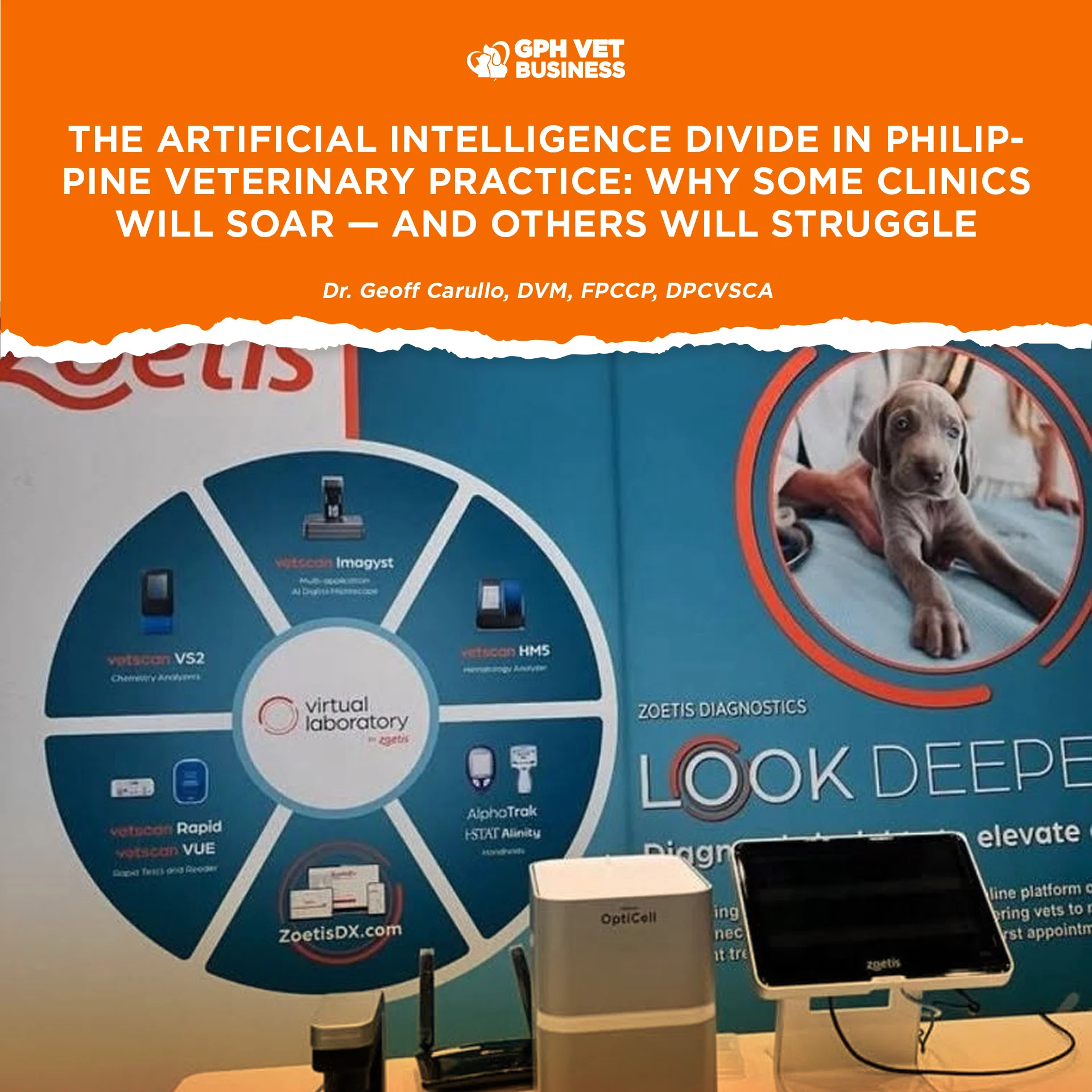
By late 2025, major platforms — including one from Zoetis — will officially launch AI-integrated diagnostic devices in the Philippines.
These will make artificial intelligence more accessible, even for small- to mid-sized clinics outside Metro Manila.
But Zoetis is not alone. Globally, veterinary tech companies are racing to localize AI platforms — and Filipino clinics that prepare early will have the first-mover advantage.
The Clinics That Will Lead the Pack
1. Clinics That Are Digitally Ready
They use EMRs, digital imaging, cloud storage, and structured SOPs.
Artificial intelligence will seamlessly plug into their systems, enhancing every step of their workflow.
2. Clinics That Embrace Strategic Growth
Artificial intelligence isn’t a gimmick — it’s a business asset.
Clinics that adopt AI tools will reduce diagnostic delays, increase caseload capacity, and improve per-client revenue.
3. Clinics That Train and Empower Their Teams
Successful AI adoption isn’t about machines alone — it’s about people.
Leading clinics will invest in training staff to interpret, explain, and apply AI-generated insights.
The Clinics That Will Be Left Behind
1. Manual, Low-Tech Practices
Clinics that still run on paper charts, analog microscopes, and handwritten prescriptions will find themselves at a disadvantage.
Artificial intelligence won’t be able to help clinics that don’t have the digital infrastructure to support it.
2. Owners Who See Tech as a Cost, Not a Catalyst
Artificial intelligence can boost income and efficiency — but only if owners view it as a long-term investment, not a short-term expense.
3. Clinics Without a Vision
Veterinary medicine is evolving rapidly. Clinics without a roadmap for growth, delegation, and modernization will lose clients and staff to more future-ready competitors.

Final Thoughts: Artificial Intelligence Is the New Standard
The question is no longer if artificial intelligence will reshape veterinary practice in the Philippines.
The question is:
Will your clinic lead this transformation — or be disrupted by it?
Artificial intelligence won’t replace veterinarians. But the veterinarians who use it will outperform those who don’t.
In the next 36 months, the most successful clinics won’t just be the busiest — they’ll be the smartest.
Sharing this helps others understand what it really means to be a vet. Like and follow if you’re with us.
Dr. Geoff Carullo is a Fellow and the current President of the Philippine College of Canine Practitioners.