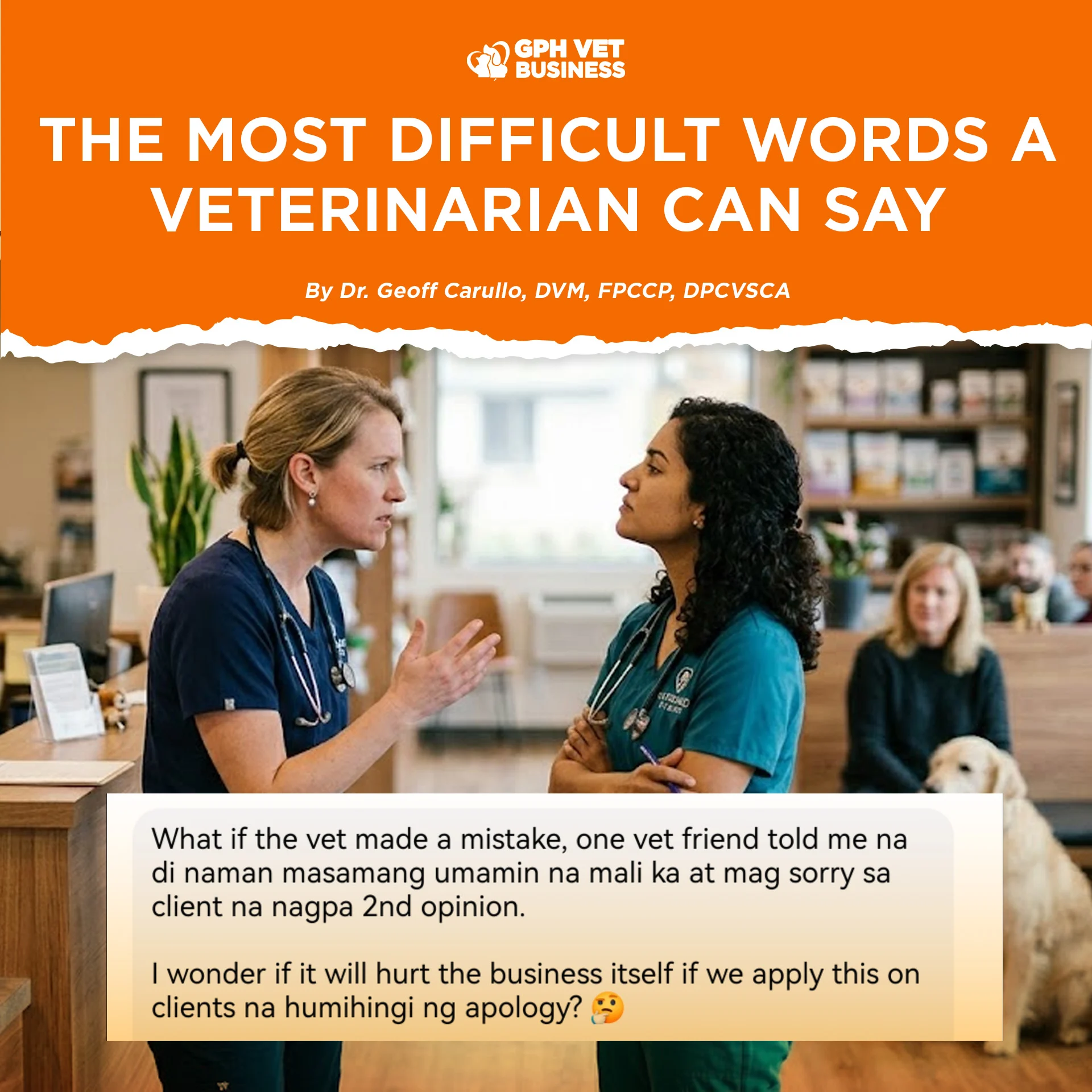
“What if the vet made a mistake?”
It is one of the most uncomfortable questions in veterinary medicine.
Not because mistakes never happen.
But because every veterinarian knows that behind every mistake is a patient, a family, and a professional reputation that may have taken decades to build.
A young veterinarian once asked me:
“If a client gets a second opinion and it turns out I was wrong, should I admit it and apologize?”
At first glance, the answer seems simple.
But veterinary medicine is not always black and white.
The first thing we need to do is categorize the “mistake.”
Not Every Wrong Outcome Is a Mistake
Many veterinarians carry unnecessary guilt because a case did not go as planned.
- A patient dies.
- A treatment fails.
- A diagnosis changes after referral.
- A specialist discovers something that was not initially seen.
These things happen.
Medicine is not mathematics.
Medicine is probability.
A different diagnosis from a second opinion does not automatically mean the first veterinarian committed an error.
Sometimes new tests become available.
Sometimes the disease evolves.
Sometimes another veterinarian simply sees something different.
That is called professional judgment.
And professional judgment is not negligence.
When an Apology Is Appropriate
If the veterinarian truly made a preventable mistake, then honesty matters.
- Wrong medication.
- Incorrect dosage.
- Missed laboratory result.
- Documentation error.
In situations where a genuine error occurred, acknowledging it can preserve trust more than denying it.
Clients are often more forgiving than we imagine.
What many clients struggle to forgive is not the mistake itself.
It is the cover-up.
It is the defensiveness.
It is the refusal to communicate.
The Fear Behind Every Apology
Many veterinarians hesitate to apologize because they fear:
- Losing clients
- Damaging their reputation
- Triggering complaints
- Creating legal exposure
These fears are understandable.
A veterinary clinic is not only a medical institution.
It is also a business.
And every business depends on trust.
Ironically, trust is often strengthened when people see authenticity.
Clients know veterinarians are human.
What they want is honesty, accountability, and compassion.
The Real Question
The real question is not:
“Should I apologize?”
The real question is:
“What exactly happened?”
Was it a professional judgment call based on available information?
Or was it a genuine preventable error?
Those are two very different situations.
If it was professional judgment, there may be nothing to apologize for.
If it was a genuine error, then integrity demands ownership.
The Truth That Many Veterinarians Learn Late
Your reputation is not built on being perfect.
No veterinarian will ever be perfect.
Your reputation is built on how you respond when things do not go perfectly.
Clients remember competence.
But they also remember character.
And sometimes, character is revealed most clearly in the moments when admitting the truth is the hardest thing to do.
Dr. Geoff Carullo is a Fellow and the current President of the Philippine College of Canine Practitioners.
Sharing this helps others understand what it really means to be a vet. Like and follow if you’re with us.