Sometimes, the most meaningful lessons in veterinary medicine are not found in textbooks, conferences, or journal articles.
They are found in conversations.
A recent post by the Facebook page I Love Veterinary Medicine asked a simple question:
“What’s the best career advice you ever got in Vet Med?”
Thousands of veterinarians around the world have probably asked themselves the same question at one point in their careers. What made this post special was not the question itself, but the wisdom shared in the comments.


“The amount of useful information you get from a client is inversely proportional to the amount they provide.”
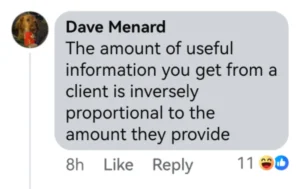
Every practicing veterinarian smiled at this.
There are clients who tell you only one sentence:
“My dog isn’t eating.”
Then, after twenty minutes of history-taking, you discover that the dog recently traveled, was given three different medications, ate chocolate, swallowed a toy, vomited twice, and has been coughing for a week.
Meanwhile, another client gives a thirty-minute story filled with details that have nothing to do with the actual problem.
The lesson is simple.
Listening is important, but knowing what questions to ask is even more important.
History-taking is an art.
“When do you start to feel like you know what you’re doing?”
Another veterinarian shared a conversation that many of us can relate to.
“My third year in practice, I asked a vet who had been practicing for 20 years, ‘When do you start to feel like you know what you’re doing?’ She smiled and said, ‘I’ll let you know.'”
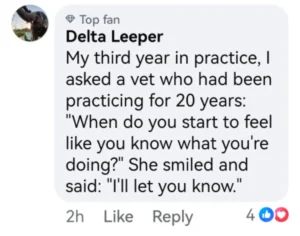
That answer is both funny and profoundly honest.
Veterinary medicine has a way of keeping us humble.
No matter how many surgeries you’ve performed, unusual cases still appear.
No matter how many ultrasounds you’ve done, a patient will eventually show you something you’ve never seen before.
The day you think you’ve mastered everything is probably the day you stop learning.
The best veterinarians remain students for life.


“Being a vet is what you do, not who you are.”
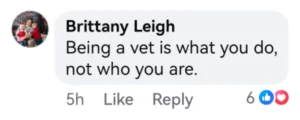
Perhaps the healthiest advice came from another commenter.
This deserves to be framed on the wall of every veterinary hospital.
Many veterinarians unintentionally build their entire identity around the profession.
When cases go well, they feel worthy.
When patients die or clients become angry, they question their value as a person.
But our profession should never consume our identity.
We are veterinarians.
We are also spouses, parents, sons, daughters, friends, mentors, artists, athletes, travelers, and ordinary human beings.
Protecting your identity outside the clinic is not selfish.
It is essential for longevity in this profession.
Wisdom Is Shared, Not Owned
What I appreciated most about this post was that no single comment claimed to have all the answers.
Instead, dozens of veterinarians shared small pieces of wisdom collected over years of experience.
One sentence.
One lesson.
One realization.
When combined, those experiences become something much larger than any individual could write alone.
That is one of the greatest strengths of our profession.
We learn from mentors.
We learn from colleagues.
We learn from difficult cases.
Sometimes, we even learn from our mistakes.

A Final Reflection
If someone asked me today for the best career advice in veterinary medicine, my answer would be this:
Stay humble enough to keep learning. Stay confident enough to make decisions. Stay compassionate enough to care. And remember that while veterinary medicine is a wonderful profession, it should enrich your life, not become your entire identity.
Because at the end of the day, none of us ever truly “arrive.”
We simply become a little wiser with every patient we treat, every client we meet, and every colleague willing to share a lesson worth remembering.
Dr. Geoff Carullo is a Fellow and the current President of the Philippine College of Canine Practitioners.
Sharing this helps others understand what it really means to be a vet. Like and follow if you’re with us.