One of the most common questions pet owners ask is:
“Doc, nadeworm na po ang alaga ko. Bakit kailangan ulitin?”
The answer lies in the life cycle of parasites.
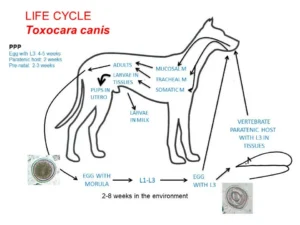
Figure 1. Life cycle of Toxocara canis showing environmental egg development, larval migration, paratenic host transmission, and transplacental and transmammary infection of puppies. These multiple routes of transmission contribute to the high prevalence of canine toxocariasis.
Source: University of Saskatchewan, WCVM Learn About Parasites Program (Toxocara canis).
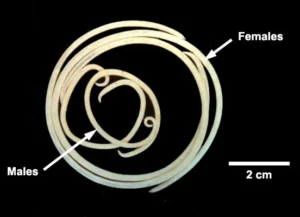
Figure 2. Adult male and female Toxocara canis roundworms. Females are larger and longer than males, while males possess a characteristic curved posterior end. T. canis is a common intestinal nematode of dogs and an important zoonotic parasite worldwide.
Source: University of Saskatchewan, Western College of Veterinary Medicine (WCVM), Learn About Parasites Project.


Most deworming medications are highly effective at killing adult worms living inside the intestines. However, they may not eliminate all immature stages, larvae, or parasite eggs that are still developing within the body or present in the environment.
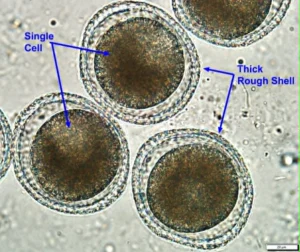
Figure 3. Toxocara canis eggs observed under light microscopy. The eggs are characterized by their thick, rough, pitted shell and a dense single-cell embryo occupying most of the egg interior. These highly resistant eggs are shed in the feces of infected dogs and become infective after embryonation in the environment.
Source and image credit:
Adapted from the University of Saskatchewan, Western College of Veterinary Medicine (WCVM) Learn About Parasites Program. WCVM Learn About Parasites – Toxocara canis
Caption prepared for educational and veterinary reference purposes.
Think of it this way.
Imagine cutting down all the mature weeds in a garden today. The garden may look clean, but if seeds are still buried in the soil, new weeds will emerge in the coming weeks.
The same thing happens with intestinal parasites.
After the first deworming, some immature worms can continue their development. As they mature, they become susceptible to the dewormer. This is why veterinarians often recommend a second treatment approximately 2 to 4 weeks later, depending on the parasite involved and the pet’s age.
The second deworming serves several purposes:
- Eliminates worms that were too young to be affected during the first treatment.
- Reduces the chance of reinfestation.
- Lowers environmental contamination from parasite eggs.
- Helps break the parasite life cycle more effectively.

This is especially important in puppies and kittens because they can acquire parasites from their mother before birth, through milk, or from contaminated surroundings. Young animals are particularly vulnerable to heavy worm burdens, which can lead to diarrhea, poor growth, anemia, and weakened immunity.
In some cases, veterinarians may recommend a series of deworming treatments rather than a single dose. The goal is not simply to kill worms today, but to ensure that the pet remains parasite-free over time.
Deworming is not just about treating parasites. It is about interrupting a biological cycle that has evolved over millions of years.
That second deworming is not because the first one failed.
It is because your veterinarian understands the enemy’s life cycle.


Dr. Geoff Carullo is a Fellow and the current President of the Philippine College of Canine Practitioners.
Sharing this helps others understand what it really means to be a vet. Like and follow if you’re with us.