Heart disease is one of the most common medical conditions encountered in companion animal practice. Mitral valve disease, dilated cardiomyopathy, hypertrophic cardiomyopathy, congenital defects, and arrhythmias are seen regularly.
Cardiac cancer, however, is a different story.
Compared with tumors of the skin, mammary glands, liver, spleen, or gastrointestinal tract, primary cardiac tumors are remarkably uncommon in both dogs and cats. In fact, studies have reported that primary heart tumors occur in only about 0.12–0.17% of dogs at necropsy and are even rarer in cats. Most cardiac tumors identified in clinical practice are either incidental findings or are discovered only after they have caused severe complications.
The Heart Simply Doesn’t Divide Much
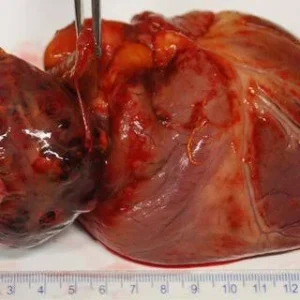
Figure 1. Gross pathologic appearance of canine cardiac hemangiosarcoma. A large, dark red to black, hemorrhagic mass is attached to the right atrial wall at the heart base. The neoplasm is associated with marked hemopericardium, with blood filling the pericardial sac, resulting in pericardial effusion and potential cardiac tamponade. Cardiac hemangiosarcoma is the most common primary cardiac tumor in dogs and typically originates from the right atrium or right auricular appendage. Rupture of these fragile vascular tumors often leads to acute intrapericardial hemorrhage, collapse, and sudden death.
Source: Noszczyk-Nowak A, Nowak M, Pasławska U, et al. A retrospective study of cardiac hemangiosarcoma in dogs. Polish Journal of Veterinary Sciences. 2014;17(1):173–177. Available via ResearchGate: https://www.researchgate.net/publication/260839392
One of the most important reasons lies in the biology of the heart itself.
Most cancers develop after cells repeatedly divide, allowing DNA mutations to accumulate over time. The heart muscle, however, is composed primarily of cardiomyocytes, which lose most of their ability to divide shortly after birth.
Unlike the skin, intestinal lining, or bone marrow, the adult heart has an extremely low rate of cell turnover. With fewer cell divisions occurring throughout life, there are simply fewer opportunities for mutations that can lead to cancer.


A Protected Organ
The heart is also relatively protected from direct exposure to environmental carcinogens.
- Skin is exposed to ultraviolet light.
- The gastrointestinal tract constantly encounters dietary chemicals and toxins.
- The respiratory tract is exposed to inhaled pollutants.
- The heart, on the other hand, is enclosed within the thoracic cavity and has limited direct exposure to these external cancer-causing factors.
When Cardiac Tumors Occur, They Are Often Secondary
Although primary cardiac tumors are rare, the heart can still become involved in cancer through metastasis.
Tumors arising elsewhere in the body may spread to the heart, particularly advanced malignant neoplasms such as lymphoma, carcinoma, or hemangiosarcoma. In fact, several studies have shown that metastatic involvement of the heart is more common than many clinicians previously appreciated.
The Most Common Primary Cardiac Tumors
When a tumor truly originates from the heart, several types are recognized:
- Hemangiosarcoma, especially involving the right atrium
- Chemodectoma (aortic body tumor) at the heart base
- Ectopic thyroid carcinoma
- Mesothelioma affecting the pericardium
- Rare tumors such as fibroma and rhabdomyoma
Among these, right atrial hemangiosarcoma remains the most clinically significant primary cardiac tumor in dogs.


Why Small Tumors Can Cause Big Problems
Ironically, even a relatively small cardiac tumor can become life-threatening.
Because the heart functions as a continuously pumping organ, any mass can interfere with normal cardiac performance. Cardiac tumors may lead to:
- Pericardial effusion
- Cardiac tamponade
- Arrhythmias
- Syncope or collapse
- Exercise intolerance
- Sudden death
For this reason, veterinarians often consider a right atrial mass among the top differential diagnoses in middle-aged or older dogs presenting with unexplained pericardial effusion.

The Take-Home Message
The rarity of cardiac tumors is not because the heart is immune to cancer.
Rather, it reflects the unique biology of the organ. The heart’s highly specialized cells divide very little during adult life, limiting opportunities for cancer to develop. At the same time, its protected location reduces direct exposure to many environmental carcinogens.
Unfortunately, when cardiac tumors do occur, their location makes them particularly dangerous. A mass only a few centimeters in size can disrupt circulation, trigger life-threatening arrhythmias, or cause fatal pericardial tamponade.
Sometimes, in medicine, it is not the size of the tumor that matters most, but where it grows.
References
- Treggiari E, Pedro B, Dukes-McEwan J, Gelzer AR, Blackwood L. A descriptive review of cardiac tumours in dogs and cats. Veterinary and Comparative Oncology. 2017.
- Machida N, et al. Primary and Secondary Heart Tumours in Dogs and Cats. Journal of Comparative Pathology. 2006.
- Ware WA, Hopper DL. Cardiac tumors in dogs: 1982–1995. Journal of Veterinary Internal Medicine. 1999.
Dr. Geoff Carullo is a Fellow and the current President of the Philippine College of Canine Practitioners.
Sharing this helps others understand what it really means to be a vet. Like and follow if you’re with us.