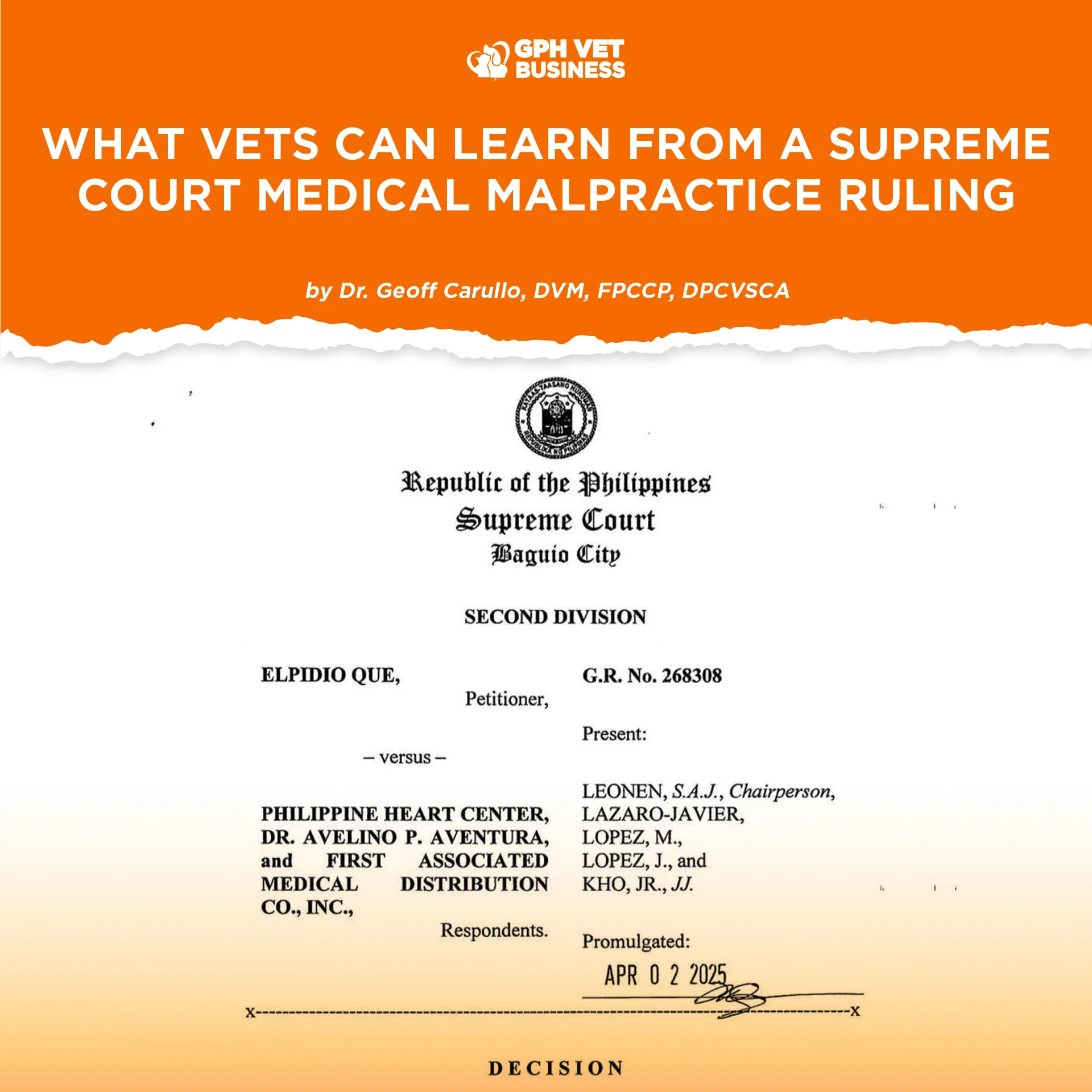
In a landmark decision that rippled through the Philippine medical community, the Supreme Court recently ruled in favor of a surgeon accused of malpractice following the death of a patient.
The court emphasized one crucial factor in its decision: INFORMED CONSENT.
As veterinarians, we must take this as more than a legal curiosity — it’s a wake-up call.
The case involved a patient, Quintin Que, who was presented with two treatment options for an aortic aneurysm: open-chest surgery or a less invasive stenting procedure.
His surgeon, Dr. Avelino P. Aventura, explained the risks of each, including the possibility of death.
When Que chose the stenting option — which was beyond Dr. Aventura’s expertise — he was referred to a visiting Belgian physician, Dr. Eric Verhoeven, who ultimately performed the procedure.
Tragically, complications occurred during the attempt, resulting in the patient’s death.
A lawsuit followed.
But after years of litigation, the Supreme Court dismissed the complaint.
Why?
Because the facts showed Dr. Aventura provided clear, thorough, and honest information — and the patient consented, fully aware of the risks.
Let’s take a closer look at what this means for our profession.


Informed Consent is More Than a Form — It’s Protection
This ruling reinforces a truth we often overlook: informed consent is not just legal armor — it’s part of ethical veterinary practice.
Many vets rely on generic waivers or forget to sit down and really explain a procedure.
But when something goes wrong, it’s the strength of that conversation — and the documentation — that could protect you.
Your client must understand:
- What the diagnosis means
- What options exist (including doing nothing)
- What the risks are, including possible complications
- What your limitations are as the attending veterinarian
- How much it will cost
And yes — even in emergencies, documentation matters. A consent form without a discussion is a weak shield.
A conversation, a note in your SOAP record, and a signed form together are a strong legal defense.
Know When to Refer — and Say It Proudly
Dr. Aventura didn’t perform the procedure himself.
He knew his limits and referred the case. That saved him — not just legally, but ethically.
We should never hesitate to refer when the case demands it. There is no shame in saying, “This is beyond what I can do here.” Whether it’s orthopedic surgery, advanced imaging, or oncology — our duty is to the patient’s best interest, not our ego.
The key: be clear about who’s doing the procedure, what their qualifications are, and what to expect.
That’s part of informed consent, too.


Not All Bad Outcomes Are Malpractice
Another lesson: the Supreme Court acknowledged that death was a known risk of the procedure — not the result of incompetence.
This distinction is critical.
In our line of work, things can go wrong even when we do everything right.
Anaesthetic deaths, adverse vaccine reactions, unexpected complications — they can happen.
The goal is not to eliminate all risk.
The goal is to make sure the client understands the risk, and that you’ve taken every step to minimize it.
Documentation Is Your Lifeline
What saved the doctor wasn’t just the consent form.
It was the complete paper trail — the records, the timeline, the referral, and the communication.
Are your medical records defensible in court?
If your notes are rushed, inconsistent, or missing key information, you’re vulnerable.
Every case — especially high-risk ones — deserves complete documentation:
- What was discussed
- What the owner agreed to
- What complications were anticipated
- What the plan B was
Write it down.
Every time…..

Be Transparent, Not Perfect
The heart of this ruling isn’t technical. It’s human. The Supreme Court essentially said: the doctor was transparent. That’s what mattered most.
As vets, we can’t control every outcome. But we can control how we communicate, how we educate, and how we honor the trust our clients give us.
Don’t hide uncertainty.
Don’t sugarcoat.
Don’t make promises you can’t keep.
Be honest, even when it’s hard.
That’s what builds trust. That’s what shields you — both morally and legally.
Final Word
This isn’t just a win for one doctor.
It’s a lesson for all of us in the healing profession.
Let’s stop seeing informed consent as a piece of paper.
It’s a process — of communication, empathy, honesty, and documentation.
The courtroom may never call your name.
But if it does, let your honest conversations and ethical decisions be the voice that speaks in your defense.
Dr. Geoff Carullo is a Fellow and the current President of the Philippine College of Canine Practitioners.
Sharing this helps others understand what it really means to be a vet. Like and follow if you’re with us.